Found a caterpillar and want to know what it is? The fastest route to an answer is not its color. It is three questions, in this order:
- Is it really a butterfly caterpillar? Most caterpillars people find are moth larvae, and a few look-alikes are not caterpillars at all.
- What plant is it eating? Many butterfly caterpillars feed on a small, predictable group of plants. The plant often narrows the list to two or three species.
- What is its body like? Spines, fleshy filaments, eyespots, a big “necked” head or a flattened shape each point to a different butterfly family.
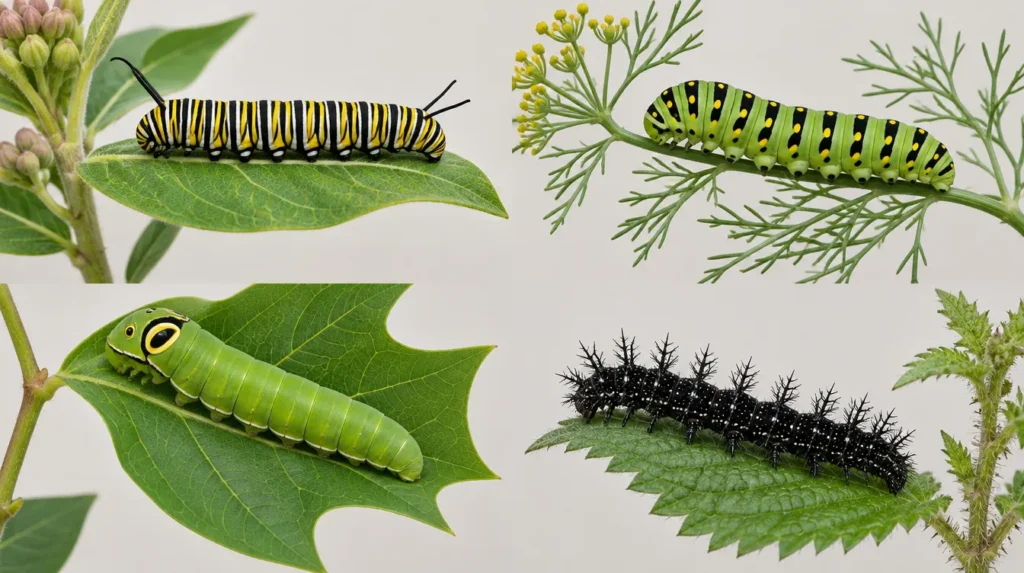
Once you have those answers, the chart below covers 17 butterfly caterpillars that beginners in North America, the UK and Europe find most often.
Step 1: Is it a butterfly caterpillar at all?
Start here, because the odds are against butterflies. The Smithsonian Institution puts the number of butterfly species in the United States at about 750 and moth species at nearly 11,000. Britain is similar: dozens of butterflies against thousands of moths. A random caterpillar on a fence or a garden shrub is far more likely to be a moth.
Rule out sawfly larvae first
Sawfly larvae (relatives of wasps) feed on leaves and look very like caterpillars. Count the fleshy, stubby legs on the abdomen, called prolegs:
- Caterpillars have 2 to 5 pairs of prolegs, each with a ring of tiny hooks (crochets).
- Sawfly larvae usually have 6 or more pairs, with no hooks. They also have a single small eye on each side of the head, where caterpillars have a cluster of several.
Sawfly larvae often feed in groups and rear up together when disturbed, which is a useful field clue.
Clues that point to a moth caterpillar
None of these is a perfect rule, but each one makes a moth much more likely:
- It moves like an inchworm. Looping caterpillars that arch their middle as they walk usually have only two or three pairs of prolegs at the rear. These are geometrid moth larvae (inchworms) and some other moth groups. The common butterfly caterpillars covered here have the full set of prolegs.
- It has a single horn on its tail end. A curved horn near the rear is the classic mark of a hornworm, the caterpillar of a hawk moth (sphinx moth). Tomato and tobacco hornworms are the ones gardeners meet most.
- It is covered in long, dense hair or neat tufts. Woolly bears, tussock moth caterpillars, eggars and similar furry caterpillars are moths. Butterfly caterpillars may carry branched spines or short, fine hairs, but rarely a thick coat of long hair.
- It lives in a silk cocoon or a shared tent in a tree. Some butterfly caterpillars do build webs (the nettle-feeders below are an example), but large silk tents in tree branches are usually made by moth caterpillars.
If your caterpillar fits one of these clues, a moth guide will serve you better than this one. Our butterfly vs moth differences guide explains how the adults differ.
A safety note before you touch
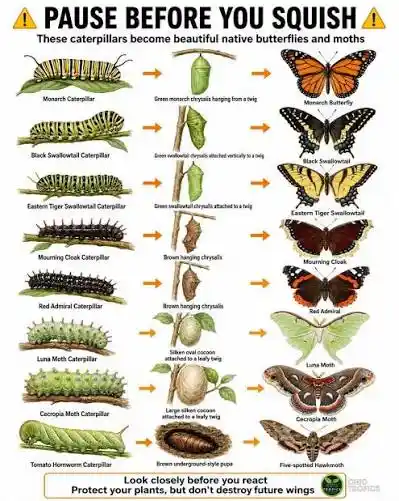
Do not handle a hairy or spiny caterpillar you cannot identify. In North America, the caterpillars that sting include flannel moth caterpillars such as the puss caterpillar, slug caterpillars such as the saddleback, and the larvae of buck and io moths. All of them are moth caterpillars. In the UK, the hairs of oak processionary moth and brown-tail moth caterpillars can cause skin rashes, and oak processionary hairs can also irritate eyes and airways.
The spiny butterfly caterpillars in this guide, such as the common buckeye and the Gulf fritillary, are described by extension entomologists as harmless; their spines are not venomous. Monarch caterpillars do not sting either, but they store toxins from milkweed that make them poisonous to many predators, so never eat one or let a pet do so. If you move a caterpillar, use a leaf or a stick, and wash your hands afterward.
Step 2: Look at the plant it is eating
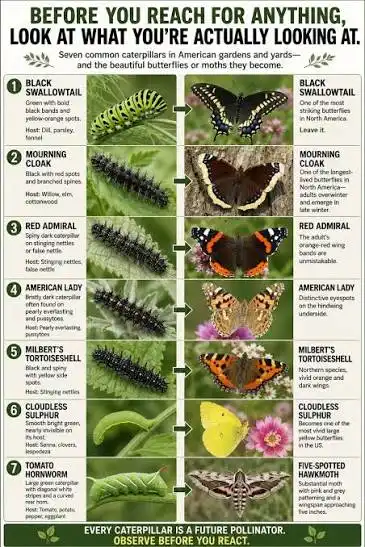
This is the single most useful clue for butterfly caterpillars. The plant a caterpillar eats is its larval host plant, which is often a different plant from the flowers the adult butterfly visits for nectar. Many species are specialists:
- Milkweeds (Asclepias) → monarch (and, in the southern U.S., the queen)
- Carrot family: dill, parsley, fennel, carrot, Queen Anne’s lace → black swallowtail
- Citrus, prickly ash, hop tree → giant swallowtail
- Spicebush, sassafras, sweet bay → spicebush swallowtail
- Passionflower vines (Passiflora) → Gulf fritillary, zebra longwing
- Cabbage, kale, broccoli, nasturtium and other mustard-family plants → cabbage white (small white), large white
- Common nettle (Urtica dioica) → peacock, small tortoiseshell, red admiral, comma (UK and Europe); red admiral in North America
- Thistles → painted lady
- Willows, elms, poplars, birches → mourning cloak
Caterpillars do wander away from their host plant when they are ready to pupate, so one found crossing a path or climbing a wall may not be on its food plant. Check nearby plants for chewed leaves, droppings or silk.
Our butterfly host plants guide covers which plants support which butterflies in more detail.
Step 3: Match the body shape to a butterfly family
Butterfly caterpillars fall into a few broad body types. Getting the family right shrinks the list of possibilities quickly.
| Family | Typical caterpillar | Examples |
|---|---|---|
| Swallowtails (Papilionidae) | Smooth-looking, often thickest near the front. Young caterpillars of many species look like bird droppings. Older ones may have false eyespots. All have an osmeterium, a forked, foul-smelling orange or yellow organ they push out behind the head when disturbed. No other butterflies or moths have one. | Black, eastern tiger, spicebush and giant swallowtails |
| Whites and sulphurs (Pieridae) | Slender, cylindrical and usually green, covered with very short hair that gives a velvety look. Often have thin lengthwise stripes. | Cabbage white, orange-tip |
| Brush-footed butterflies (Nymphalidae) | The most varied family. Many have rows of branched spines. Monarchs and their relatives have no spines but carry fleshy filaments. Satyrs and browns are usually green or brown grass-feeders with a forked tail end. Emperors have horns on the head. | Monarch, painted lady, peacock, buckeye, Gulf fritillary |
| Blues, coppers and hairstreaks (Lycaenidae) | Small, flattened, short and broad, often described as slug-like or woodlouse-shaped. Many are tended by ants, which collect a sugary secretion from the caterpillar. Many feed on flowers and seeds. | Common blue, chalk hill blue, hairstreaks |
| Skippers (Hesperiidae) | A large head on a narrow “neck.” They hide in silk-lined shelters made by folding or tying leaves together and often feed at night, so they are easy to miss. | Large skipper, duskywings |
Caterpillar identification chart
The descriptions below are for the last, fully grown stage unless noted. Younger caterpillars can look quite different (see “Why the same caterpillar can look different” below).
| Caterpillar | What it looks like when fully grown | Host plants | Where |
|---|---|---|---|
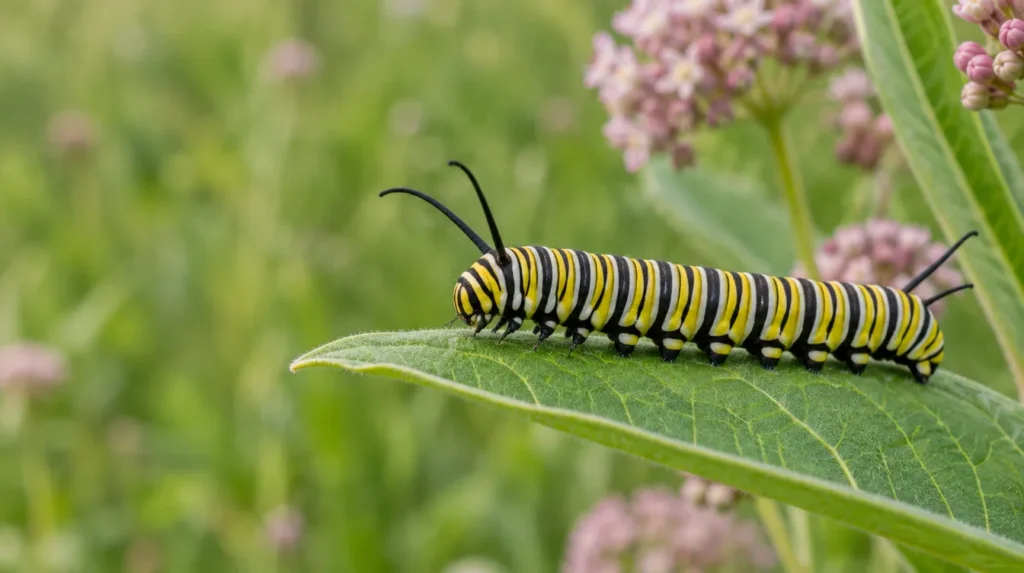
| Monarch (Danaus plexippus) | White, yellow and black bands of roughly equal width. One pair of long black filaments near the head, a shorter pair near the rear. No spines. Up to about 2 in (5 cm). | Milkweeds (Asclepias) | North America |
| Black swallowtail (Papilio polyxenes) | Green with black crossbands dotted with yellow spots. Yellow-orange osmeterium. Young caterpillars are black and spiny with a white “saddle.” | Carrot family: dill, parsley, fennel, carrot, Queen Anne’s lace; sometimes rue | Most of the eastern U.S., west to Colorado and parts of the Southwest |
| Eastern tiger swallowtail (Papilio glaucus) | Bright green with one pair of large eyespots just behind the head. Orange osmeterium. | Tulip tree, wild cherry, ash, cottonwood, willow, hop tree | Eastern North America |
| Spicebush swallowtail (Papilio troilus) | Green with small blue spots and two pairs of large eyespots. Rests inside a leaf folded over with silk. | Spicebush, sassafras, sweet bay; sometimes tulip tree | Eastern U.S. and southern Canada, west to central Texas |
| Giant swallowtail (Papilio cresphontes) | Brown with grayish-white patches, including a broad pale “saddle” in the middle: a bird-dropping mimic at all ages. Red or pinkish osmeterium. Called the “orange dog” in citrus groves. | Citrus family: citrus, prickly ash, hop tree, rue | Eastern and southern North America (see note below) |
| Gulf fritillary (Agraulis incarnata) | Orange with dark stripes and rows of soft black spines. | Passionflowers (Passiflora) only | Southern U.S. to California |
| Zebra longwing (Heliconius charithonia) | White with black spots and many black branched spines. | Passionflowers (Passiflora) | Florida and the far southern U.S., south into the tropics |
| Common buckeye (Junonia coenia) | Mostly black with many blue-black branched spines. | Plantains (Plantago), toadflax, snapdragon, false foxglove (Agalinis), fogfruit | Southern U.S., spreading north each year |
| Mourning cloak (Nymphalis antiopa) | Black with tiny white dots, black spines and a row of red spots down the back. Feeds in groups in silk webs. | Willows, elms, poplars, cottonwood, hackberry, birch | Most of North America; also Europe and Asia |
| Cabbage white / small white (Pieris rapae) | Pale, velvety green with a thin yellow line down the back and yellow marks along the sides. Usually alone. | Cabbage, kale, broccoli and other mustard-family plants; nasturtium | Native to Europe; introduced and widespread in North America |
| Large white (Pieris brassicae) | Grey-green with three yellow stripes and black spots, each bearing a hair. Feeds in groups. | Cabbage family; nasturtium | UK and Europe |
| Painted lady (Vanessa cardui) | Spiny, mostly black or dark grey with a broken yellow stripe along each side. Lives alone in a silk tent spun around leaves. | Thistles above all; also mallows, burdocks and many others | Every continent except Australia and Antarctica |
| Red admiral (Vanessa atalanta) | Very variable, from black to greenish-brown to pale yellow-green, with branched spines and often a yellow line along the sides. Hides alone in a nettle leaf folded into a tent. | Nettles; also pellitory, false nettle, hop | North America, Europe, North Africa, Asia |
| Peacock (Aglais io) | Jet black with shiny black spines and fine white dots. Lives in groups in silk webs on top of nettles. | Common nettle | UK and Europe |
| Small tortoiseshell (Aglais urticae) | Black above with a yellow, checkered band along each side; some are mostly black, others mostly yellowish. Spiny. Lives in groups in nettle webs. | Common and small nettle | UK and Europe |
| Comma (Polygonia c-album) | Black and brownish with a large white patch over the rear half of the back. Rests on top of leaves and looks very like a bird dropping. | Common nettle; also hop, elm, willow, currants | UK and Europe |
| Orange-tip (Anthocharis cardamines) | Green above, bluish-green on the sides, with a white stripe along each side. Lies along a seed pod and is very hard to spot. | Seed pods of cuckooflower and garlic mustard | UK and Europe |
Notes on names. Gulf fritillaries in the southern U.S. were long called Agraulis vanillae; recent research split that species, and North American populations are now treated as A. incarnata. Giant swallowtails in the southwestern U.S. and southward are now recognized as a separate, almost identical species, the western giant swallowtail (Papilio rumiko). For a caterpillar in the Southwest, the location matters as much as the look.
For help with the adult swallowtails, see our swallowtail butterfly identification guide.
Look-alikes and how to separate them
Monarch vs. queen
Both feed on milkweed, and both are banded. A monarch caterpillar has two pairs of filaments (one long pair at the front, a shorter pair at the back) and bands of fairly even width. A queen caterpillar has three pairs, two long pairs toward the front and one near the rear, and heavier black bands with yellow spots. You only need to make this check where queens occur, mainly in the southern United States.
Monarch vs. black swallowtail
People confuse these two more than any other pair, because both have black, yellow and pale bands. Two quick checks settle it. A monarch has black filaments at both ends and never eats parsley or dill. A black swallowtail has no filaments, has a green base color with yellow spots set inside the black bands, and pushes out a yellow-orange forked organ when poked.
Eastern tiger vs. spicebush swallowtail
Both are green with false eyes on a swollen front end. Count the eyespots: the tiger has one large pair, the spicebush has two pairs plus small blue spots. The plant helps too, since spicebush caterpillars hide in folded leaves of spicebush or sassafras.
Bird-dropping caterpillars
Young black swallowtails, young spicebush swallowtails, giant swallowtails of all ages and mature comma caterpillars all disguise themselves as bird droppings. Separate them by plant: carrot family, spicebush or sassafras, the citrus family, and nettles respectively.
Black spiny caterpillars on nettles (UK and Europe)
Four species share nettle beds, and behavior separates them as well as color does:
- Groups in a web, jet black with white dots: peacock.
- Groups in a web, black with yellow side stripes: small tortoiseshell.
- Alone, inside a folded leaf tent, variable color: red admiral.
- Alone, on top of a leaf, with a white rear half: comma.
Cabbage white vs. large white
On cabbages and kale, a single velvety green caterpillar with a faint yellow back line is the cabbage white (small white). A cluster of grey-green caterpillars boldly marked with yellow stripes and black spots is the large white.
Why the same caterpillar can look different
A caterpillar sheds its skin several times as it grows, and each stage between molts is called an instar. Most of the butterflies in this guide pass through five. The early instars can look nothing like the last one: the black swallowtail starts out black and spiny with a white saddle and ends up smooth and green, while the comma starts out pale ochre tinged with green and only later takes on its bird-dropping pattern. If your caterpillar is small and does not match the chart, look closely at the plant, because the host plant does not change even when the colors do.
When it is fully grown, a caterpillar stops feeding and wanders to find a place to pupate. To learn what happens next, read our guide to butterfly metamorphosis.
How to photograph a caterpillar for identification
If you plan to ask an expert or post to an identification app, a good record matters more than a perfect photo. Try to capture:
- a side view showing the whole body, legs and prolegs;
- a top view of the back;
- a close-up of the head and the rear end (horns, filaments, tails);
- the plant it is on, including a leaf or flower clear enough to identify;
- its approximate length (place a coin or ruler nearby, without touching the caterpillar);
- where and when you found it, and whether it was alone or in a group.
Our general guide on how to identify a butterfly uses the same approach for adults: combine several clues instead of relying on color alone.
FAQ
What caterpillar is this on my parsley or dill?
In eastern and central North America, a green caterpillar with black bands and yellow spots on parsley, dill or fennel is very likely a black swallowtail. Young ones are black with a white patch in the middle. In the West, from British Columbia to California and the Southwest, the anise swallowtail also feeds on parsley-family plants, so check a regional guide there. They usually eat only part of a plant, and many gardeners grow extra for them.
How can I tell if a caterpillar will turn into a butterfly or a moth?
There is no single test, but a few clues help. Inchworm-style looping, a horn on the tail end, thick long hair or tufts, and building a cocoon all suggest a moth. A caterpillar feeding on a known butterfly host plant, with branched spines, fleshy filaments or the swallowtail’s forked orange organ, is more likely a butterfly.
Are butterfly caterpillars poisonous to touch?
The stinging caterpillars beginners meet in North America and Europe are moth caterpillars. The spiny butterfly caterpillars in this guide are not known to sting, though some, like the monarch, are toxic if eaten. Handle any caterpillar gently with a leaf, and wash your hands afterward.
Is there a caterpillar identification chart for my area?
The chart above covers widespread species in North America, the UK and Europe. For a local list, regional field guides, state or provincial wildlife agencies and butterfly conservation groups are the best sources, because they know which species actually breed where you live.
What should I do with a caterpillar I’ve found?
Usually, leave it where it is. It is on that plant because it needs it. If it is on a crop you want to protect, you can move it to another plant of the same kind.
Sources
- Smithsonian Institution, Encyclopedia Smithsonian: Butterflies in the United States; Moths.
- University of Wisconsin–Madison Extension: Sawflies; Black Swallowtail, Papilio polyxenes.
- UK Butterflies (ukbutterflies.co.uk): Life cycle and morphology of Lepidoptera; species accounts for peacock, small tortoiseshell, red admiral, painted lady, comma, orange-tip, large white and small white.
- The Wildlife Trusts: Identify caterpillars.
- Animal Diversity Web, University of Michigan: Geometridae.
- Maine Department of Agriculture, Conservation and Forestry: Tomato hornworm.
- University of Kentucky Entomology: Stinging caterpillars (ef003).
- Department of Agriculture, Environment and Rural Affairs (Northern Ireland): Oak processionary moth.
- Toronto Entomologists’ Association, Butterflies of Canada: family accounts for Hesperiidae, Lycaenidae, Pieridae and Nymphalidae.
- The Caterpillar Key (Lucidcentral): Papilionidae.
- Lady Bird Johnson Wildflower Center: Monarch vs. Queen.
- Missouri Department of Conservation field guides: monarch, eastern tiger swallowtail, giant swallowtail, mourning cloak, cabbage white.
- NC State Extension: Spicebush swallowtail; Buckeye butterfly.
- UF/IFAS EDIS: Zebra longwing (IN805); Common buckeye (IN801).
- LSU AgCenter: Gulf fritillary, Agraulis incarnata.
- Butterflies and Moths of North America: species accounts for Papilio polyxenes, P. glaucus, P. troilus, P. cresphontes, P. rumiko, Nymphalis antiopa, Vanessa cardui and V. atalanta.
- Butterfly Conservation: Peacock; Small Tortoiseshell.