
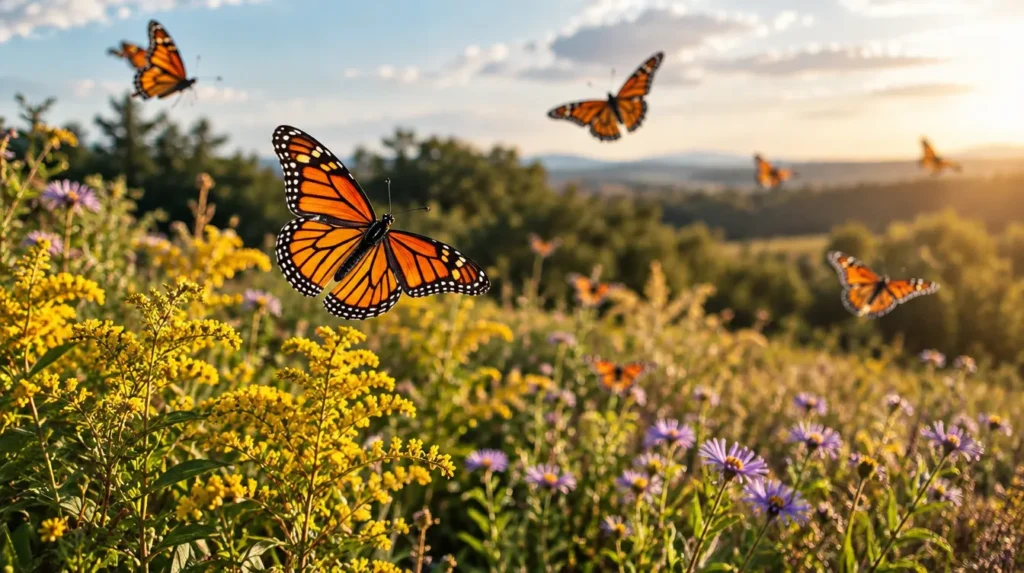
Monarch Butterfly Migration: Where They Go, When, and Why
Every fall, monarch butterflies begin leaving their summer breeding grounds across North America. Some travel thousands of miles, crossing fields, cities, mountains, and national borders before gathering in the same wintering regions used by generations before them.
The most surprising part is that these butterflies have never made the journey before. They do not follow experienced adults or learn the route from their parents.
Monarch butterfly migration is a seasonal movement between breeding areas and overwintering sites. Eastern North American monarchs migrate south to the mountain forests of central Mexico, while most western migratory monarchs spend winter along the California coast. Fall migration generally takes place from August through November, with the northward return beginning in late winter or spring.
Understanding this migration means looking at two different routes, an unusual life cycle, and a remarkably precise system of navigation.
Where Do Monarch Butterflies Migrate?
The destination depends largely on where the butterflies spend their summer.
Eastern Monarchs: From Canada and the United States to Mexico
Monarchs breeding east of the Rocky Mountains generally migrate to central Mexico.
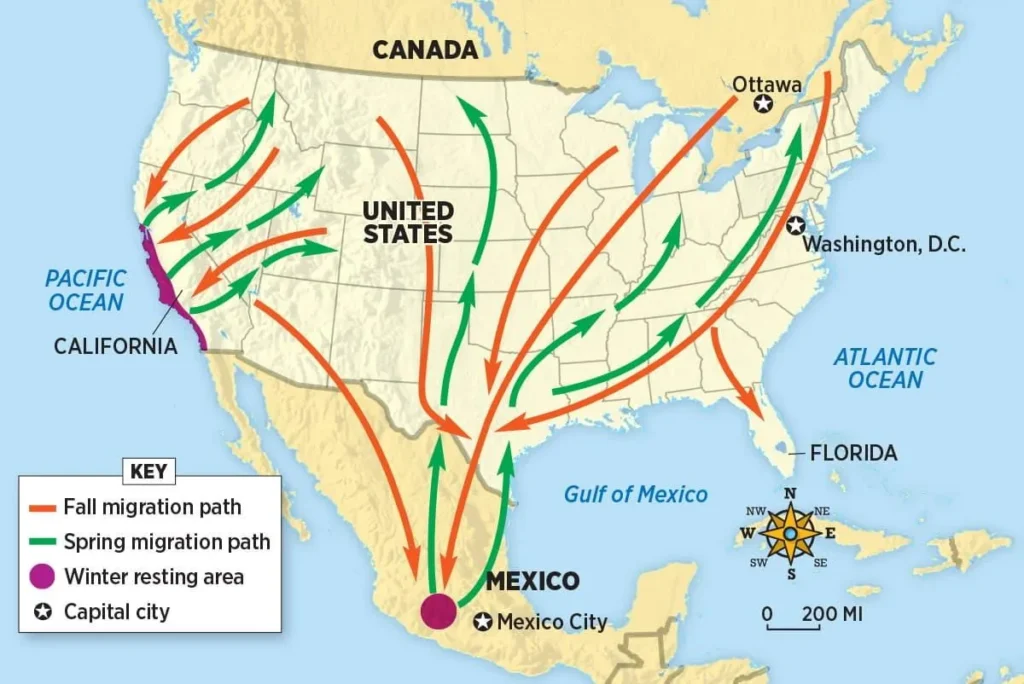
Their summer range includes parts of southern Canada and much of the central and eastern United States. As fall approaches, migrating butterflies move south through different routes that gradually converge toward Texas and northeastern Mexico.
Their destination is the mountainous region of Michoacán and the State of Mexico, where they gather in forests dominated by oyamel fir trees (Abies religiosa).
Some eastern monarchs travel as far as 3,000 miles (4,800 kilometers), although the distance varies considerably depending on where each butterfly begins its journey.
The wintering forests offer a particular combination of cool temperatures, shelter, and moisture. Without these conditions, monarchs would have difficulty conserving enough energy to survive until spring.
Western Monarchs: Toward Coastal California
Western monarchs follow a different pattern.
Many breed in the western United States, including parts of California, Oregon, Washington, Idaho, Nevada, and neighboring regions. During fall, they generally move toward sheltered overwintering sites along the California coast.
These include groves around Pacific Grove, Santa Cruz, and Pismo Beach.
Unlike eastern monarchs, which primarily gather in Mexico’s high-elevation fir forests, western monarchs often cluster in eucalyptus, Monterey pine, Monterey cypress, and other suitable coastal trees.
Their migration is generally shorter, although individual routes and distances vary. Some monarchs in the Southwest follow more complicated movements, and the eastern and western populations are not completely isolated.
Not every North American monarch migrates. Some populations, particularly in warm areas such as southern Florida, may breed throughout the year.
Monarch Butterfly Migration Map: Spring and Fall Routes
A monarch migration map reveals an important pattern: the butterflies do not follow one narrow highway across North America.
Instead, their movements connect extensive breeding regions with a comparatively small number of wintering sites.
[Insert official monarch butterfly migration map here]
Map: U.S. Fish and Wildlife Service. Orange arrows indicate fall migration, while green arrows show spring migration. The mapped routes are generalized pathways, not the exact flight paths of every butterfly.
The main differences are easy to see:
| Population | Fall migration | Spring migration | Main winter destination |
|---|---|---|---|
| Eastern monarchs | South toward Mexico | North through the southern U.S. | Central Mexico |
| Western monarchs | Toward the California coast | Inland and northward | Coastal California and nearby regions |
The spring and fall arrows also represent different biological processes.
In fall, a long-lived migratory generation can travel from northern breeding areas to wintering grounds. The northward expansion, however, involves reproduction and several successive generations.
For observations from the current migration season, the Journey North monarch migration maps provide reports of adult sightings, eggs, caterpillars, and fall roosts.
These observations show where monarchs have been reported, rather than a complete count or a precise route for every individual.
When Do Monarch Butterflies Migrate?
Monarch migration follows a seasonal cycle, but there is no single departure date that applies everywhere.
Latitude, temperature, daylight, weather conditions, and the availability of nectar plants all influence the timing.
Monarch Migration by Season
| Time of year | Eastern monarchs | Western monarchs |
|---|---|---|
| February–March | Overwintering adults begin leaving Mexico, mainly in March | Adults leave coastal wintering sites and move inland |
| April–May | New generations expand north through the U.S. | Breeding populations expand inland and northward |
| June–July | Monarchs breed across much of their summer range | Summer breeding continues throughout suitable western habitats |
| August–September | Migratory adults begin moving south | Fall migration begins in parts of the West |
| October–November | Monarchs continue south and arrive in Mexico | Monarchs gather at coastal overwintering sites |
| December–January | Overwintering in central Mexico | Overwintering along the Pacific coast |
These are approximate windows, not fixed dates. The timing can shift from year to year and differs between northern and southern regions.
When Does Fall Monarch Migration Begin?
In much of the northern United States and southern Canada, fall migration begins in late August or September.
The transition starts before the first frost.
As daylight hours shorten and temperatures begin changing, monarchs emerging in late summer develop differently from those born earlier in the season. Instead of quickly becoming reproductive adults, many enter a state called reproductive diapause.
This allows them to put energy into migration and winter survival rather than immediate reproduction.
Farther south, migrating monarchs may remain visible well into October. In central Mexico, many reach their wintering areas around late October and early November.
When Do Monarchs Return in Spring?
Eastern monarchs typically begin leaving their Mexican wintering sites in March.
They travel north, often reaching Texas and other southern states, where females lay eggs on newly emerging milkweed.
Most of these butterflies do not continue to Canada. Their offspring develop into adults and carry the seasonal expansion farther north.
Western monarchs generally begin leaving coastal overwintering sites in February or March, with subsequent generations spreading into suitable breeding habitats across the West.
Why Do Monarch Butterflies Migrate?
Monarchs migrate because the conditions they need to survive and reproduce change throughout the year.
Northern summers provide extensive breeding habitat, particularly where milkweed is abundant. But winters across much of the United States and Canada are too cold for monarchs to remain active and survive reliably outdoors.
Rather than reproduce continuously in those northern regions, migratory populations spend winter in areas that provide more suitable conditions.
Central Mexico’s high-elevation forests are especially important because they remain cool enough to slow the butterflies’ metabolism without consistently exposing them to the extreme winter conditions found farther north.
The sheltered coastal groves used by western monarchs serve a comparable purpose.
This is not simply a search for the warmest possible location.
Excessively warm conditions can increase activity and cause monarchs to use their stored energy too quickly. Severe freezing, strong winds, or unusually wet conditions can also threaten overwintering colonies.
Successful wintering depends on finding the right environmental balance.
The Monarch Super Generation: How One Butterfly Makes the Long Journey
Most adult monarch butterflies living during the summer survive for only a few weeks.
Yet the butterflies that migrate south in fall can live for six to nine months.
This unusually long-lived group is often called the super generation.
Unlike typical summer adults, these monarchs delay reproduction and build up the energy reserves required for long-distance flight and overwintering.
They feed on nectar along the migration route, storing energy that helps sustain them through the journey and the months ahead.
A butterfly born in southern Canada in late summer may therefore travel all the way to central Mexico, remain there for winter, and begin flying north again in spring.
What it generally does not do is complete the entire annual round trip back to its original northern birthplace.
Why Monarch Migration Takes Several Generations
The yearly migration is best understood as a cycle involving multiple generations.
Spring: Overwintered monarchs leave their wintering grounds. Eastern butterflies move toward the southern United States, reproduce, and lay eggs on milkweed.
Late spring and early summer: Their offspring emerge and continue expanding northward. Further generations reach breeding areas across the United States and southern Canada.
Late summer: Shortening days and changing conditions help trigger the development of the long-lived migratory generation.
Fall and winter: These butterflies travel to overwintering sites, survive the colder months, and eventually begin the cycle again.
This multigenerational system explains one of the migration’s greatest mysteries: the butterflies reaching Mexico in fall have never visited the wintering forests before.
How Do Monarch Butterflies Know Where to Go?
Monarchs cannot learn the migration route from older butterflies. The individuals that make the autumn journey belong to a different generation from those that traveled the previous year.
So how do they maintain the correct direction?
Researchers have identified several navigation mechanisms, although not every detail of how monarchs locate specific wintering sites is understood.
The Sun Compass
One of the most important mechanisms is a time-compensated sun compass.
Monarchs use information about the sun’s position together with an internal biological clock to maintain a consistent travel direction as the sun moves across the sky.
Research has shown that their antennae play an important role in providing the timing information used by this system.
Without time compensation, the sun’s changing position throughout the day would make directional navigation much less reliable.
A Possible Backup from Earth’s Magnetic Field
Experimental research has also demonstrated that migratory monarchs possess a light-dependent magnetic inclination compass.
This mechanism may help them maintain orientation when useful directional sunlight cues are unavailable.
Scientists continue to investigate how these systems interact and how butterflies ultimately locate particular overwintering forests.
The evidence does not support the idea that monarchs simply memorize a route. Their directional abilities arise from biological systems that function without previous experience of the migration.
How Far Do Monarch Butterflies Fly Each Day?
The distance traveled in one day depends on weather, wind, temperature, and opportunities to feed.
Migrating monarchs may cover dozens of miles in a day, and favorable conditions can allow considerably longer movements.
Warm air currents and favorable winds can help them travel efficiently, while rain, low temperatures, and strong opposing winds may interrupt migration.
Monarchs generally migrate during daylight.
At night, they settle in sheltered locations. During fall migration, they sometimes gather in groups known as roosts.
A roost may contain a few butterflies or hundreds of individuals clustered in trees.
These temporary resting places are different from the major overwintering colonies in Mexico and California. A fall roost along the migration route may be occupied for only a short period before the butterflies continue moving.
How to Track Monarch Butterfly Migration
You do not need to live near the wintering sites to observe monarch migration.
Throughout North America, volunteers and researchers record sightings that help document when and where the butterflies are moving.
Look for Fall Roosts
During late summer and fall, watch for groups of monarchs gathering in sheltered trees, particularly near nectar-producing flowers.
Roosts are often easier to observe in the early morning, before temperatures rise enough for sustained flight.
Watch for Milkweed in Spring
In spring, the emergence of milkweed often coincides with the return of breeding monarchs.
Finding milkweed does not guarantee that monarchs have arrived, but it provides an important clue about when suitable breeding habitat is becoming available.
Adult monarchs may appear first, followed by eggs and caterpillars.
For more information about the plants butterflies need, see our guide to butterfly host plants.
Use Live Migration Maps
The Journey North interactive maps collect seasonal observations from across North America.
Visitors can explore reports of adults, eggs, larvae, and fall roosts.
Remember that community-science maps reflect where people have submitted observations. An area with few reports does not necessarily mean monarchs are absent.
Why Monarch Migration Is Under Threat
The annual migration depends on suitable habitat at several different stages.
Monarchs need milkweed for reproduction, nectar-producing flowers for energy, and protected forests or groves in which to spend winter.
Damage to any of these habitats can affect the migration cycle.
Loss of milkweed from breeding landscapes makes it harder for successive generations to develop.
Loss of nectar plants may reduce the energy available to migrating adults.
Meanwhile, habitat degradation in overwintering areas can expose large concentrations of butterflies to unfavorable weather and other threats.
Pesticide exposure, changing weather patterns, and climate-related extremes add further challenges.
Protecting monarch migration therefore requires more than preserving a single destination. Conservation efforts must account for breeding grounds, migration stopovers, and wintering habitats across several countries.
Home gardeners can contribute by choosing locally native milkweed species where appropriate, growing nectar-rich flowers that bloom through the migration season, and avoiding unnecessary insecticide use.
You can learn more about creating suitable habitat in our butterfly habitat guide.
Frequently Asked Questions About Monarch Migration
Where do monarch butterflies migrate in winter?
Eastern North American monarchs generally migrate to mountain forests in central Mexico, particularly in Michoacán and the State of Mexico. Western migratory monarchs mainly overwinter in sheltered groves along the California coast.
When do monarchs migrate south?
Fall migration usually begins in August or September in northern breeding regions. Many eastern monarchs travel south through September and October, reaching wintering sites in central Mexico around late October or November.
Do monarch butterflies migrate every year?
Yes. Migratory North American monarch populations follow an annual seasonal cycle. However, not every monarch migrates, and nonmigratory populations exist in areas with suitable year-round conditions.
How far do monarch butterflies migrate?
Some eastern monarchs travel up to about 3,000 miles (4,800 kilometers) to reach their wintering grounds. Individual distances vary widely, and western migrations are generally shorter.
Do monarch butterflies return to the same place every year?
Monarch populations repeatedly use many of the same overwintering regions, and sometimes the same forest groves. However, the butterflies arriving in fall are a new generation. They have not personally visited those wintering sites before.
Can you see monarch migration on a live map?
Yes. Journey North publishes observation maps showing reported sightings throughout the migration season. These maps are useful for following seasonal progress, although they do not display the exact locations of every migrating butterfly.
Final Thoughts
The monarch’s migration is more than a long flight south.
It is a yearly cycle connecting milkweed fields in Canada, flower-rich landscapes across the United States, sheltered coastal groves in California, and high mountain forests in Mexico.
Perhaps its most remarkable feature is that the journey continues even though the butterflies making it have never experienced the route before.
Each generation inherits the ability to continue a migration that extends far beyond an individual butterfly’s lifetime.
And that is what makes monarch butterfly migration such an extraordinary biological phenomenon.
References
- Monarch Joint Venture — Monarch Migration
- U.S. Fish and Wildlife Service — Monarch Butterfly Migration Map
- Journey North — Monarch Migration Maps
- Guerra et al. (2014) — A Magnetic Compass Aids Monarch Butterfly Migration
How This Article Was Created
This guide was prepared using information from monarch conservation organizations, U.S. wildlife agencies, migration-monitoring programs, and peer-reviewed research. Seasonal migration dates are presented as approximate ranges because butterfly movements vary with geography and annual conditions.
Last reviewed: October 13, 2026.