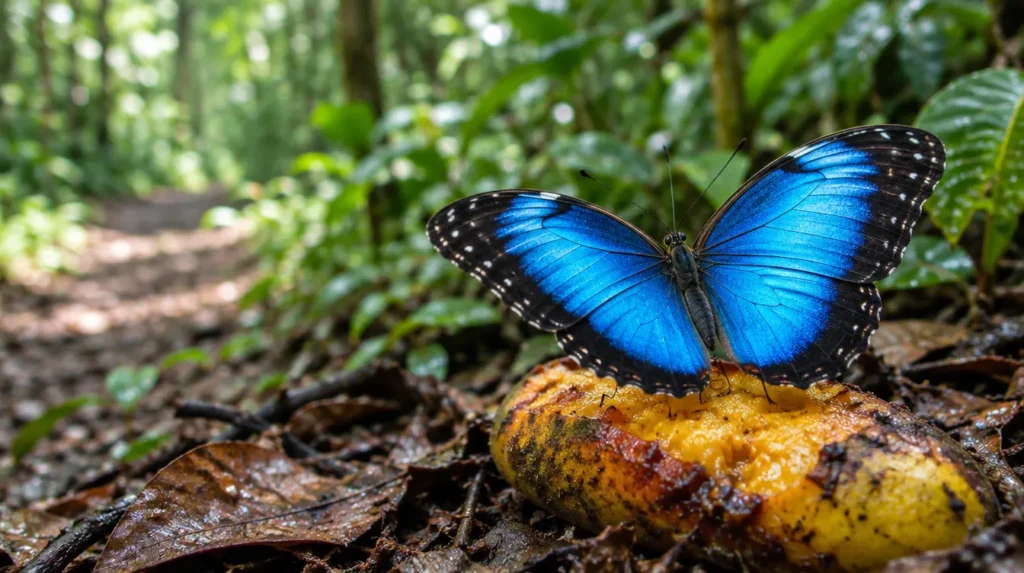
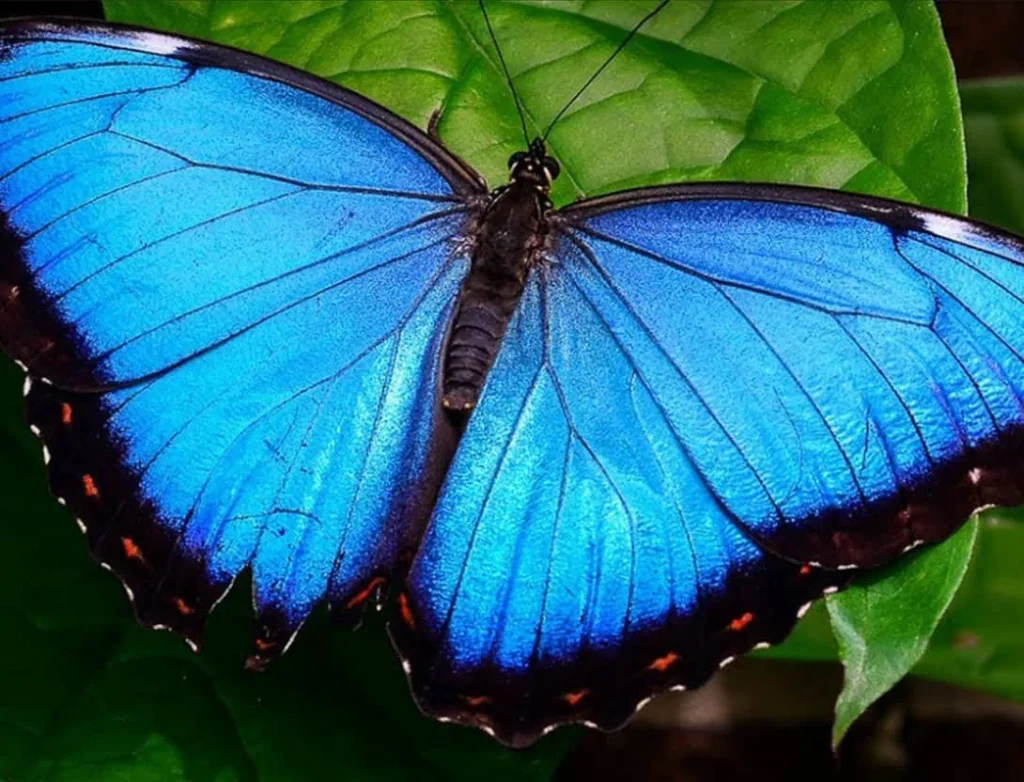
The blue morpho is a large tropical butterfly from Mexico, Central America and South America, famous for the electric blue on the upper side of its wings. That blue is not a pigment. It comes from microscopic structures in the wing scales that reflect blue light. Close the wings and the butterfly turns almost entirely brown, with a row of eyespots that blend into the forest floor.
“Blue morpho” is used loosely for several blue species in the genus Morpho. This guide covers the one most people mean: Morpho peleides, the common blue morpho, which is also the species most often flown in museum and zoo butterfly houses.
Blue morpho quick facts
| Scientific name | Morpho peleides Kollar, 1850 (often treated as Morpho helenor peleides) |
| Other names | Common blue morpho, peleides blue morpho, common morpho |
| Family | Nymphalidae (brush-footed butterflies) |
| Native range | Mexico through Central America into South America |
| Habitat | Tropical forest, especially edges, trails, streams and secondary growth |
| Wingspan | About 5–8 in (13–20 cm), depending on the source and individual |
| Adult food | Juice from rotting fruit and tree sap, not flower nectar |
| Caterpillar host plants | Mainly legumes (Fabaceae), such as Machaerium, Pterocarpus, Lonchocarpus, Dalbergia and Mucuna |
| Egg to adult | Roughly 9–13 weeks |
| Global status | Described as widespread and abundant; no global threat listing found |
What species is the “blue morpho”?
There are around 30 species of Morpho, and not all of them are blue. Some are white, brown or orange. Several blue species get called “blue morpho,” which is why sources sometimes disagree about size, range or appearance.
Morpho peleides has its own name problem. Many authorities now treat it as a subspecies of Morpho helenor, so you will see it written as Morpho helenor peleides. The University of Florida’s species profile notes both names and lists 13 described subspecies under peleides. If you read about “Morpho helenor,” the common blue morpho, it is usually the same butterfly or a close regional form of it.
Morphos belong to the brush-footed butterfly family, Nymphalidae. Older books put them in their own subfamily, Morphinae. Many newer classifications fold them into the subfamily Satyrinae as the tribe Morphini. Either way, they are close relatives of the owl butterflies and the satyrs.
How to identify a blue morpho
Upperside (wings open)
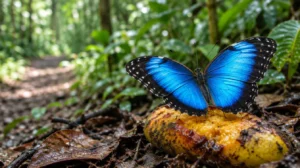
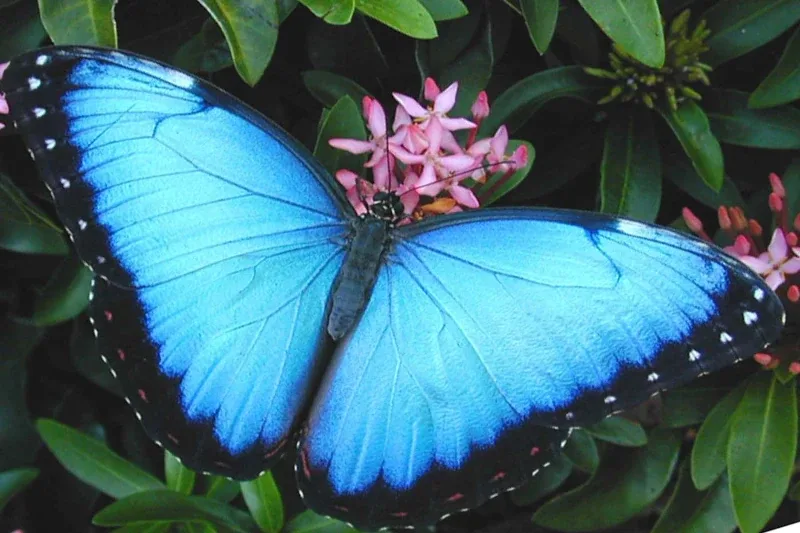
- Bright metallic blue across the centre of all four wings.
- A black border around the outer edge, with a row of small white spots in the black on the forewing.
- The blue can look violet, sky blue or almost silver as the angle of light changes.
Underside (wings closed)
- Brown, with darker and paler bands and wavy lines.
- A row of ringed eyespots (ocelli) along both wings, each with a small pale centre spot.
- No blue shows at all when the butterfly is resting with its wings closed, which is how you will see it most of the time.
Size and flight
This is a big butterfly. The University of Florida and the Florida Museum give a wingspan of about 5 to 8 inches. In flight it bounces and zigzags, flashing blue on each downstroke and brown on each upstroke. Males often patrol trails, forest edges and streams in the morning.
Male vs female
The sexes look similar at a glance, but females usually have a wider black border on the upperside, with more obvious white spots in it, and they tend to be a little larger. Males have the broader, more continuous blue. In some other Morpho species the females are mostly brown, which is one reason you may read that “only males are blue.” That is not the rule for M. peleides.
Similar species
In Central America, the closest look-alike is Morpho granadensis. The two are hard to separate in flight. Specialists use details of the eyespots on the underside of the hindwing, so a clear photo of the closed wings is far more useful than a photo of the blue upperside.
Other large blue morphos, such as Morpho menelaus and Morpho amathonte, are usually more uniformly blue above, with a narrower dark edge or only a dark forewing tip in males. Location helps too: in a Mexican or Central American forest, M. peleides is the species you are most likely to see.
Outside the tropics, any blue morpho you see is almost certainly in a butterfly house. Blue morphos are not native to the United States, Canada or Europe. If you are trying to name a blue butterfly in your own garden there, our how to identify a butterfly guide is the better starting point.
Why is the blue morpho blue?
The blue morpho has no blue pigment. Its colour is structural.
Each wing is covered in tiny overlapping scales. Every scale carries rows of ridges, and each ridge holds a stack of very thin shelves separated by air gaps. A study of Morpho peleides scales measured these shelves at around 90 nanometres thick, with air layers of about 70 nanometres between them. When light hits this stack, waves bouncing off the different layers line up for blue wavelengths and reinforce each other, while other colours largely cancel out. The result is an intense, metallic blue.
Two practical consequences:
- The colour shifts with angle. Seen from the side, the blue moves toward violet.
- The brown underside is ordinary pigment. That is why the butterfly seems to “switch off” its colour when it lands and folds its wings.
Engineers have studied morpho scales for ideas on dye-free colour, anti-counterfeiting marks and water-repellent surfaces.
Where blue morphos live
Morpho peleides ranges from Mexico through Central America into South America. Exactly how far south depends on how the species is defined. A breeder and specialist source in Costa Rica gives the range as Mexico to Colombia and Venezuela. The University of Florida, using the broader sense of the name, extends it to Paraguay. The wider Morpho helenor complex reaches Argentina. Blue morphos also occur in Trinidad.
Within that range, they use tropical forest from the lowlands into the mountains, from sea level to about 1,800 m according to a Costa Rican source. Despite the “deep rainforest” image, they favour open places inside forest: trails, clearings, forest edges, riverbanks and secondary growth. Dense, unbroken forest interior is used less.
What do blue morphos eat?
Adults
Adult blue morphos are fruit feeders. They drink juice from fallen, fermenting fruit and feed on tree sap. They rarely, if ever, visit flowers for nectar. Several adults may share the same fruit without fighting, and these feeding spots are also where males and females often meet. In butterfly houses they are usually given slices of banana, mango and other soft fruit.
If you are interested in this side of butterfly feeding, see what butterflies drink besides nectar.
Caterpillars
The caterpillars eat leaves of their host plants, mostly members of the pea family (Fabaceae). Recorded hosts include:
- Machaerium (including M. seemannii and M. salvadorensis)
- Pterocarpus
- Lonchocarpus
- Dalbergia
- Platymiscium
- Mucuna
- Swartzia
- Erythrina (females seen laying eggs on it)
A few non-legumes are also used locally. In Trinidad, the main wild host is Paragonia pyramidata, a vine in the trumpet-creeper family (Bignoniaceae). The host range is broad overall, which helps explain why the species is so widespread.
Keep the two diets separate: adults feed on fruit and sap, while caterpillars eat only leaves. For a general explanation, see our guide to butterfly host plants.
Blue morpho life cycle
Like all butterflies, the blue morpho goes through complete metamorphosis: egg, caterpillar, pupa and adult. Stage lengths below come from rearing studies summarised by the University of Florida and vary with subspecies and conditions.
| Stage | Approx. duration | What it looks like |
|---|---|---|
| Egg | 7–16 days | Small (1–2 mm), dome-shaped, pale green with a ring of brown spots; laid singly on the upper side of a leaf |
| Caterpillar | About 40–50 days (5 instars) | Young caterpillars are yellow-green with maroon patches and tufts of red and white hairs; older ones turn mostly brown. Grows to about 7.5–9 cm |
| Prepupa | About 3 days | The caterpillar stops feeding, hangs, and turns pale green |
| Pupa (chrysalis) | About 2 weeks (up to 22 days) | Smooth, pale green, oval; becomes see-through shortly before the adult emerges |
| Adult | A few weeks | The Florida Museum puts the whole life span, egg to death, at under 120 days |
The caterpillars feed mainly around dawn and dusk and keep still the rest of the time. Their hair tufts help break up their outline on a leaf.
Behaviour and defence
The blue morpho’s main defence is visual. When it flies, the alternating blue and brown flashes make it appear and disappear. Researcher Allen Young suggested in 1971 that this flashing may make a flying morpho hard for birds to follow. When it lands and closes its wings, the brown underside works as camouflage.
The underside eyespots may add a second line of defence. Large eyespots can startle a predator or draw a peck toward the wing edge instead of the body. This is a widely discussed idea for butterflies with eyespots, but how well it works for morphos in particular is still being studied.
Courtship often begins at feeding sites. Males chase females in looping flights, and mating pairs can stay joined for many hours, sometimes more than a day.
Is the blue morpho endangered?
Morpho peleides is not considered rare. The University of Florida describes it as one of the most widespread and abundant morpho species, with large populations in both lowland and mountain forest. We found no global threat listing for it.
That does not mean morphos are free of pressure. Forest clearing reduces habitat for all tropical forest butterflies, and dead morphos are sold for jewellery and decorative displays. Some other Morpho species have small ranges and face greater risk than the common blue morpho. Live blue morphos in museum and zoo butterfly houses are typically raised on butterfly farms in the tropics and shipped as pupae.
Blue morphos in culture
Outside biology, the blue morpho has become a symbol of tropical nature. In 2022 Costa Rica’s Legislative Assembly declared Morpho helenor a national symbol (Law 10261). Press coverage named the subspecies Morpho helenor narcissus. The law puts the environment ministry in charge of conserving the species and the tourism institute in charge of promoting it.
Blue morpho FAQ
Is the blue morpho really blue? Only in the way it reflects light. The wing contains no blue pigment. Nanoscale layers in the scales reflect blue light, so the blue depends on the angle you view it from. The brown underside is pigmented.
Why does a blue morpho look brown when it lands? It usually rests with its wings closed, showing only the brown, eyespotted underside. The blue is on the upper side.
How long does a blue morpho live? The whole life cycle, from egg to the end of adult life, is under about four months. Most of that is spent as an egg, caterpillar and pupa. The adult stage lasts a few weeks.
Do blue morphos drink nectar? Rarely, if at all. Adults feed on rotting fruit and tree sap.
Can you see blue morphos in the United States? Not in the wild. They are native to the American tropics. In the US you can see them in butterfly houses at museums and zoos.
Is Morpho peleides the same as Morpho helenor? Many authorities treat peleides as a subspecies of Morpho helenor, so the two names often refer to the same butterfly. Others keep M. peleides as a separate species. Both names are in current use.
More butterfly guides
- Types of butterflies — the main butterfly families, including brush-footed butterflies like the morphos
- Butterfly species — all species profiles on this site
Sources
- Ray, H. & Miller, J.Y. Blue Morpho Butterfly, Morpho peleides Kollar. University of Florida / IFAS Extension, publication IN1101 (2015, reviewed 2019).
- Florida Museum of Natural History. Blue morpho butterflies in the exhibit (2017).
- Natural History Museum, London. Spotlight: blue morpho.
- Ding, Y., Xu, S. & Wang, Z.L. (2009). Structural colors from Morpho peleides butterfly wing scales. Journal of Applied Physics 106, 074702.
- Young, A.M. (1971). Wing coloration and reflectance in Morpho butterflies as related to reproductive behavior and escape from avian predators. Oecologia 7: 209–222.
- Constantino, L.M. (1997). Natural history, immature stages and hostplants of Morpho amathonte from western Colombia. Tropical Lepidoptera 8(2): 75–80.
- El Mundo CR and La Nación (Costa Rica), coverage of the 2022 vote declaring Morpho helenor a national symbol.