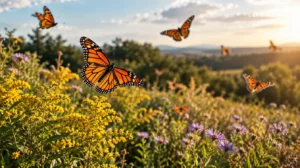
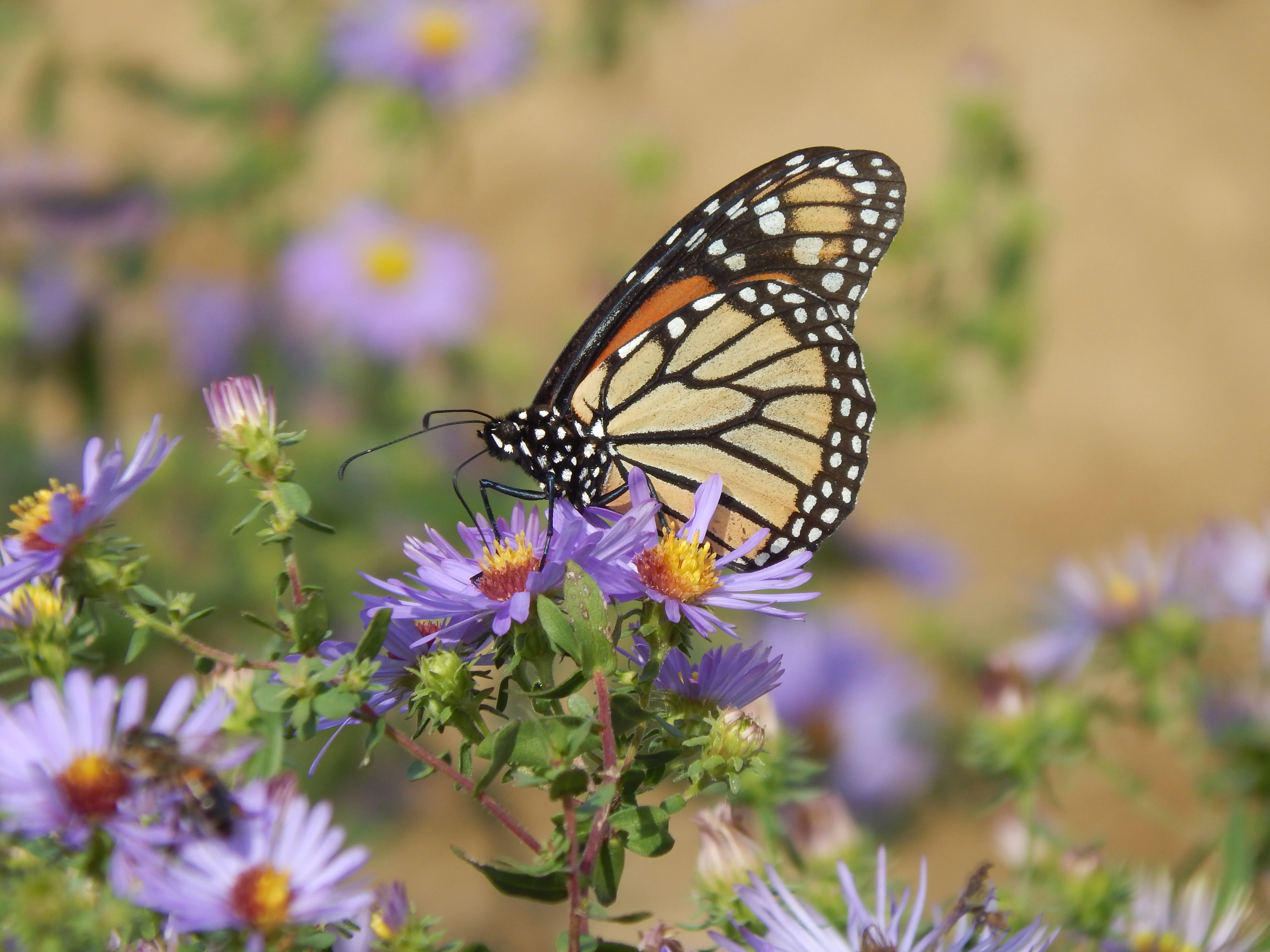
The monarch butterfly is one of those insects that almost everyone recognizes, even if they are not especially interested in butterflies. With its bright orange wings, bold black veins, and extraordinary long-distance migration, it has become one of the most admired butterflies in the world.
What makes the monarch butterfly so fascinating is not just its appearance, but the story behind it. From tiny eggs laid on milkweed leaves to adults capable of traveling thousands of miles, monarchs live a life that feels surprisingly dramatic for such a delicate creature. In North America, their seasonal migration is one of the most remarkable natural events on the continent.
In this guide, we will look at monarch butterfly habitat, life cycle, diet, migration, and a few facts that help explain why this species continues to capture so much attention.
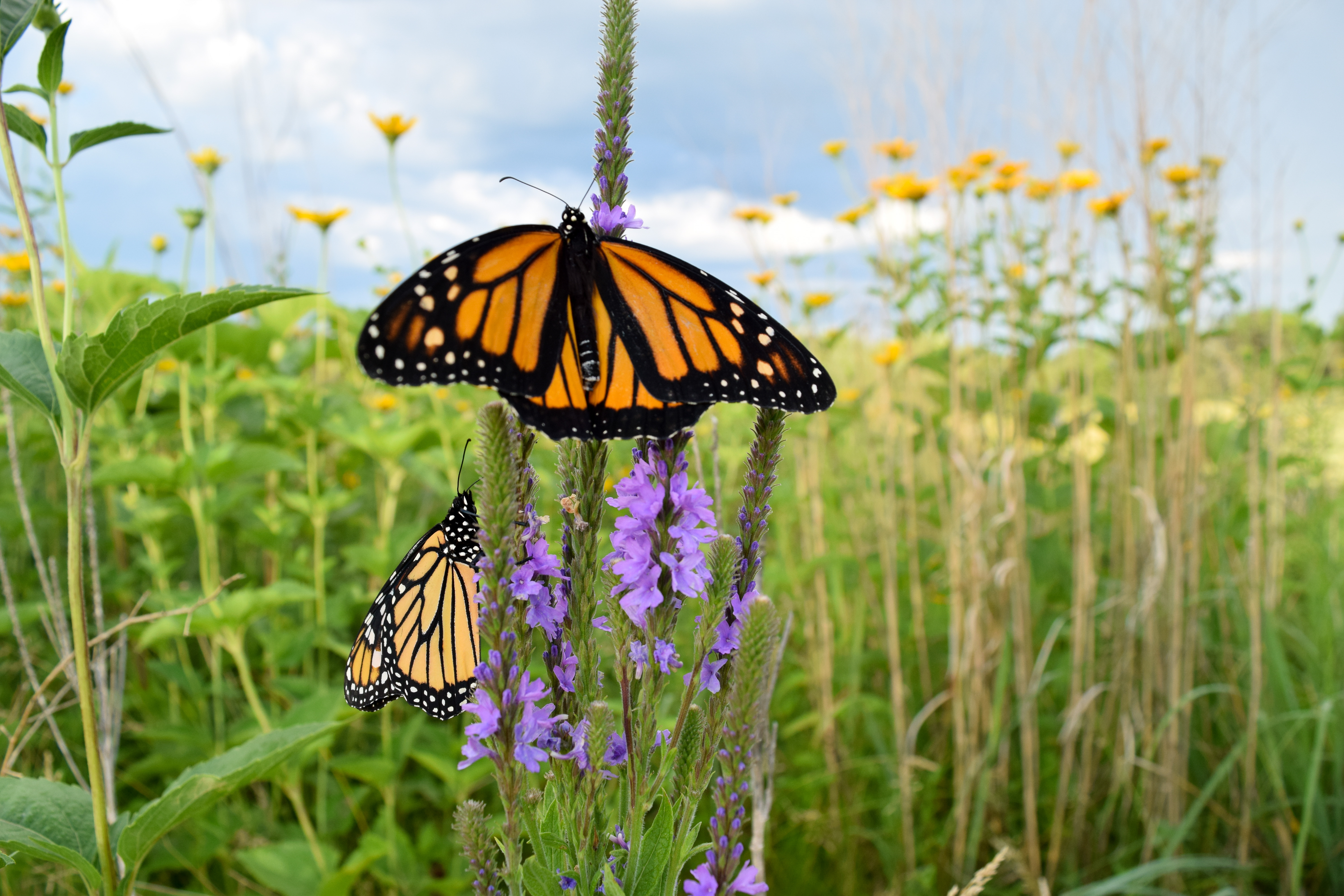
What Is a Monarch Butterfly?
The monarch butterfly, Danaus plexippus, belongs to the nymphalid family and is considered a large butterfly. Its wingspan usually falls around 95 to 100 mm, which gives it a noticeably larger presence than many other garden butterflies.
Monarchs are especially famous for two things: their close relationship with milkweed plants and their ability to migrate over extraordinary distances. They are native to the Americas and are found across a broad range, from southern Canada through the United States and into parts of Central and South America.
Although they are strongly associated with North America, monarch butterflies are also known as rare migrants in places such as the British Isles, where breeding has not been recorded because their caterpillar foodplant, milkweed, is not native there.
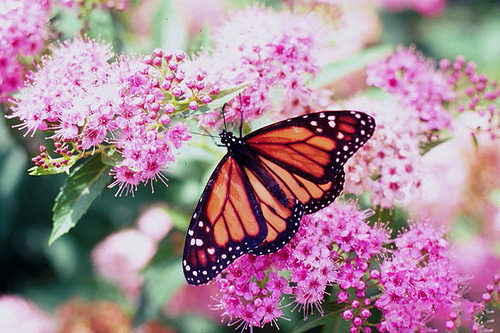
Monarch Butterfly Habitat
When people search for monarch butterfly habitat, they often expect a single answer. In reality, monarchs need different habitats at different stages of life.
Breeding Habitat
During the breeding season, monarch butterflies live wherever milkweed grows. This includes meadows, farmland edges, roadsides, open fields, prairies, parks, and even home gardens. Female monarchs lay their eggs only on milkweed, because the newly hatched caterpillars must feed on it to survive.
Without milkweed, there is no monarch nursery.
Nectar-Rich Habitat
Adult monarchs also need access to flowering plants. Nectar provides the energy they need for daily activity and, more importantly, for migration. A healthy monarch habitat is not just a place with milkweed, but a landscape filled with blooming native flowers throughout the season.
Overwintering Habitat
One of the most extraordinary parts of monarch ecology is the way they spend the winter.
The eastern population migrates from the northeastern United States and southeastern Canada to mountain forests in central Mexico. The western population moves toward coastal California, where monarchs gather in sheltered groves. These overwintering sites provide the cool, stable conditions the butterflies need to conserve energy until spring returns.
So, when we talk about monarch butterfly habitat, we are really talking about a connected chain of habitats: breeding grounds, nectar corridors, and overwintering refuges.
Monarch Butterfly Life Cycle
Like all butterflies, the monarch butterfly goes through complete metamorphosis. Its life cycle has four stages: egg, larva, pupa, and adult.
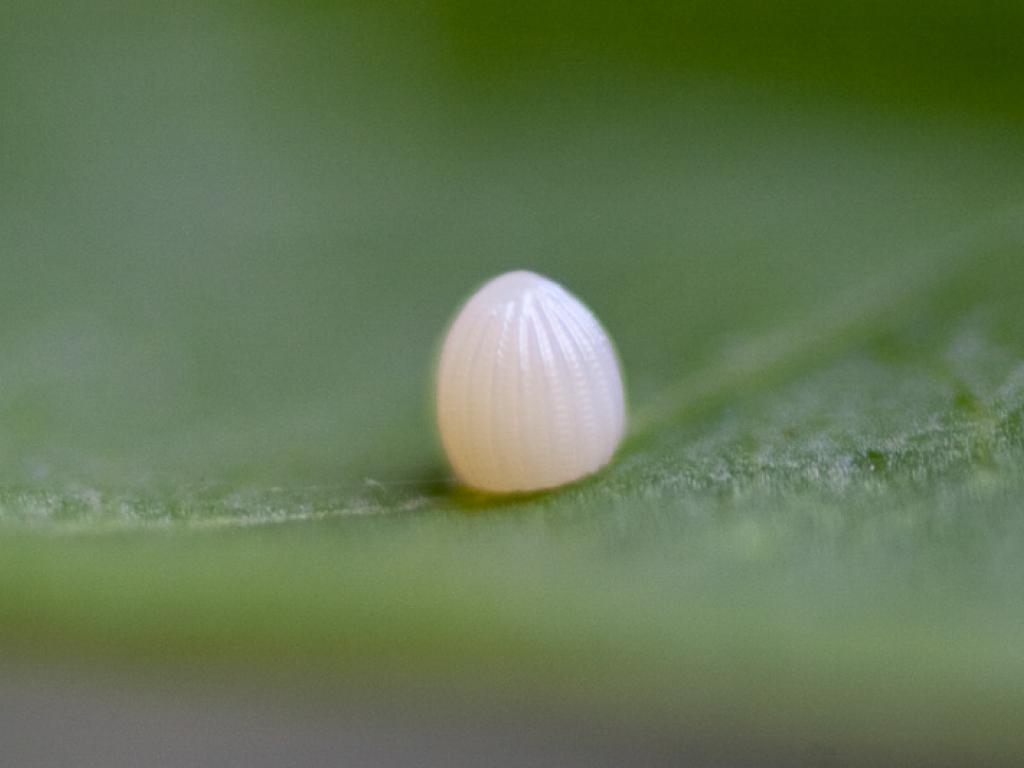
Egg Stage
A female monarch lays her eggs one by one on milkweed leaves, attaching each egg with a sticky substance. Over the course of two to five weeks, one female may lay several hundred eggs.
The eggs are small and easy to miss. After about three to five days, they hatch.
Larva Stage
The larva, or caterpillar, has one main job: eat and grow.
Monarch caterpillars feed only on milkweed. Over roughly two weeks, they pass through five instars, or growth stages, shedding their skin each time. Early instars are tiny and pale, but as they develop, the caterpillars become more recognizable, with the familiar black, white, and yellow banding.
This stage is vulnerable. Weather extremes, predators, parasites, and disease all take a heavy toll, and only a small percentage of monarch eggs and caterpillars survive to adulthood.
Pupa Stage
When the caterpillar is fully grown, it finds a safe place and forms a chrysalis. Before pupating, it hangs in a characteristic J-shape. Then the larval skin splits, revealing a soft green chrysalis decorated with tiny golden dots.
Inside the chrysalis, one of nature’s most astonishing transformations takes place. Over about 8 to 15 days, the caterpillar’s body reorganizes into the structure of an adult butterfly.
Adult Stage
When the monarch emerges, its wings are soft and crumpled. It must hang quietly for several hours while the wings expand and dry.
Adult monarchs do not all live the same length of time. Summer generations may live only two to five weeks, mainly to feed, mate, and reproduce. The final generation of the year is different. These monarchs delay reproduction, migrate south, and can live for several months, sometimes up to nine months.
That longer-lived migratory generation is one of the reasons the monarch butterfly life cycle feels so remarkable. The butterfly that flies south in autumn is not the same individual that flew north in spring.
The larva (caterpillar) has five stages (instars), molting at the end of each instar. Instars last about 3 to 5 days, depending on factors such as temperature and food availability.
The first-instar caterpillar that emerges from the egg is pale green or grayish-white, shiny, and almost translucent, with a large, black head. It lacks banding coloration or tentacles. The larvae or caterpillar eats its egg case and begins to feed on milkweed with a circular motion, often leaving a characteristic, arc-shaped hole in the leaf. Older first-instar larvae have dark stripes on a greenish background and develop small bumps that later become front tentacles. The first instar is usually between 2 and 6 mm (0.079 and 0.236 in) long.
The second-instar larva develops a characteristic pattern of white, yellow, and black transverse bands. The larva has a yellow triangle on the head and two sets of yellow bands around this central triangle. It is no longer translucent, and is covered in short setae. Pairs of black tentacles begin to grow, a larger pair on the thorax and a smaller pair on the abdomen. The second instar is usually between 6 mm (0.24 in) and 1 cm (0.39 in) long.
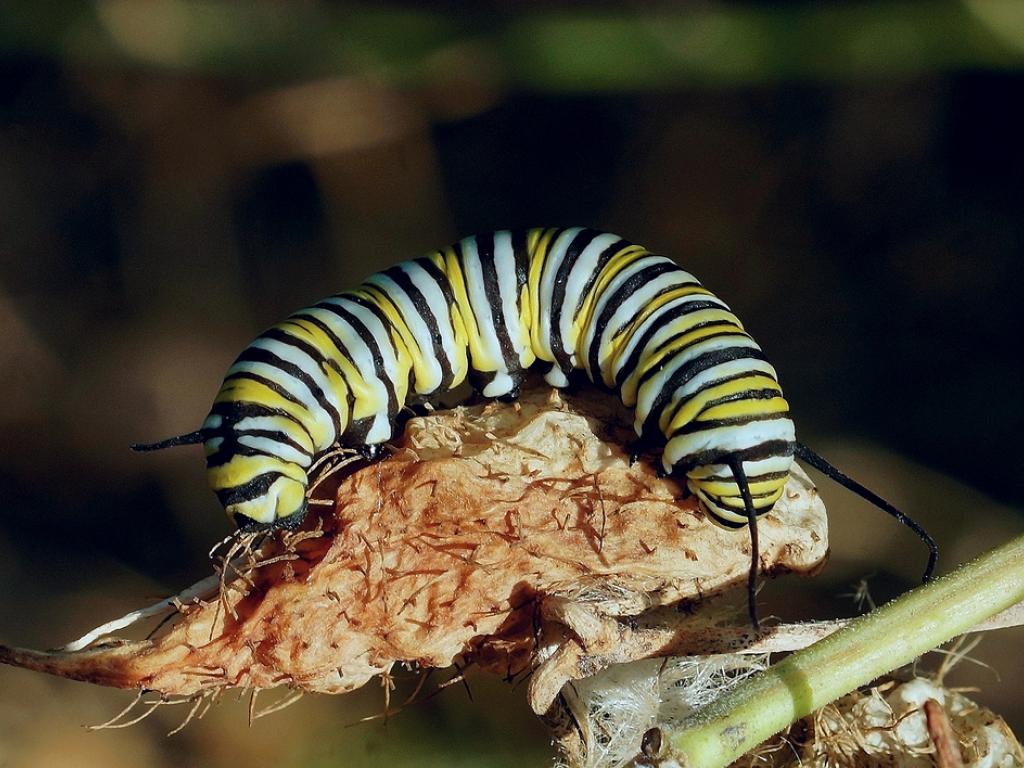
The larva (caterpillar) has five stages (instars), molting at the end of each instar. Instars last about 3 to 5 days, depending on factors such as temperature and food availability.
The first-instar caterpillar that emerges from the egg is pale green or grayish-white, shiny, and almost translucent, with a large, black head. It lacks banding coloration or tentacles. The larvae or caterpillar eats its egg case and begins to feed on milkweed with a circular motion, often leaving a characteristic, arc-shaped hole in the leaf. Older first-instar larvae have dark stripes on a greenish background and develop small bumps that later become front tentacles. The first instar is usually between 2 and 6 mm (0.079 and 0.236 in) long.
The second-instar larva develops a characteristic pattern of white, yellow, and black transverse bands. The larva has a yellow triangle on the head and two sets of yellow bands around this central triangle. It is no longer translucent, and is covered in short setae. Pairs of black tentacles begin to grow, a larger pair on the thorax and a smaller pair on the abdomen. The second instar is usually between 6 mm (0.24 in) and 1 cm (0.39 in) long.
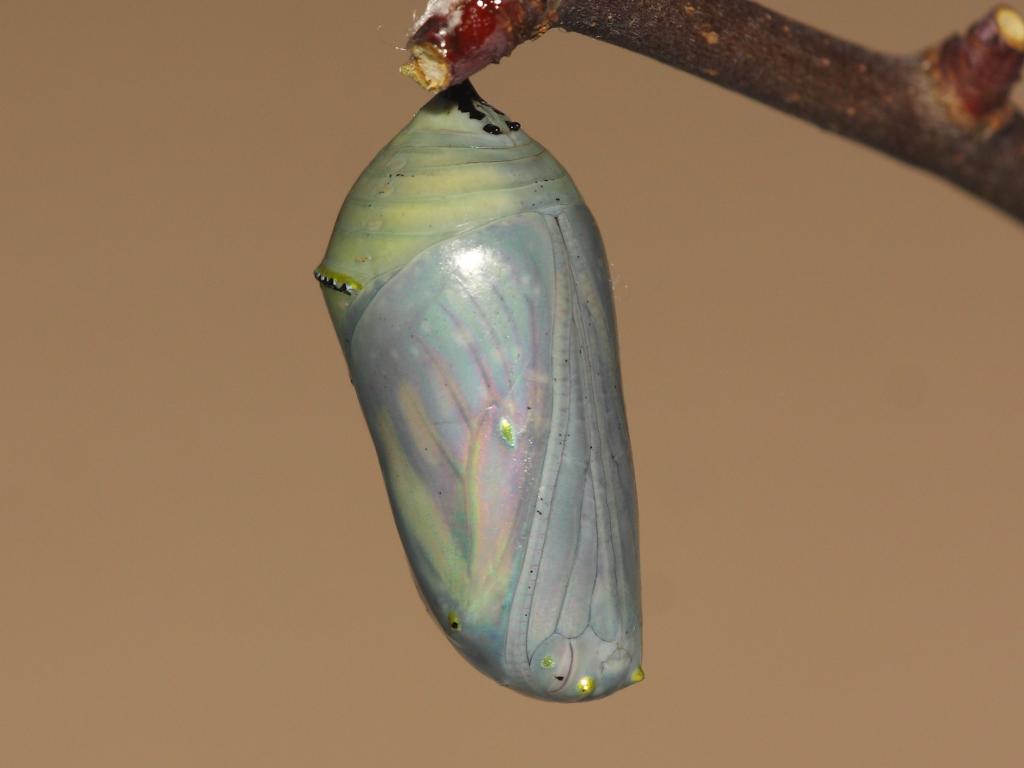
To prepare for the pupal or chrysalis stage, the caterpillar chooses a safe place for pupation, where it spins a silk pad on a downward-facing horizontal surface. At this point, it turns around and securely latches on with its last pair of hind legs and hangs upside down, in the form of the letter J. After “J-hanging” for about 12–16 hours, it soon straightens out its body and goes into peristalsis some seconds before its skin splits behind its head. It then sheds its skin over a period of a few minutes, revealing a green chrysalis . At first, the chrysalis is long, soft, and somewhat amorphous, but over a few hours, it compacts into its distinct shape – an opaque, pale-green chrysalis with small golden dots near the bottom, and a gold-and-black rim around the dorsal side near the top. At first, its exoskeleton is soft and fragile, but it hardens and becomes more durable within about a day. At this point, it is about 2.5 cm (0.98 in) long and 10–12 mm (0.39–0.47 in) wide, weighing about 1.2 g (0.042 oz). At normal summer temperatures, it matures in 8–15 days (usually 11–12 days). During this pupal stage, the adult butterfly forms inside. A day or so before emerging, the exoskeleton first becomes translucent and the chrysalis more bluish. Finally, within 12 hours or so, it becomes transparent, revealing the black and orange colors of the butterfly inside before it ecloses (emerges).
What Do Monarch Butterflies Eat?
The monarch butterfly diet changes completely depending on life stage.
What Monarch Caterpillars Eat
Monarch caterpillars feed exclusively on milkweed leaves. This is not a casual preference. Milkweed contains toxic compounds, and monarch larvae are adapted to tolerate and store them. Those chemicals help make the caterpillars, and later the adults, less appealing to predators.
That is one reason milkweed is so central to monarch survival.
What Adult Monarch Butterflies Eat
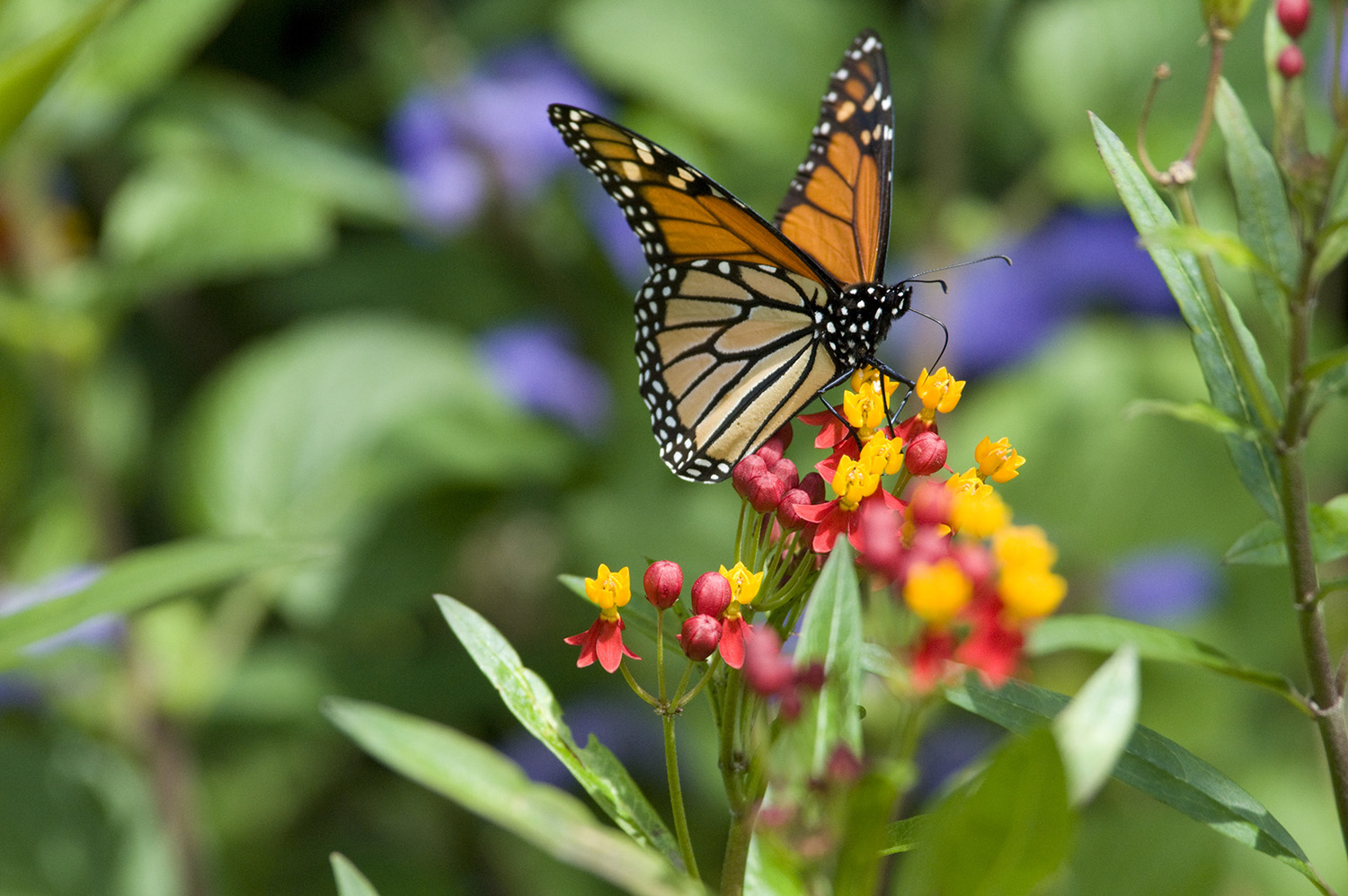
Adult monarchs feed on nectar from flowers. Nectar supplies sugars that fuel flight, reproduction, and migration. During migration, access to nectar-rich flowers becomes especially important because monarchs need to build and maintain energy reserves.
Milkweed flowers are one nectar source, but adult monarchs also visit many other flowering plants, especially native species that bloom along their migration routes.
Monarch Butterfly Migration Facts
For many people, migration is what turns the monarch from a beautiful butterfly into a truly unforgettable species.
Millions of monarchs in North America travel vast distances each year. Some eastern monarchs move from as far north as Canada to central Mexico, covering around 2,000 miles. That journey is one of the best-known insect migrations in the world.
What makes this even more impressive is that no single butterfly completes the full annual cycle in both directions. Multiple generations are involved. Spring and summer generations breed and move northward step by step, while the final generation of the year travels south and overwinters.
It is a migration story built across generations.
Why Monarch Butterflies Matter
The monarch butterfly is not just visually iconic. It also plays an ecological role as part of pollinator communities and serves as a powerful indicator of habitat health.
Because monarchs depend on both milkweed and nectar plants, their presence tells us something about the condition of the landscape. When wildflower habitats disappear, roadside vegetation is cleared, or pesticide use intensifies, monarch numbers can fall.
For that reason, monarch conservation is often tied to broader efforts to restore native plants, protect migration corridors, and preserve overwintering forests.
Threats to Monarch Butterflies
Despite their fame, monarch butterflies face real pressure.
Habitat Loss
Urban expansion, intensive agriculture, and land-use change have reduced milkweed-rich breeding areas and flowering habitats.
Pesticides and Herbicides
These chemicals can directly harm insects or indirectly remove the plants monarchs depend on, especially milkweed.
Climate Change
Changing weather patterns can disrupt breeding conditions, migration timing, and overwintering sites. Severe storms, drought, and temperature extremes all create additional stress.
Overwintering Forest Decline
In some overwintering regions, forest loss has reduced the sheltered conditions monarchs need to survive the winter.
How to Help Monarch Butterflies
Even small actions can make a difference.
- Plant native milkweed where it is appropriate for your region
- Add nectar-rich flowering plants to gardens and green spaces
- Reduce pesticide use whenever possible
- Support habitat restoration and forest protection efforts
- Leave some areas of the garden a little wilder during the growing season
Monarch conservation often begins with something simple: growing the right plants in the right place.
Final Thoughts on the Monarch Butterfly
The monarch butterfly is easy to admire for its beauty, but the deeper you look, the more interesting it becomes. Its life depends on a delicate relationship with milkweed, its body transforms through complete metamorphosis, and its migration spans entire regions.
That combination of fragility and endurance is probably why the monarch continues to fascinate both scientists and casual nature lovers. It is not just a familiar butterfly. It is a species with one of the most compelling life stories in the insect world.
FAQ
What is a monarch butterfly?
A monarch butterfly is a large, orange-and-black butterfly species known for its long-distance migration and close dependence on milkweed plants.
Where do monarch butterflies live?
Monarch butterflies live across much of North America and parts of Central and South America. They use different habitats for breeding, feeding, migration, and overwintering.
What do monarch butterfly caterpillars eat?
Monarch caterpillars eat only milkweed. They cannot develop normally without it.
What do adult monarch butterflies eat?
Adult monarch butterflies drink nectar from flowering plants. Nectar gives them energy for flying, mating, and migrating.
How long is the monarch butterfly life cycle?
The full monarch butterfly life cycle from egg to adult can take as little as about 25 days in warm conditions, though it may take longer in cooler weather.
Why is the monarch butterfly famous?
The monarch butterfly is famous for its striking appearance and its extraordinary migration, with some populations traveling thousands of miles between breeding and overwintering areas.
Do monarch butterflies migrate?
Yes. Monarchs are one of the best-known migratory butterflies in the world, especially in North America.
How can people help monarch butterflies?
People can help by planting milkweed and nectar flowers, reducing pesticide use, and supporting habitat protection.