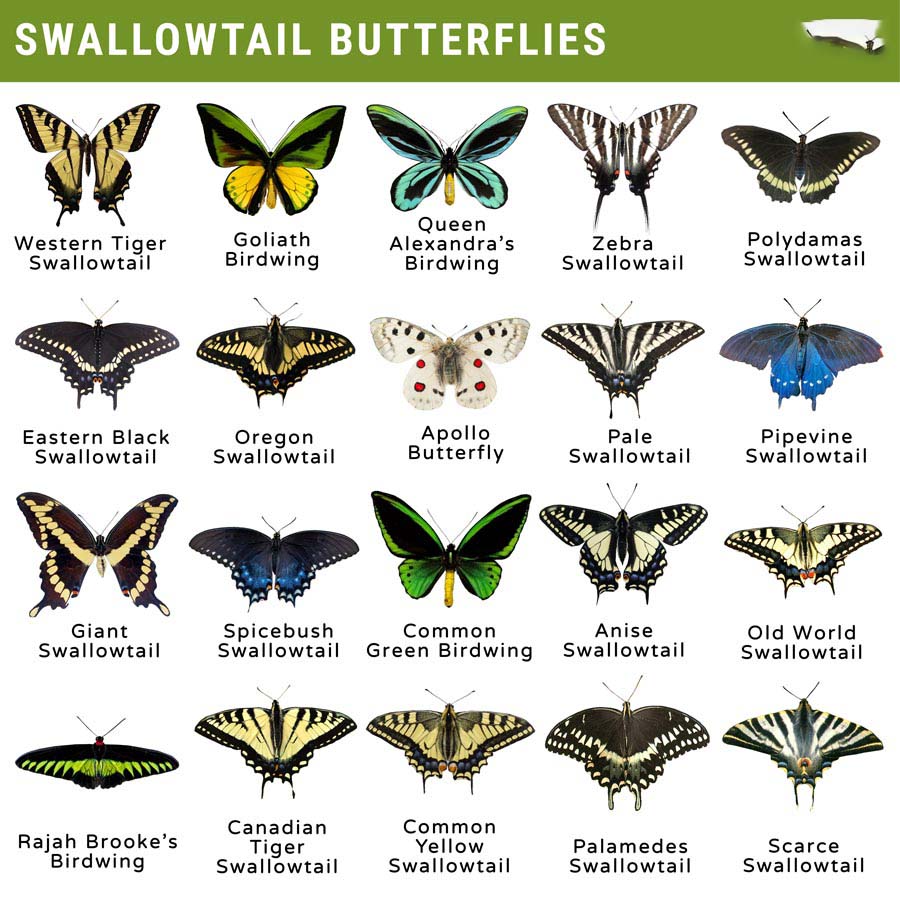
Swallowtail butterfly identification usually starts with one obvious clue: many swallowtails are large butterflies with extended “tails” on their hindwings. But that is only the beginning. Some swallowtails have long, graceful tails. Others have short tails, broken tails, or tails that are hard to see when the butterfly is moving. A few swallowtails may even appear almost tailless at first glance.
The most reliable way to identify a swallowtail is to look at a combination of features: wing shape, body size, color pattern, hindwing markings, flight style, habitat, and nearby host plants. Swallowtails belong to the family Papilionidae, a group that includes some of the most recognizable butterflies in the world, such as tiger swallowtails, black swallowtails, pipevine swallowtails, spicebush swallowtails, zebra swallowtails, and giant swallowtails.
For beginners, swallowtails are a rewarding group to learn because they are usually big enough to observe without special equipment, often visit flowers, and show clear visual patterns once you know what to look for.
Quick Answer: How Do You Identify a Swallowtail Butterfly?
You can often identify a swallowtail butterfly by its large size, broad wings, graceful flight, and hindwing tails. Many species also have bold markings such as yellow-and-black stripes, blue spots, orange eyespots, pale bands, or dark iridescent wings.
However, identification should not rely on the tail alone. Look for these clues together:
- Large butterfly with broad, triangular forewings
- Hindwings often have tail-like extensions
- Strong, gliding or fluttering flight
- Bright or high-contrast wing patterns
- Frequent visits to nectar flowers
- Caterpillars often feed on specific host plants
- Some species have blue, orange, yellow, black, or white markings on the hindwings
If the butterfly is large, elegant, and has noticeable hindwing extensions, it is a strong candidate for a swallowtail. The next step is to narrow it down by color pattern and location.
Swallowtail Butterfly Identification: What to Look For First
When you see a possible swallowtail, do not rush to identify it from one feature. Butterflies move quickly, and light can change how colors appear. Instead, observe several details.
1. Overall Size
Swallowtails are usually medium to large butterflies. Many are noticeably larger than common small garden butterflies, skippers, blues, or hairstreaks. Some, such as giant swallowtails, can look especially impressive in flight.
A large butterfly does not automatically mean “swallowtail,” but size is a useful first clue.
2. Hindwing Tails
The name “swallowtail” comes from the tail-like extensions on the hindwings of many species. These tails may look like narrow points, streamers, or small projections.
But there are two important cautions:
First, tails can be damaged. Butterflies often lose part of a wing edge after encounters with birds, spiders, weather, or rough vegetation. A swallowtail with broken tails may look confusing.
Second, tail length varies by species. Zebra swallowtails have long, slender tails. Black swallowtails have shorter tails. Some swallowtails may not show dramatic tails from every angle.
So, tails are helpful, but they are not the whole identification.
3. Wing Shape
Swallowtails usually have broad, elegant wings. The forewings are often triangular, while the hindwings are rounded or scalloped with tail projections.
When the butterfly is resting with wings open, the shape can be easier to see. When it is feeding on flowers, it may continue moving its wings, giving you brief but useful views of the upper side and underside.
4. Color and Pattern
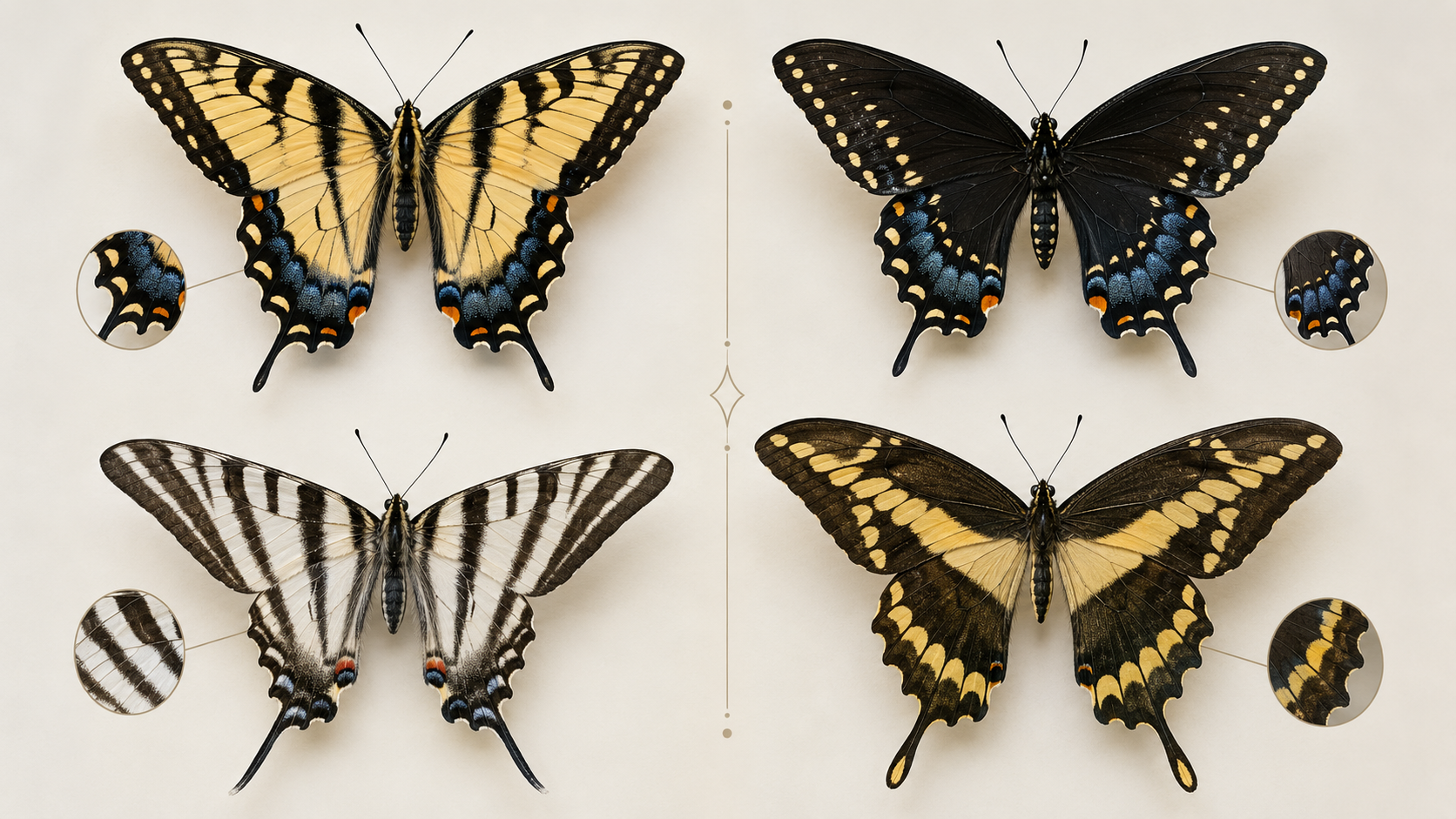
Swallowtails are often identified by bold patterning. Common patterns include:
- Yellow wings with black tiger-like stripes
- Mostly black wings with blue and orange markings
- Black wings with pale yellow or white spots
- Pale greenish-white wings with zebra-like black stripes
- Large dark butterflies with iridescent blue or green tones
Color alone can be misleading because females and males may differ, worn butterflies may look faded, and lighting can change the apparent color. Still, pattern is one of the most useful clues.
5. Flight Style
Many swallowtails have a strong, graceful flight. They may glide, swoop, or move steadily over gardens, woodland edges, fields, and roadsides. Some species fly high around trees; others come low to nectar flowers or damp soil.
A swallowtail often looks more powerful in flight than smaller butterflies.
Common Types of Swallowtail Butterflies Beginners May See
Swallowtail species vary by region, so the examples below are especially useful for readers in North America. If you live elsewhere, the same identification approach still applies: check wing shape, color, markings, host plants, habitat, and range.
Eastern Tiger Swallowtail
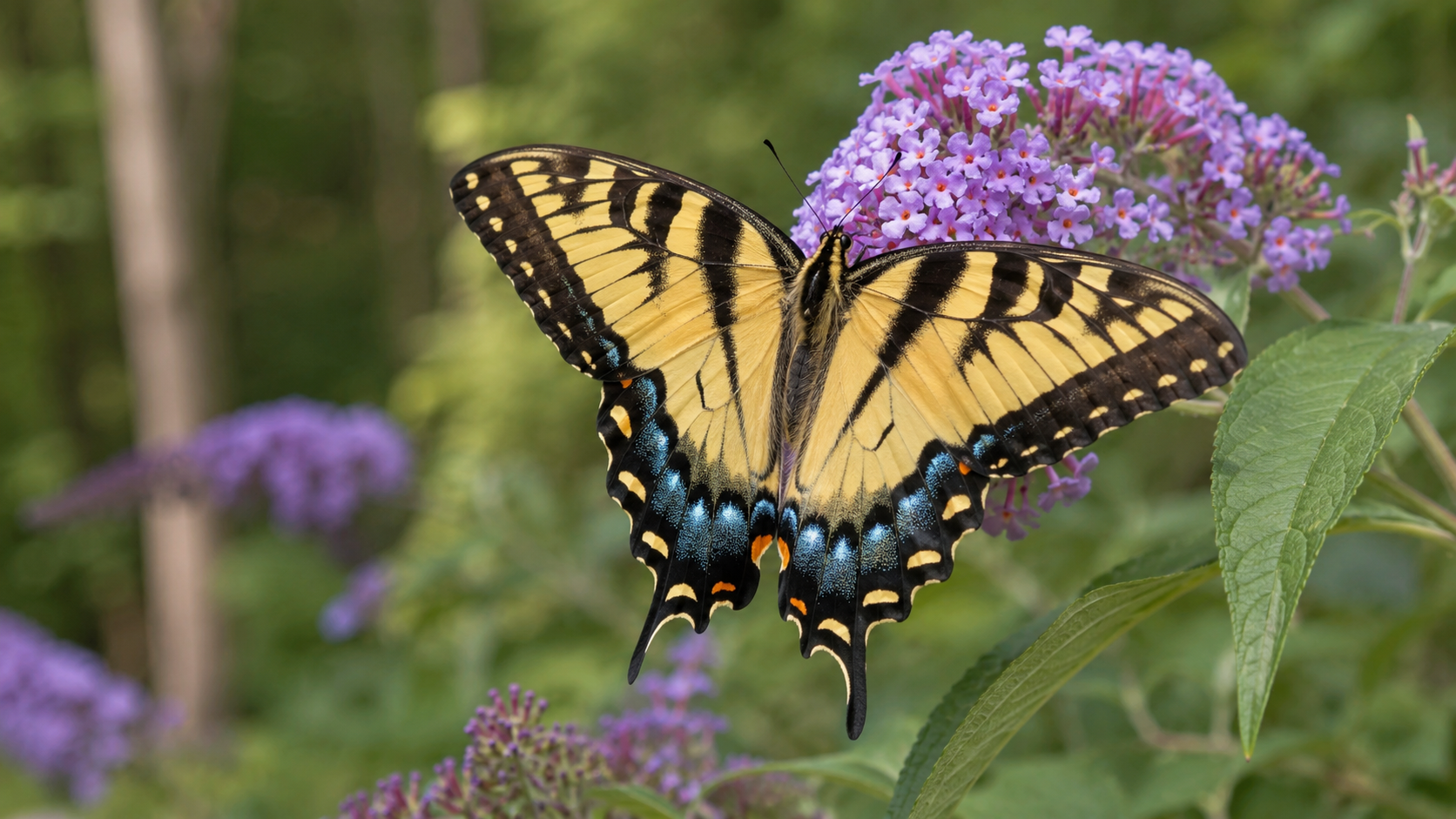
The Eastern Tiger Swallowtail is one of the most familiar swallowtails in eastern North America. Many individuals are bright yellow with black tiger-like stripes. They often have blue and orange markings near the hindwing edges.
Females can appear in two forms in some areas: a yellow form and a darker form. The dark female form can be confusing because it may resemble other dark swallowtails.
Useful identification clues:
- Large size
- Yellow wings with black stripes in many individuals
- Long tails on the hindwings
- Blue markings near the lower hindwings
- Often seen around woodland edges, gardens, parks, and roadsides
Common host plants include several trees, such as tulip tree, wild cherry, ash, and magnolia, though host use can vary by region.
Black Swallowtail
The Black Swallowtail is often seen in gardens, especially where plants in the carrot family are growing. It is mostly black, with rows of yellow spots and blue markings on the hindwings. Females often show more blue on the hindwings than males.
Useful identification clues:
- Mostly black wings
- Yellow spot rows along the wing edges
- Blue shading on the hindwings, especially in females
- Small orange eyespot near the lower hindwing
- Often found in gardens, open fields, meadows, and disturbed areas
Its caterpillars commonly feed on plants in the parsley/carrot family, including parsley, dill, fennel, carrot, and Queen Anne’s lace.
Pipevine Swallowtail
The Pipevine Swallowtail is a dark swallowtail known for its beautiful blue or blue-green iridescence, especially on the hindwings. It is associated with pipevine plants, which serve as host plants for the caterpillars.
Useful identification clues:
- Dark upper wings
- Shimmering blue or blue-green hindwings
- Row of pale spots on the underside
- Often seen near woodlands, gardens, streamsides, and areas with pipevine
- Can be mimicked by other dark butterflies
Pipevine swallowtails are important in butterfly identification because several other species resemble them. Their chemical protection from pipevine host plants makes them a model for mimicry in some regions.
Spicebush Swallowtail
The Spicebush Swallowtail is another dark swallowtail that can be confused with pipevine and black swallowtails. It often shows blue or greenish-blue scaling on the hindwings, with pale spots along the wing edges.
Useful identification clues:
- Mostly black wings
- Bluish or greenish hindwing wash
- Pale spots near wing margins
- Usually associated with woodland edges and moist habitats
- Caterpillars feed on spicebush, sassafras, and related plants
The caterpillars are especially well known for their eyespot-like markings, which make them look somewhat snake-like.
Zebra Swallowtail
The Zebra Swallowtail is one of the easiest swallowtails to recognize when fresh and clearly seen. It has pale wings with bold black stripes and long, thin tails. Its host plant is pawpaw.
Useful identification clues:
- Pale greenish-white or white wings
- Strong black zebra-like striping
- Long, narrow tails
- Often seen in areas where pawpaw grows
- More common near woodland edges, streamsides, and moist areas in suitable regions
If you see a pale butterfly with black stripes and very long tails, zebra swallowtail is a strong possibility in the right range.
Giant Swallowtail
The Giant Swallowtail is one of the largest swallowtails in North America. It has dark wings with bold yellow bands, creating a dramatic cross-like pattern when seen from above.
Useful identification clues:
- Very large size
- Dark wings with broad yellow bands
- Yellow markings on both forewings and hindwings
- Strong, high, floating flight
- Caterpillars often use citrus relatives, prickly ash, and other plants in the rue family
Its caterpillar is famous for resembling bird droppings, a camouflage strategy that helps protect it from predators.
Habitat: Where to Look for Swallowtail Butterflies
Swallowtails can be found in many habitats, but the exact habitat depends on the species. Good places to look include:
Gardens and Flower Beds
Many adult swallowtails visit nectar flowers. Butterfly gardens with native flowers, milkweed, coneflowers, phlox, lantana, verbena, zinnias, Joe-Pye weed, and other nectar plants may attract swallowtails, depending on region.
Woodland Edges
Many swallowtails use trees or shrubs as host plants, so woodland edges are excellent observation spots. Tiger swallowtails, spicebush swallowtails, and zebra swallowtails are often associated with wooded habitats.
Meadows and Open Fields
Black swallowtails are commonly seen in open habitats, especially where parsley-family plants grow. Roadsides, meadows, farms, and sunny weedy areas can all be useful places to watch.
Streamsides and Moist Areas
Some swallowtails visit damp ground to take in minerals, a behavior called puddling. This is especially common among males of many butterfly species. If you see several butterflies gathered on wet soil or gravel, they may be taking in moisture and dissolved minerals.
Host Plants, Diet, and Life Cycle
Understanding host plants is one of the best ways to improve swallowtail butterfly identification. Adult butterflies drink nectar from flowers, but caterpillars need specific plants to eat.
Adult Diet: Nectar
Adult swallowtails feed mainly on flower nectar. They may visit a wide variety of flowers, especially those with enough nectar to support large butterflies. They use a long, straw-like mouthpart called a proboscis to sip liquid food.
Caterpillar Diet: Host Plants
Swallowtail caterpillars are more specialized than adult butterflies. Each species uses certain host plants. Examples include:
- Black Swallowtail: parsley, dill, fennel, carrot, Queen Anne’s lace
- Zebra Swallowtail: pawpaw
- Pipevine Swallowtail: pipevine
- Spicebush Swallowtail: spicebush and sassafras
- Giant Swallowtail: citrus relatives, prickly ash, rue-family plants
- Tiger Swallowtails: several trees, depending on species and region
Host plants matter because they help explain why a butterfly appears in a particular place. If you see black swallowtail caterpillars on dill or parsley, that is a strong identification clue.
Life Cycle
Like all butterflies, swallowtails go through complete metamorphosis:
- Egg — laid on or near the correct host plant
- Caterpillar — feeds on leaves and grows through several stages
- Chrysalis — the resting transformation stage
- Adult butterfly — emerges, flies, feeds, mates, and lays eggs
Swallowtail caterpillars also have a special defensive organ called an osmeterium. When disturbed, the caterpillar may extend this forked, fleshy organ from behind its head. It can release an unpleasant smell that helps deter predators. This is normal swallowtail caterpillar behavior, not a sign of danger to people.
Similar Butterflies and Swallowtail Look-Alikes
Swallowtails are distinctive, but beginners may still confuse them with other butterflies.
Swallowtail vs Monarch
Monarchs are orange with black veins and white spots along the wing edges. They do not have swallowtail-like hindwing tails. Swallowtails are usually larger or differently shaped, and many have tail projections.
Dark female tiger swallowtails may occasionally confuse beginners, but monarchs have a very different orange-and-black pattern.
Swallowtail vs Fritillary
Fritillaries are usually orange or brownish-orange with dark spots and silver or pale markings on the underside. They lack the long hindwing tails typical of many swallowtails.
If the butterfly is orange and spotted rather than striped or tailed, it is probably not a swallowtail.
Swallowtail vs Hairstreak
Hairstreaks are small butterflies, and many have tiny tails on the hindwings. This can confuse beginners because they also have “tails.” The easiest difference is size. Hairstreaks are much smaller than swallowtails and usually have more delicate, compact bodies.
If the butterfly is tiny and perches with wings closed, it may be a hairstreak, not a swallowtail.
Swallowtail vs Moth
Some day-flying moths can be colorful and active around flowers, but swallowtails have clubbed antennae, broad wings, and butterfly-like resting behavior. Moths often have feathery or threadlike antennae, though this varies.
A simple beginner clue: butterflies usually have antennae with small clubs at the tips. Swallowtails follow this pattern.
How to Identify a Swallowtail in the Field
Here is a simple observation method for beginners.
Step 1: Notice the Size and Shape
Ask: Is it a large butterfly with broad wings? Are there tails or pointed extensions on the hindwings?
Step 2: Check the Main Color Pattern
Is it yellow with black stripes? Mostly black with blue marks? Pale with zebra stripes? Dark with yellow bands?
This narrows the possibilities quickly.
Step 3: Look at the Hindwings
The hindwings often hold the best clues. Look for:
- Tail length
- Blue patches
- Orange eyespots
- Rows of pale spots
- Yellow bands
- Scalloped edges
Step 4: Observe the Habitat
Where did you see it?
- Garden with parsley or dill? Consider black swallowtail.
- Woodland edge with tall trees? Consider tiger or spicebush swallowtails.
- Pawpaw habitat? Zebra swallowtail may be possible.
- Citrus or prickly ash nearby? Giant swallowtail may be possible in the right region.
Step 5: Consider Your Region
Swallowtail identification depends strongly on location. A species common in one region may be absent in another. Always compare your observation with a local butterfly guide or regional checklist when possible.
Step 6: Take a Photo If You Can
A clear photo of the upper wing and underside is extremely helpful. Even a phone photo can capture the pattern, tail shape, and body position. Try to photograph the butterfly from the side and from above if it stays still long enough.
Practical Tips for Butterfly Watchers and Gardeners
If you want to identify swallowtails more easily, make your garden or observation area more butterfly-friendly.
Planting both nectar plants and host plants is especially useful. Nectar flowers attract adults, while host plants support caterpillars. A garden with only nectar flowers may bring adult butterflies briefly, but a garden with host plants can support the full life cycle.
For example, parsley, dill, and fennel may attract black swallowtails in many regions. Pawpaw supports zebra swallowtails where both occur. Pipevine supports pipevine swallowtails, but gardeners should be careful to use appropriate pipevine species for their region, as not all ornamental pipevines are equally suitable for native butterflies.
Avoid unnecessary pesticide use in butterfly gardens. Caterpillars are part of the butterfly life cycle, and treating every chewed leaf as a problem can prevent butterflies from completing their development.
Common Mistakes in Swallowtail Identification
Mistake 1: Identifying Only by the Tail
Tails are useful, but they can be broken, short, or hidden. Always check color, pattern, and location too.
Mistake 2: Ignoring Female Color Forms
Some swallowtail species have females that look different from males. Dark female tiger swallowtails, for example, can confuse beginners because they do not look like the classic yellow tiger pattern.
Mistake 3: Forgetting About Regional Range
A butterfly may look similar to a species in a field guide, but if that species does not occur in your area, another explanation is more likely.
Mistake 4: Confusing Caterpillar Host Plants with Adult Nectar Plants
Adult swallowtails visit many flowers, but caterpillars need specific host plants. Seeing an adult on a flower does not mean that flower is its caterpillar host plant.
FAQ About Swallowtail Butterfly Identification
Are all swallowtail butterflies easy to identify?
Not always. Some are very distinctive, such as zebra swallowtails or many yellow tiger swallowtails. Others, especially dark swallowtails, can be difficult because several species may look similar. Location, wing markings, and host plants help narrow the identification.
Do all swallowtail butterflies have tails?
Many do, but tail length varies. Some have long tails, some have short tails, and some individuals may lose their tails through wing damage. Do not rely on the tail alone for identification.
What is the easiest swallowtail to recognize?
That depends on the region. In eastern North America, zebra swallowtails are often easy to recognize because of their pale wings, black stripes, and long tails. Eastern tiger swallowtails are also recognizable when they show the classic yellow-and-black tiger pattern.
What plants attract swallowtail butterflies?
Adult swallowtails visit many nectar flowers. Caterpillars require host plants, which vary by species. Black swallowtail caterpillars often use parsley, dill, fennel, and related plants. Zebra swallowtails use pawpaw. Pipevine swallowtails use pipevine. Spicebush swallowtails use spicebush and sassafras.
Are swallowtail caterpillars harmful to people?
Swallowtail caterpillars are not dangerous to people. Some may release an unpleasant smell from a defensive organ called an osmeterium when disturbed, but this is a natural defense against predators.
Why are some swallowtails black while others are yellow?
Color patterns vary by species, sex, and sometimes form. Some swallowtails use dark coloration and mimicry, while others have bright yellow or pale striped patterns. These differences are part of what makes swallowtail identification interesting.
Conclusion
Swallowtail butterfly identification becomes much easier when you look beyond the tail. A good identification uses several clues together: size, wing shape, color pattern, hindwing markings, habitat, host plants, and region.
For beginners, the best approach is simple: observe carefully, take a photo when possible, note the plants nearby, and compare the butterfly with local species. With practice, large yellow tiger swallowtails, dark blue-black swallowtails, zebra-striped swallowtails, and giant swallowtails become much easier to recognize.
Swallowtails are not only beautiful garden visitors. They also teach us how closely butterflies are connected to plants, habitats, seasons, and local ecosystems.