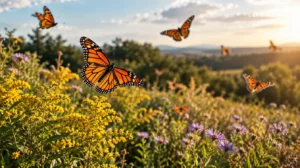
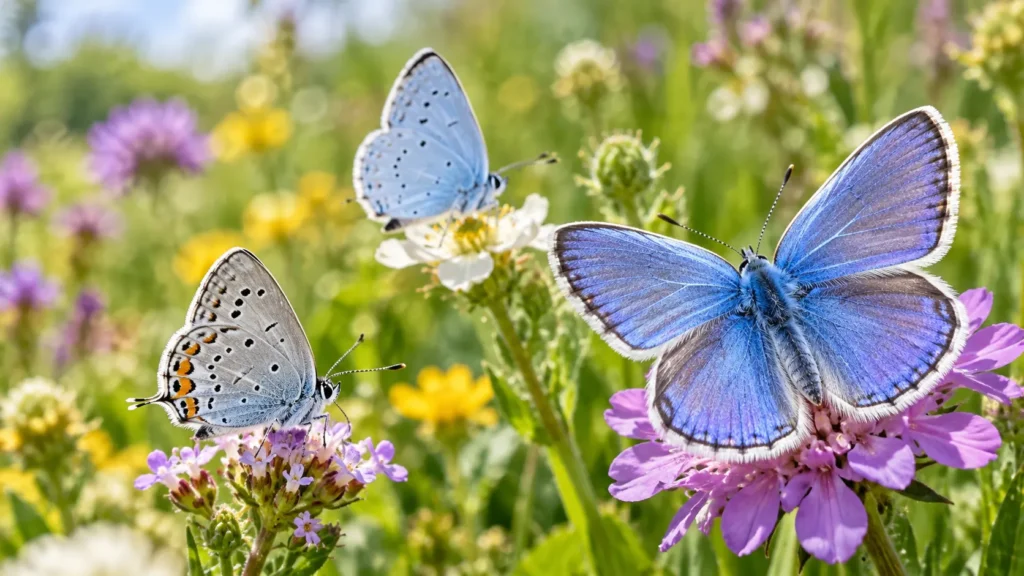
A small flash of blue over a garden path can be surprisingly difficult to identify. One moment the butterfly looks brilliant blue; the next, it settles on a flower and appears almost gray. Some have tiny tails, others carry orange spots beneath their wings, and several look remarkably alike in flight.
The most reliable way to identify a blue butterfly is to examine its wing undersides, size, markings, and location—not just its blue color. A thin hindwing tail may point to an Eastern Tailed-Blue, while pale undersides with small dark spots suggest an azure. In Britain, orange markings beneath the hindwings often help separate a Common Blue from a Holly Blue.
This guide covers 12 types of blue butterflies found in North America, Europe, and tropical regions. It also explains how to recognize small blue butterflies, distinguish similar species, and understand what makes their wings blue.
How to Identify a Blue Butterfly
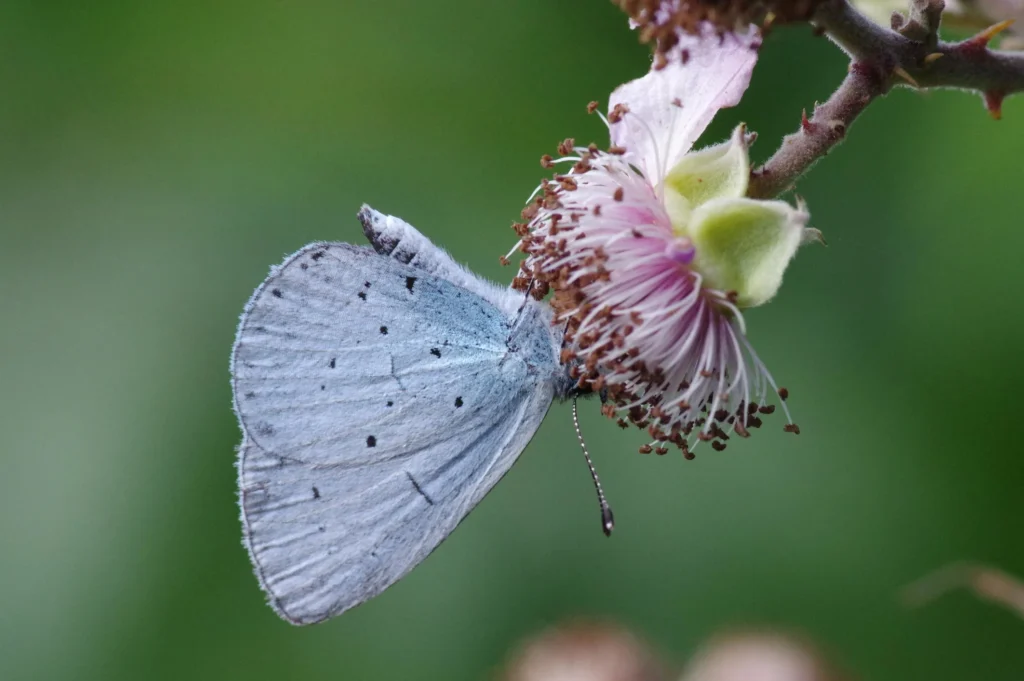
Most of the small blue butterflies found in gardens, meadows, and woodland clearings belong to the family Lycaenidae, particularly the subfamily Polyommatinae.
However, not every butterfly with blue wings belongs to this group. The much larger Blue Morpho, for example, belongs to the brush-footed butterfly family, Nymphalidae.
To identify a butterfly, begin with five simple observations.
1. Look at the Wing Undersides
The underside often provides better identification clues than the bright upper surface.
Some blue butterflies have pale gray undersides covered with tiny black dots. Others show orange crescents, white-ringed spots, or narrow brown bands.
These markings can remain visible even when the butterfly is resting with its wings closed.
2. Check for Small Tails
Some species have a delicate, threadlike extension on each hindwing.
The Eastern Tailed-Blue is a familiar example. Its tiny tails can be difficult to see from a distance, especially when the wings are worn or damaged.
Do not confuse these short extensions with the much longer tails of many swallowtail butterflies.
3. Notice the Size
Many blue butterflies have wingspans of approximately 20–35 mm, although size varies considerably among species.
A butterfly measuring only a little over 20 mm across may belong to one of several small blue species. A butterfly with a wingspan exceeding 100 mm is unlikely to be a typical grassland blue.
4. Record Where You Saw It
Geography can eliminate many possibilities immediately.
A small blue butterfly in an eastern United States lawn is likely to belong to a different group from one flying over chalk grassland in southern England.
Habitat also matters. Some blues favor open fields and roadside vegetation, while others prefer woodland edges, gardens, dunes, or specialized grasslands.
5. Remember That Males and Females Can Look Different
In many blue butterfly species, males have bright blue upperwings, while females are predominantly brown or have broader dark wing borders.
This difference, known as sexual dimorphism, means two butterflies of the same species may look surprisingly different.
A brown butterfly should not automatically be excluded from a group simply because the males are blue.
12 Types of Blue Butterflies
The following species represent several distinctive forms of blue butterflies. Some are widespread, while others have more restricted distributions.
They are grouped here for identification rather than presented as a complete worldwide species list.
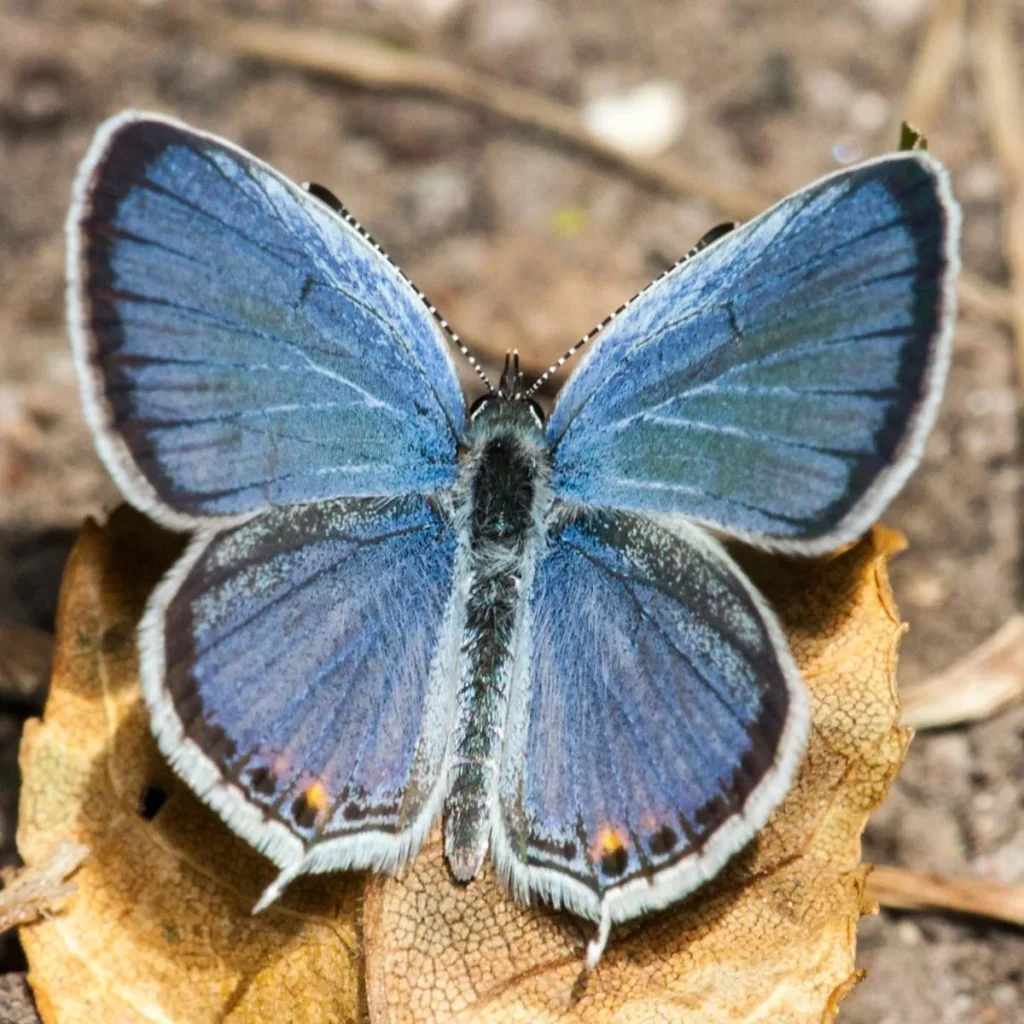
1. Eastern Tailed-Blue (Cupido comyntas)
Where found: Eastern and central North America, with additional populations farther south.
Wingspan: Approximately 22–29 mm.
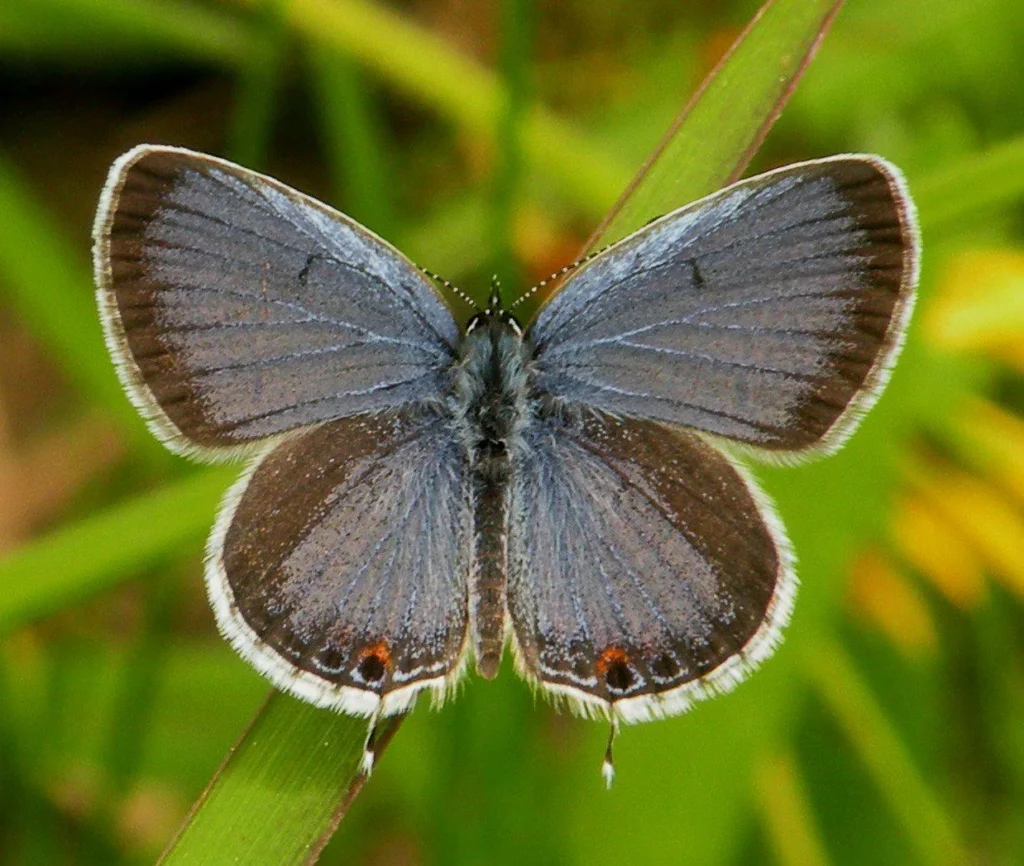
The Eastern Tailed-Blue is a small butterfly frequently seen in sunny fields, lawns, roadsides, and other open habitats.
Males have iridescent blue upperwings, while females are often brown with variable blue scaling. Their most useful identification feature is the narrow tail extending from each hindwing.
The underside is pale gray with dark spots and conspicuous orange markings near the tails.
Look closely at the rear edge of the hindwings. A tiny tail combined with orange spots provides a strong identification clue.
Eastern Tailed-Blues often fly low over vegetation and visit small flowers close to the ground.
Their caterpillars feed on various plants in the pea family, including clovers, vetches, and alfalfa.
Key identification feature: A fine hindwing tail accompanied by orange markings on the underside.
2. Spring Azure (Celastrina ladon)
Where found: Much of eastern North America, within a broader and taxonomically complex group of azures.
Wingspan: Approximately 22–35 mm.
The Spring Azure is one of the small blue butterflies associated with the arrival of spring.
Its upperwings are generally blue, while the undersides are pale gray or whitish with darker spots, dashes, or irregular markings.
Unlike the Eastern Tailed-Blue, it lacks hindwing tails and prominent orange spots.
Spring Azures are associated with woodland edges, flowering shrubs, open woods, and similar habitats.
They may appear early in the season, sometimes before many other butterflies become active.
Identification requires caution, however. North American azures form a complicated species group, and several similar species may overlap in appearance and distribution.
A pale blue butterfly seen in spring is not necessarily Celastrina ladon. Photographs of both wing surfaces, the observation date, and the location are often needed.
Key identification feature: Pale, lightly marked undersides without tails or orange crescents, combined with seasonal and geographic clues.
3. Silvery Blue (Glaucopsyche lygdamus)
Where found: North America, across suitable habitats in different regions.
Wingspan: Approximately 22–32 mm.
The Silvery Blue is named for the reflective, silver-blue appearance of the male’s upperwings.
Females are usually darker, with more prominent dark borders.
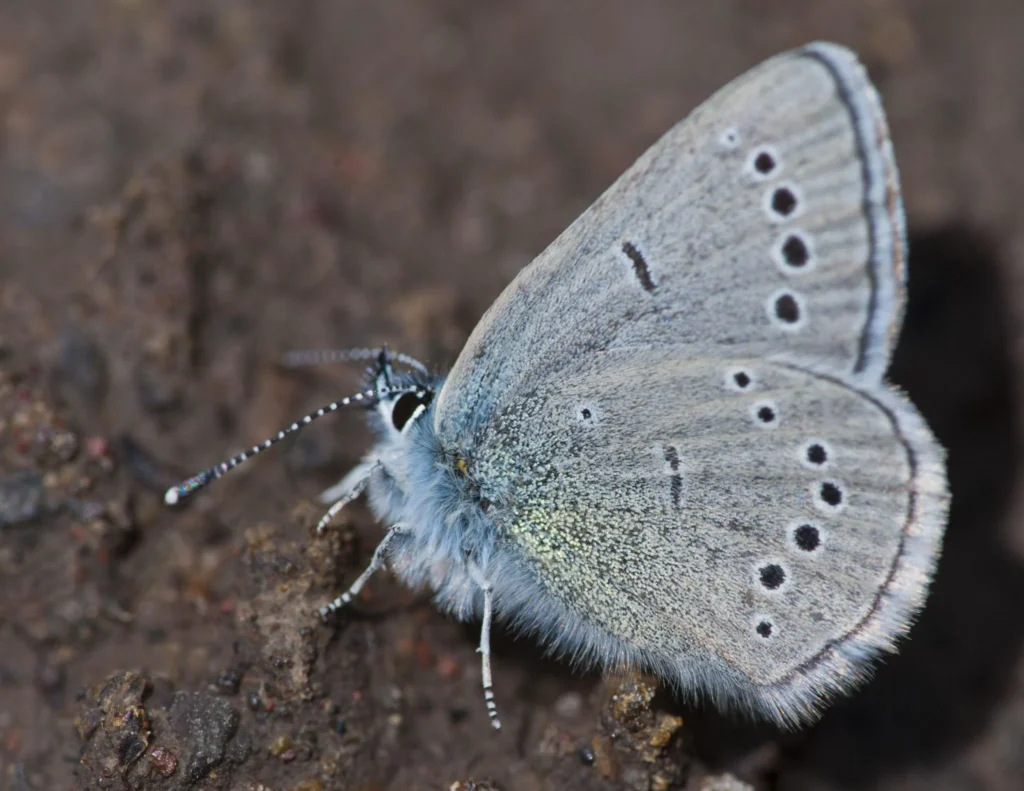
One of its most useful characteristics appears beneath the wings: a series of rounded black spots surrounded by distinct white rings.
The underside has a gray-brown background, making these contrasting markings relatively easy to recognize in a clear photograph.
Silvery Blues inhabit a range of open environments, including meadows, prairies, coastal dunes, woodland openings, and mountain habitats.
Their caterpillars use plants in the pea family, including lupines, milkvetches, and related legumes.
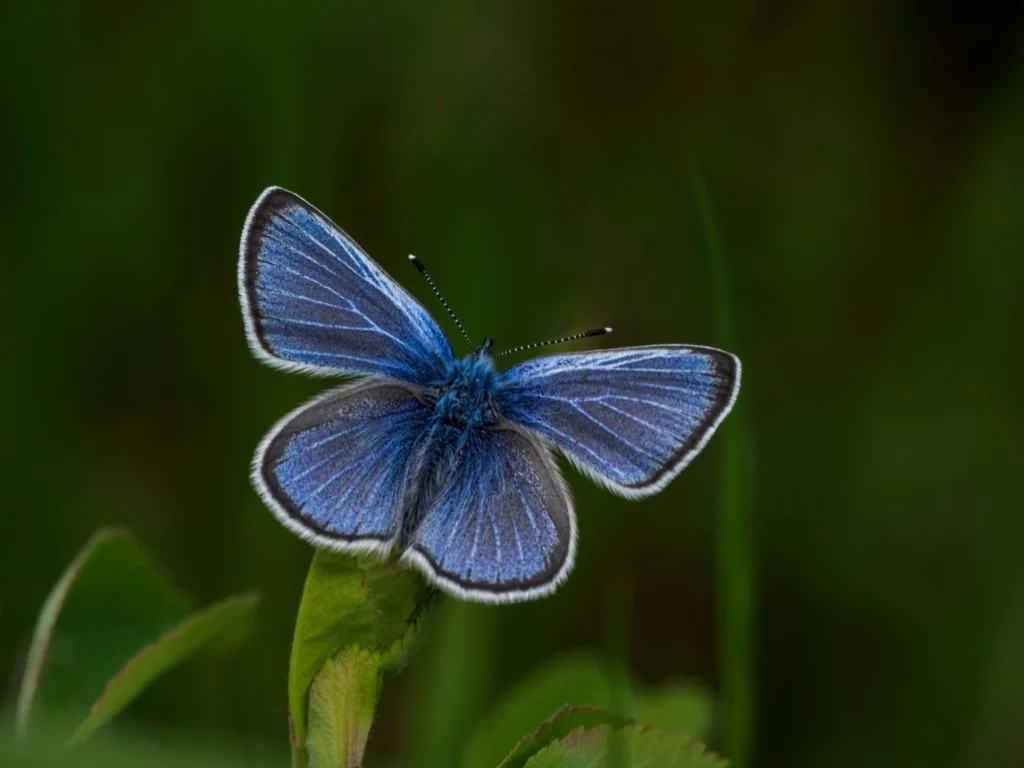
They also have an ecological relationship with ants, which may attend the caterpillars in exchange for sugary secretions.
Key identification feature: Rows of clearly white-ringed black spots on the underside.
4. Marine Blue (Leptotes marina)
Where found: Southwestern United States, Mexico, and parts of Central America, with occasional wandering individuals farther north.
Wingspan: Approximately 22–29 mm.
Marine Blues are small butterflies that often have lavender-blue or purplish upperwings.
Their most distinctive field marks appear underneath.
Rather than having only scattered spots, the wings show a series of narrow, wavy brown bands against a lighter background.
These markings can give the underside a striped appearance.
Marine Blues inhabit open, warm environments such as desert scrub, gardens, disturbed land, and agricultural areas.
Their caterpillars feed on flowers and seedpods of several plants, including legumes and leadwort.
A butterfly showing several thin brown bands beneath the wings deserves a closer look, particularly in the American Southwest.
Key identification feature: Pale undersides crossed by numerous narrow brown bands.
5. Reakirt’s Blue (Echinargus isola)
Where found: Southern United States, Mexico, Central America, and regions farther south; individuals may wander northward.
Wingspan: Approximately 20–29 mm.
Reakirt’s Blue is another small butterfly whose pale blue upperwings can make identification difficult.
Males are generally light blue with darker veins and wing margins. Females tend to be darker.
The underside provides the most useful detail.
A row of five prominent, round, white-ringed black spots appears on the underside of the forewing.
These markings are often particularly noticeable when the butterfly rests with its wings closed.
Reakirt’s Blues inhabit open landscapes, including grasslands, pastures, roadsides, and other places where suitable host plants grow.
Their caterpillars feed on plants in the pea family, and interactions with ants have also been documented.
Key identification feature: A conspicuous row of five round, white-ringed black spots beneath the forewing.
6. Ceraunus Blue (Hemiargus ceraunus)
Where found: Southern United States, the Caribbean, Mexico, Central America, and parts of South America.
Wingspan: Approximately 20–30 mm.
The Ceraunus Blue is often found in warm, sunny, open habitats.
Males have light blue upperwings with narrow dark borders. Females are usually brown, sometimes with blue near the wing bases.
The undersides are gray and marked with rows of darker dashes.
One particularly useful feature is the presence of small eyespots near the outer edge of the hindwings.
The pattern varies geographically. Butterflies in Florida typically show one prominent submarginal hindwing eyespot, while individuals in the American Southwest commonly show two.
The species occurs in places such as open woodland, pastures, dunes, roadsides, and disturbed ground.
Its caterpillars feed on several leguminous plants.
Key identification feature: Gray undersides with rows of dark dashes and one or two hindwing eyespots, depending on the population.
7. Common Blue (Polyommatus icarus)
Where found: Widespread across Europe and parts of Asia.
Wingspan: Commonly around 29–36 mm.
The Common Blue is among the most familiar blue butterflies in Britain and Ireland.
Males usually have bright violet-blue upperwings edged with a narrow dark border and white fringe.
Females vary considerably. Some are mostly brown, while others have substantial blue scaling. Orange spots often appear along the outer wing margins.
The underside has a comparatively complex pattern of dark spots, white rings, and orange markings.
This combination is useful for distinguishing the Common Blue from the Holly Blue, which has a simpler underside pattern.
Common Blues usually fly close to the ground in sunny grassland, flower-rich meadows, dunes, and other open habitats.
Their caterpillars feed primarily on plants in the pea family, particularly bird’s-foot-trefoil in Britain.
For a closer look at its appearance, habitat, and life cycle, see our Common Blue Butterfly identification guide.
Key identification feature: Bright blue males, white wing fringes, and orange markings on the hindwing undersides.
8. Holly Blue (Celastrina argiolus)
Where found: Europe and much of temperate Asia, with the name applied to a broadly distributed species complex in some classifications.
Wingspan: Commonly around 35 mm in British populations.
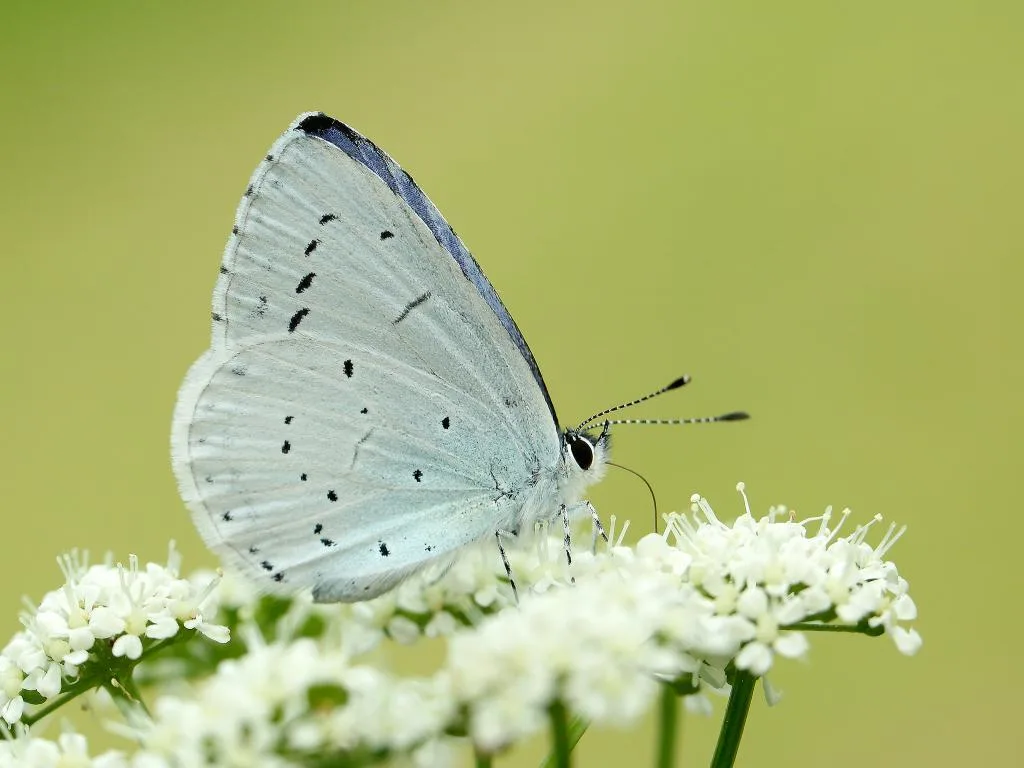
The Holly Blue is frequently seen in gardens, parks, woodland edges, and hedgerows.
Its pale, powdery-blue upperwings can resemble those of other small blue butterflies.
Females typically have pronounced dark borders along the forewings.
The underside is much simpler than that of the Common Blue. It is pale blue-gray or whitish, with small dark spots and no prominent orange marginal markings.
Behavior also provides a useful clue.
Holly Blues often fly around shrubs and trees, sometimes noticeably higher than Common Blues, which tend to stay closer to grassland vegetation.
In Britain, their caterpillars commonly use holly during the spring generation and ivy during the later generation.
Key identification feature: Pale undersides with small black spots but no orange markings, often combined with flight around shrubs and trees.
9. Adonis Blue (Polyommatus bellargus)
Where found: Parts of Europe; in Britain, mainly suitable chalk and limestone grasslands in southern England.
Wingspan: Approximately 38 mm.
Male Adonis Blues have some of the most intensely blue upperwings among British butterflies.
Their color is often described as brilliant sky blue, making them especially striking in direct sunlight.
Females are mainly chocolate brown and much less conspicuous.
One important identification feature is the dark wing veins extending into the white fringes, giving the wing margins a slightly checkered appearance.
This helps distinguish the Adonis Blue from the Common Blue, whose dark veins do not extend through the white fringe in the same way.
Adonis Blues are closely associated with short, warm, species-rich chalk grassland.
Their caterpillars depend on horseshoe vetch, and ants play an important role in their life cycle.
The species is particularly sensitive to changes in habitat management.
Read more in our Adonis Blue butterfly guide.
Key identification feature: Brilliant blue males with dark markings extending into the white wing fringes.
10. Chalk Hill Blue (Polyommatus coridon, also classified as Lysandra coridon)
Where found: Parts of Europe, including chalk and limestone grasslands in southern England.
Wingspan: Commonly around 38 mm.
The Chalk Hill Blue is generally paler than the Adonis Blue.
Males have a milky, silvery-blue appearance rather than a strong sky-blue coloration.
Females are predominantly brown, often with orange spots near the wing margins.
The species is associated with warm, open, calcareous grassland where suitable larval foodplants are available.
In Britain, horseshoe vetch is its principal caterpillar foodplant.
Chalk Hill Blues may gather in large numbers at suitable sites during their main flight season.
Color alone is not enough for a confident identification, particularly when comparing worn males or females of related species.
The pale upperwings, checkered fringes, underside markings, and specialized chalk grassland habitat should be considered together.
Key identification feature: Pale, milky blue upperwings in males, usually in suitable chalk or limestone grassland.
11. Silver-studded Blue (Plebejus argus)
Where found: Europe and parts of Asia, with localized populations in Britain.
Wingspan: Usually around 29–31 mm in British populations.
The Silver-studded Blue is named after the small reflective markings found on the underside of its hindwings.
Males have blue upperwings with relatively broad dark borders. Females are generally brown, often with orange markings near the wing margins.
The underside contains dark spots, orange markings, and small metallic blue or silvery scales near the outer edge of the hindwings.
These reflective scales can be an excellent identification clue when visible.
In Britain, Silver-studded Blues are associated with specialized habitats, particularly heathland, dunes, and some chalk or limestone grasslands.
They often remain close to their breeding habitats rather than wandering widely.
Their life cycle is closely connected with ants, which attend the caterpillars and pupae.
Learn more in our Silver-studded Blue butterfly guide.
Key identification feature: Small metallic blue or silvery spots along the underside of the hindwings.
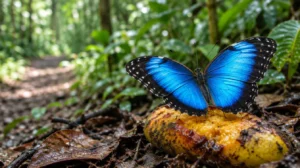
12. Blue Morpho (Morpho species)
Where found: Tropical forests of Central and South America, depending on the species.
Size: Much larger than most of the small blue butterflies described above.
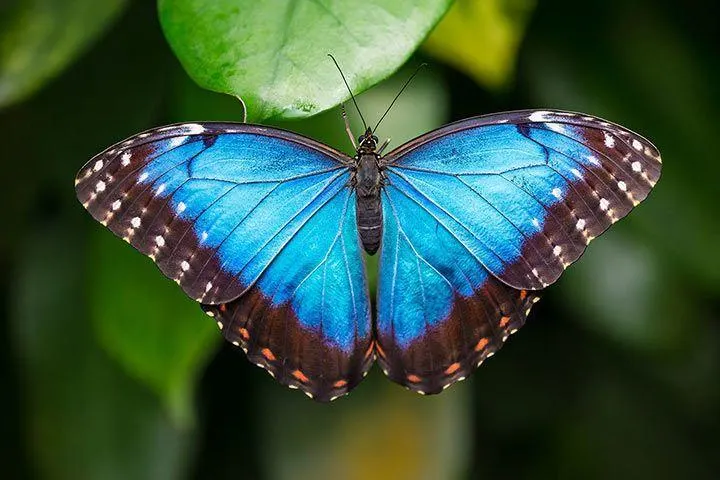
Blue Morphos are among the most recognizable blue butterflies in the world.
Unlike Common Blues or Eastern Tailed-Blues, they belong to the family Nymphalidae rather than Lycaenidae.
Several species are commonly called blue morphos, including Morpho peleides and Morpho menelaus.
The males of many species have broad wings covered with intensely reflective blue scales.
When their wings are open, the blue can appear almost metallic. When the wings close, the brown underside becomes visible, often with large eyespots.
That dramatic difference can make the butterfly seem to change color as it flies.
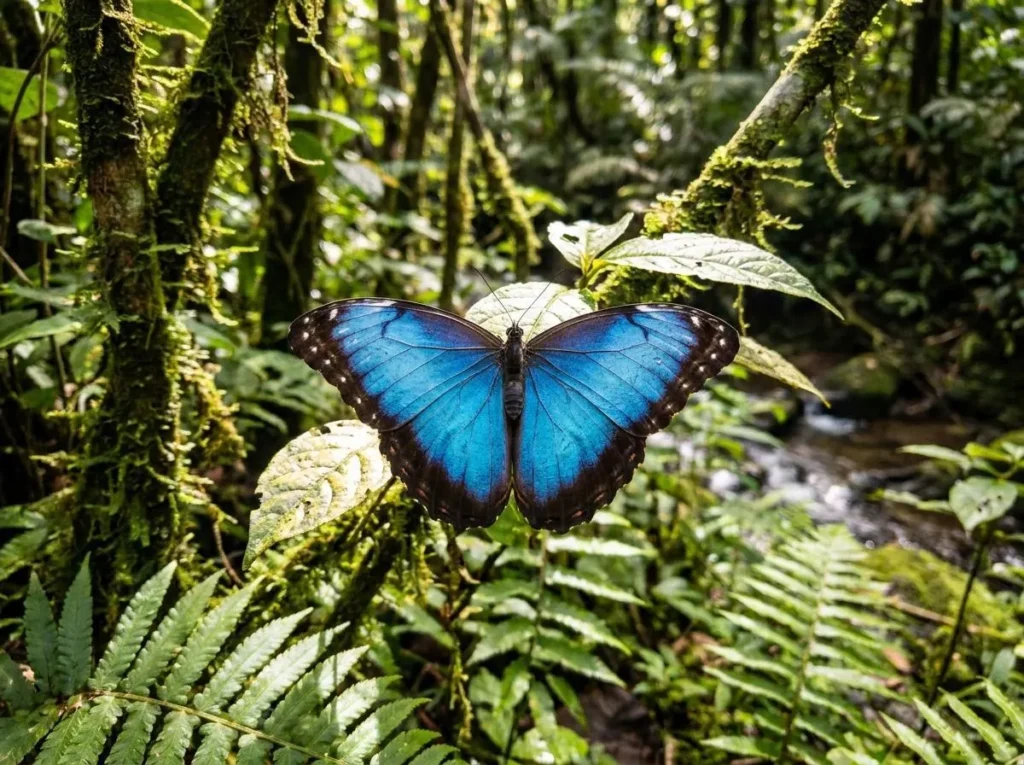
Blue Morphos inhabit tropical forest environments and are frequently seen along forest paths, openings, and rivers.
Their blue color is produced largely by microscopic wing structures that interact with light.
Key identification feature: Very large wings with brilliant iridescent blue upper surfaces and brown, eyespotted undersides.
Blue Butterfly Identification Chart
This comparison summarizes the most useful distinguishing features.
| Butterfly | Main Identification Clue | Typical Region |
|---|---|---|
| Eastern Tailed-Blue | Tiny tails and orange hindwing spots | Eastern North America |
| Spring Azure | Pale underside with small dark markings | North America |
| Silvery Blue | White-ringed black spots | North America |
| Marine Blue | Narrow brown bands underneath | Southwestern North America |
| Reakirt’s Blue | Five prominent forewing underside spots | Southern North America |
| Ceraunus Blue | Dark dashes and hindwing eyespots | Southern North America |
| Common Blue | Orange spots on hindwing undersides | Europe and Asia |
| Holly Blue | Pale underside with small dark spots | Europe and Asia |
| Adonis Blue | Bright sky blue with checkered fringes | Europe |
| Chalk Hill Blue | Milky-blue males in chalk grassland | Europe |
| Silver-studded Blue | Metallic spots beneath hindwings | Europe and Asia |
| Blue Morpho | Large, shimmering blue wings | Tropical Americas |
The chart provides starting points rather than definitive identifications. Similar species, geographic variation, worn wings, and differences between males and females can complicate the picture.
Small Blue Butterfly Identification: What Did You See?
The phrase “small blue butterfly” can describe many different species.
In North America, a tiny blue butterfly flying close to lawn grass or roadside flowers might be an Eastern Tailed-Blue, an azure, or another member of the blue butterfly group.
In Britain, the term can cause an additional misunderstanding.
There is an actual species called the Small Blue (Cupido minimus), but its upperwings are mostly dark brown rather than bright blue.
Male Small Blues may have a scattering of silvery-blue scales, particularly near the wing bases.
This species is Britain’s smallest resident butterfly, with a wingspan generally around 18–27 mm.
It is often associated with sheltered grassland where kidney vetch, its caterpillar foodplant, grows.
The distinction matters because a photograph labeled “small blue butterfly” does not automatically show the species officially named Small Blue.
If you are trying to identify a tiny blue butterfly, first establish whether you are describing its appearance or referring to a particular species.
Common Blue vs. Holly Blue: How to Tell Them Apart
These two butterflies are frequently confused in Britain.
Both can show blue upperwings, both are relatively small, and both may occur in habitats accessible to casual butterfly watchers.
The underside usually provides the clearest separation.
Common Blue:
- Gray or brownish undersides with complex spotting
- Orange markings near the hindwing margins
- Often flies low over grassy vegetation
- Frequently associated with meadows and open grassland
Holly Blue:
- Very pale blue-gray undersides
- Small, relatively simple dark spots
- No prominent orange hindwing markings
- Often flies around gardens, hedgerows, shrubs, and trees
A pale blue butterfly flying around a garden hedge in early spring is a reasonable candidate for Holly Blue.
A butterfly flying low through flower-rich grassland with orange spots beneath its wings is more suggestive of Common Blue.
These are useful clues, but close photographs remain preferable when the identification is uncertain.
Spring Azure vs. Eastern Tailed-Blue
In eastern North America, these butterflies may both appear as small flashes of blue.
The simplest distinction is usually the hindwing.
The Eastern Tailed-Blue has narrow tails and orange markings near the rear of the hindwings.
The Spring Azure lacks those tails and generally has a much plainer underside.
Season can also help, although it should not be treated as proof. Spring Azures are associated with early-season observations, while Eastern Tailed-Blues may remain active through much of the warmer season.
A good photograph of the closed wings is often more useful than a distant image showing only blue color.
Why Are Some Butterflies Blue?
The vivid blue of a butterfly is often produced by structural coloration rather than blue pigment alone.
Butterfly wings are covered with tiny overlapping scales.
In some species, microscopic structures within these scales affect how light is reflected and scattered. Certain wavelengths are reinforced, creating the bright blue appearance visible to our eyes.
This is especially dramatic in Blue Morpho butterflies.
Their reflective wing structures produce an intense, iridescent color that can change in brightness depending on the viewing angle.
This also explains why a butterfly may appear brilliant blue in direct sunlight but much duller when viewed from another direction.
Not every blue butterfly has identical wing structures, and pigments can also contribute to its overall appearance, including dark borders and other markings.
Blue coloration may be involved in visual communication and mate recognition, although its function varies among species.
Where Can You Find Blue Butterflies?
The best location depends on the species and its ecological requirements.
In North America, open fields, meadows, roadsides, gardens, and woodland edges can support various blue butterflies.
Clovers, vetches, lupines, and other leguminous plants are especially important to many species because their caterpillars depend on particular host plants.
In Britain, some blues are associated with flower-rich grassland, while others prefer hedgerows, woodland edges, or specialized heathland and chalk downland.
Holly Blues may visit ordinary gardens where suitable shrubs grow. Adonis Blues, by contrast, require much more specific habitats.
Blue Morphos occupy an entirely different environment: tropical forests.
Finding blue butterflies therefore depends on more than planting nectar-rich flowers. Suitable caterpillar foodplants, sheltered breeding areas, and appropriate habitat management are equally important.
How to Photograph a Blue Butterfly for Identification
A useful identification photograph does not need to be spectacular.
It needs to show the details that separate similar species.
Try to obtain a clear image of the upperwings and another of the underside.
A side view is often particularly valuable because it reveals the spots, bands, and orange markings that may be hidden when the butterfly is flying.
Photograph the whole butterfly when possible, including the tips of the hindwings.
Do not crop away small tails or marginal spots.
Record the location, date, approximate size, and habitat. These details may prove essential when dealing with similar species or complicated groups such as the North American azures.
Avoid handling the butterfly simply to open its wings. Waiting for it to settle naturally is usually a better approach.
If the photographs do not show enough detail, recording the identification as an uncertain species or species group is more accurate than guessing.
Frequently Asked Questions About Blue Butterflies
What is the most common blue butterfly?
There is no single answer worldwide.
In Britain and Ireland, the Common Blue (Polyommatus icarus) is the most widespread blue butterfly.
In eastern North America, Eastern Tailed-Blues and various azures are familiar sightings in many suitable habitats.
The most common species in a particular area depends on geography, habitat, and season.
What is a tiny blue butterfly in my yard?
In North America, possibilities include Eastern Tailed-Blues, azures, and several other small blue species.
Look for tiny tails, orange spots, or pale undersides with dark markings.
The location and season will help narrow the possibilities.
Are blue butterflies rare?
Some are common and widespread, while others are scarce or highly localized.
Species with specialized host plants and habitat requirements may be more vulnerable to environmental changes.
A butterfly’s blue coloration alone does not indicate whether it is rare.
Are all blue butterflies actually blue?
No.
Females of many species are mostly brown, even when the males are bright blue.
The species known as the Small Blue also has predominantly dark brown upperwings.
The word “blue” in a common name may refer to the male coloration, a small patch of reflective scales, or membership in a particular butterfly group.
Do blue butterflies have orange spots?
Some do.
Orange markings are useful identification clues in species such as the Eastern Tailed-Blue and Common Blue.
Other species, including the Holly Blue, lack prominent orange spots on their wing undersides.
Why does a blue butterfly look brown when it closes its wings?
The upper and lower wing surfaces can have very different appearances.
The upperwings may display reflective blue scales, while the undersides carry brown, gray, or cream-colored patterns.
These different surfaces may serve different biological functions, including signaling and camouflage.
Are Blue Morpho butterflies the same as small blue butterflies?
No.
Blue Morphos belong to the family Nymphalidae and are generally much larger.
Most small blue butterflies belong to the family Lycaenidae, particularly the subfamily Polyommatinae.
They share a blue appearance but are not all closely related.
Final Thoughts
A blue butterfly is easy to notice but not always easy to name.
The bright upperwings may draw your attention, yet the most useful clues are often hidden underneath: a tiny tail, a row of white-ringed spots, narrow brown bands, or a few orange markings along the hindwing.
Location and habitat are just as important.
A butterfly flying through an American meadow may belong to an entirely different species from a similar-looking individual resting in an English garden.
Start with what you can actually see, compare several features, and avoid relying on color alone.
With a little practice, those brief flashes of blue begin to reveal much more.
References
The following sources provide species identification details, taxonomy, distributions, and information about butterfly wing coloration.
- Butterfly Conservation. How to Identify Blue Butterflies in the UK. https://butterfly-conservation.org/news-and-blog/how-to-identify-blue-butterflies-in-the-uk
- Butterflies and Moths of North America. Species Accounts and Identification Records. https://www.butterfliesandmoths.org/
- North American Butterfly Association. North American Butterfly Names Checklist. https://naba.org/butterfly-names-checklist/
- Butterfly Conservation. Small Blue. https://butterfly-conservation.org/butterflies/small-blue
- Butterfly Conservation. Adonis Blue. https://butterfly-conservation.org/butterflies/adonis-blue
- Butterfly Conservation. Chalk Hill Blue. https://butterfly-conservation.org/butterflies/chalk-hill-blue
- Natural History Museum, London. Spotlight: The Blue Morpho. https://www.nhm.ac.uk/discover/spotlight-blue-morpho.html
- Smithsonian National Museum of Natural History. Butterfly Adaptations: How They Come By Their Colors. https://naturalhistory.si.edu/education/teaching-resources/life-science/butterfly-adaptations-how-they-come-their-colors
Editorial note: Scientific classifications and common names may vary among regional checklists. Identification should consider local taxonomy and confirmed distribution records.