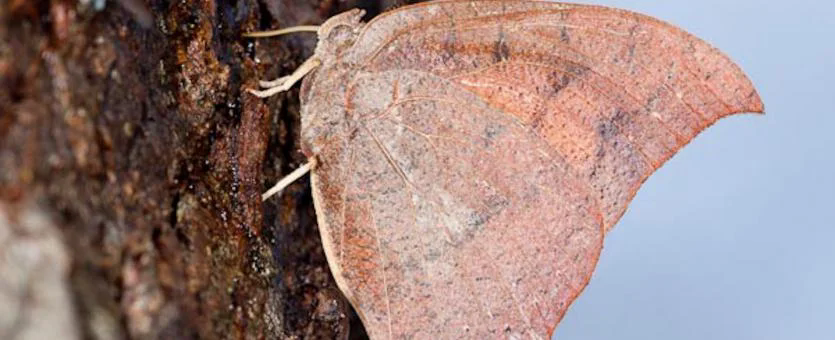
Leafwing Butterfly facts

Identification: Underside looks like a dead leaf. Male summer form is dull red with a barely hooked forewing tip, and a short tail on the hindwing. Male winter form is redder with more dark markings, a definitely hooked forewing tip, and a longer tail than the summer form. Both female forms are lighter red and have an irregular yellow submarginal band. The winter female form has hooked forewing tips. Wing Span: 2 3/8 – 3 1/4 inches (6 – 8.2 cm). Life History: Flight is swift, strong, and erratic. Males perch in clearings or on ridgetops to wait for females. Eggs are laid … Read more

Tags:

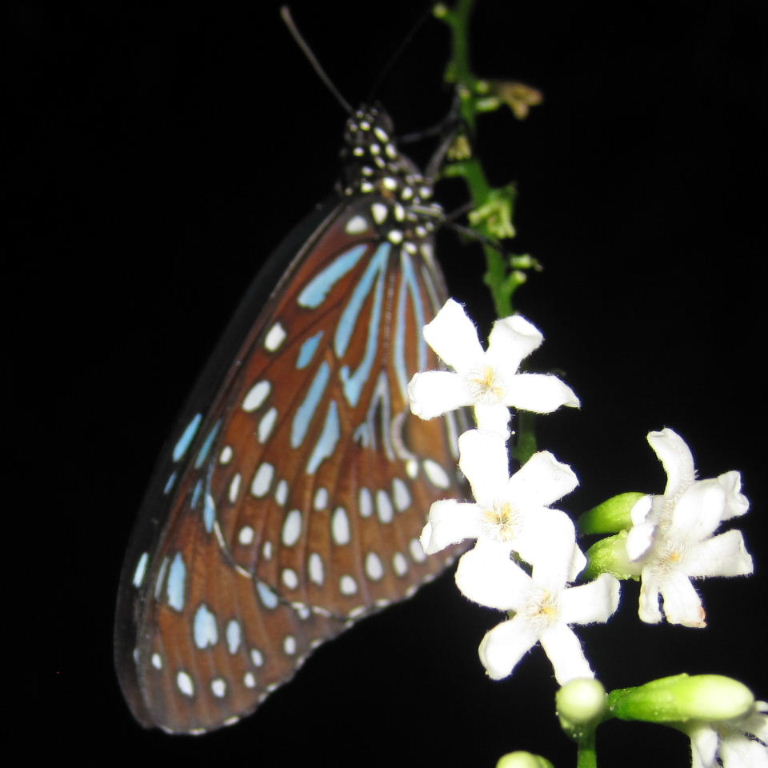
Dark Blue Tiger Butterfly | Tirumala septentrionis

  The Dark Blue Tiger Butterfly is native to South and Southeast Asia. Both the Blue Tiger and the Dark Blue Tiger are common over their overlapping ranges.   The Dark Blue Tiger (above left) is not only noticeably darker (more brown) than the Blue Tiger (above centre) but certain key features of its pattern differ (ringed). Both are males with a “pocket.” The butterfly above far right is a female (no pocket flap, more blue) and appears to have features halfway between the two — so probably a Scarce Blue Tiger from India.   The Dark Blue Tiger (Tirumala septentrionis) is a … Read more

Tags:

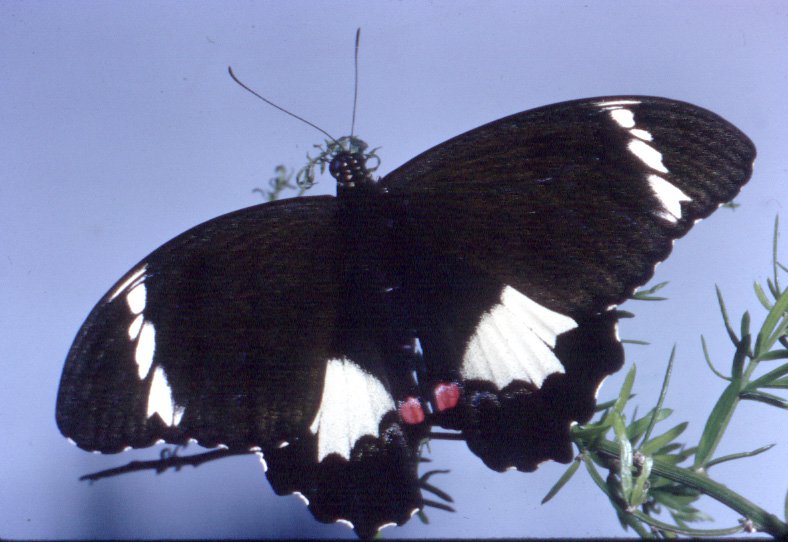
Orchard Swallowtail butterfly

  Both male and female have black forewings with a white stripe, though there is more white overall on the female forewing. The hindwing is again black, and there is a white swath through the middle. Here the markings differ in that the female has chains of red to orange and blue crescents toward the edge. The markings on the underside are similar to those on top. The body is black.The wingspan is about 140 millimetres (5.5 in) in females and 120 millimetres (4.7 in) in males, making it rather large overall and the largest butterfly commonly seen in at least … Read more

Tags:

Tailed Jay Butterfly | Graphium agamemnon

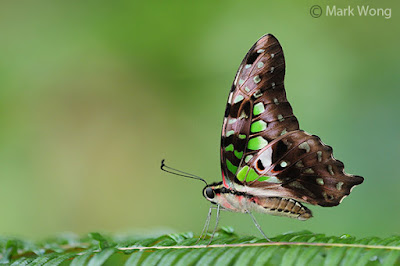
  Graphium agamemnon, the tailed jay,is a predominantly green and black tropical butterfly that belongs to the swallowtail family. The butterfly is also called the green-spotted triangle,tailed green jay, or green triangle. It is a common, non-threatened species native to Nepal, India, Sri Lanka through Southeast Asia and Australia. Several geographic races are recognized. The species was first described by Carl Linnaeus in his 1758 10th edition of Systema Naturae.   Range   Southern India to Saurashtra, northern India (Kumaon to Assam), Nepal, Sri Lanka, Andamans, Nicobars, Bangladesh, Brunei, Myanmar, Thailand, Laos, Cambodia, Indonesia, Vietnam, Singapore, southern China (including Hainan), Taiwan, Japan (Ryukyu … Read more

Tags:

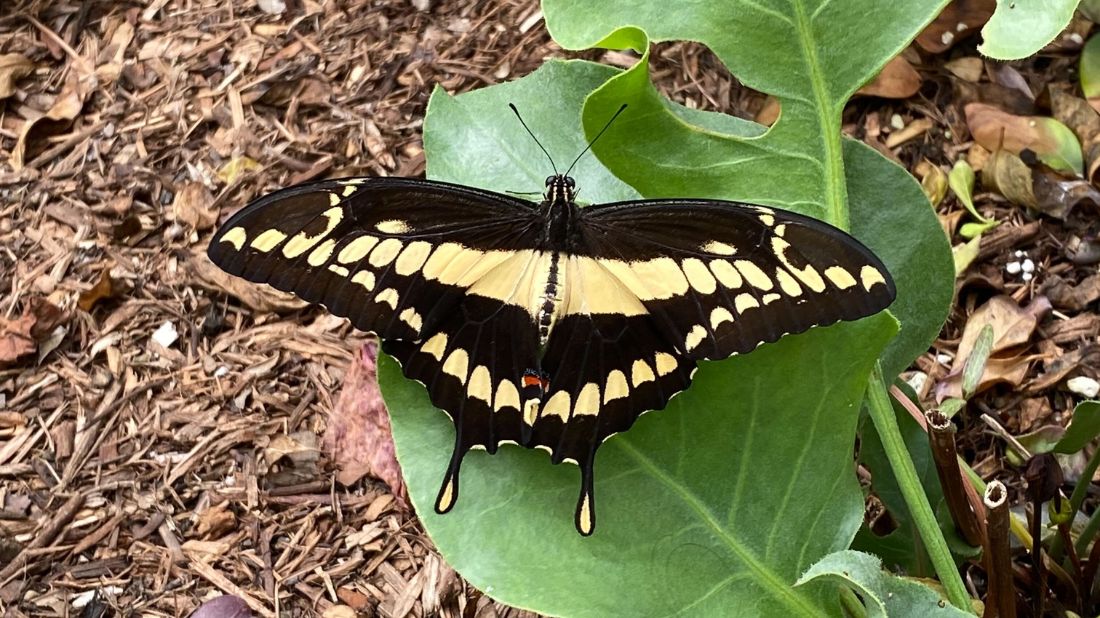
Orange Swallowtail butterfly | Papilio cresphontes

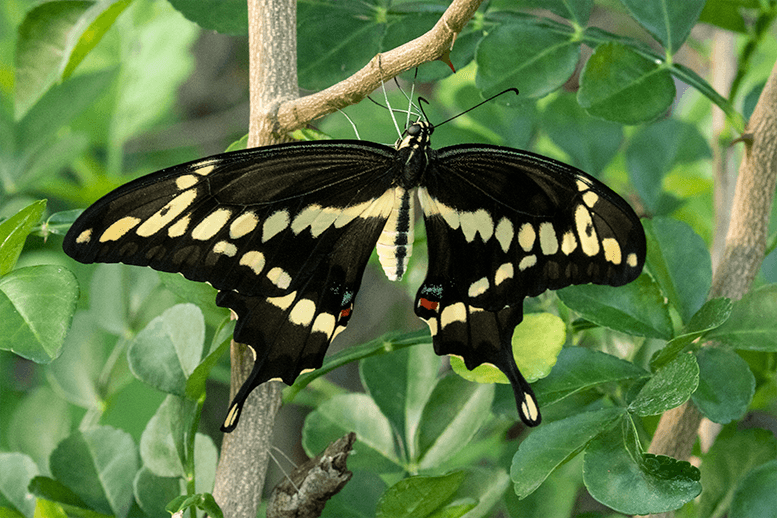
The giant swallowtail, Papilio cresphontes Cramer, is a striking, wonderfully exotic-looking butterfly that is very abundant in Florida. The adult butterfly is a welcome visitor to butterfly gardens and to general landscape plantings. The larval or caterpillar stage can be considered a pest due to its habit of feeding on the foliage of most Citrus species. A few orangedogs, as the larvae are commonly called, can quickly defoliate small or young plants. However, larvae can be tolerated on large dooryard citrus trees in order to enjoy the soon-to-develop magnificent adult butterfly stage. Distribution The giant swallowtail is widely distributed throughout … Read more

Tags:

Lime Swallowtail Butterfly | Papilio demoleus

Papilio demoleus sthenelus is found only in Australia and, along with the subspecies in Papua New Guinea, utilizes different host plants than the Asian and African subspecies. The population in the Dominican Republic has been traced to a southeastern Asian subspecies (Eastwood et al. 2006). This species is also morphologically similar to Papilio demodocus Esper from Africa and Madagascar. DISTRIBUTION This species is found throughout tropical and subtropical regions of southern Asia, ranging from Saudi Arabia, Iran and the Middle East to India, Nepal, southern China, Taiwan, and Japan. It is also found in Malaysia, Indonesia, New Guinea, and Australia. In recent years, Papilio … Read more

Tags:

Malachite butterfly FACTS | Siproeta stelenes

The malachite has large wings that are black and brilliant green or yellow-green on the upper-side and light brown and olive green on the underside. It is named for the mineral malachite, which is similar in color to the bright green on the butterfly’s wings. Adults feed on flower nectar, rotting fruit, dead animals, and bat dung. Females lay eggs on the new leaves of plants in the Acanthaceae family, especially ruellia. The larvae are horned, spiny, black caterpillars with red markings. Malachites often are confused with Philaethria dido. They have similar coloration, but their wing shapes are different. Named … Read more

Tags:

Zebra Longwing Butterfly | Heliconius charithonia

Not only do they love the flowers, but it seems the flowers make them fall in love. Well, no, not love. But they sure do start mating a lot on and around the plants. It must bloom at some peak of their multigenerational northward migration. Like they did in September of last year, they mated, and mated some more, and the resulting caterpillars ate our milkweed plants down to their stems. I feel like I’ve seen more death in my yard this year than in other years, but that’s because there’s so much more life in my yard than in … Read more

Tags: