Texas is excellent butterfly country, but the species you see can change dramatically between the Piney Woods, Hill Country, High Plains, Gulf Coast, South Texas brush country, and Lower Rio Grande Valley. Among the butterflies most commonly reported in the state are Monarchs, Gulf Fritillaries, Gray Hairstreaks, Pipevine Swallowtails, Queens, Fiery Skippers, Common Buckeyes, Black Swallowtails, Red Admirals, Giant Swallowtails, Orange Sulphurs, Painted Ladies, and American Snouts.
That does not mean all 13 are equally common everywhere in Texas. Texas sits where eastern, western, temperate, and subtropical habitats meet, so location and season are often almost as useful for identification as wing color.
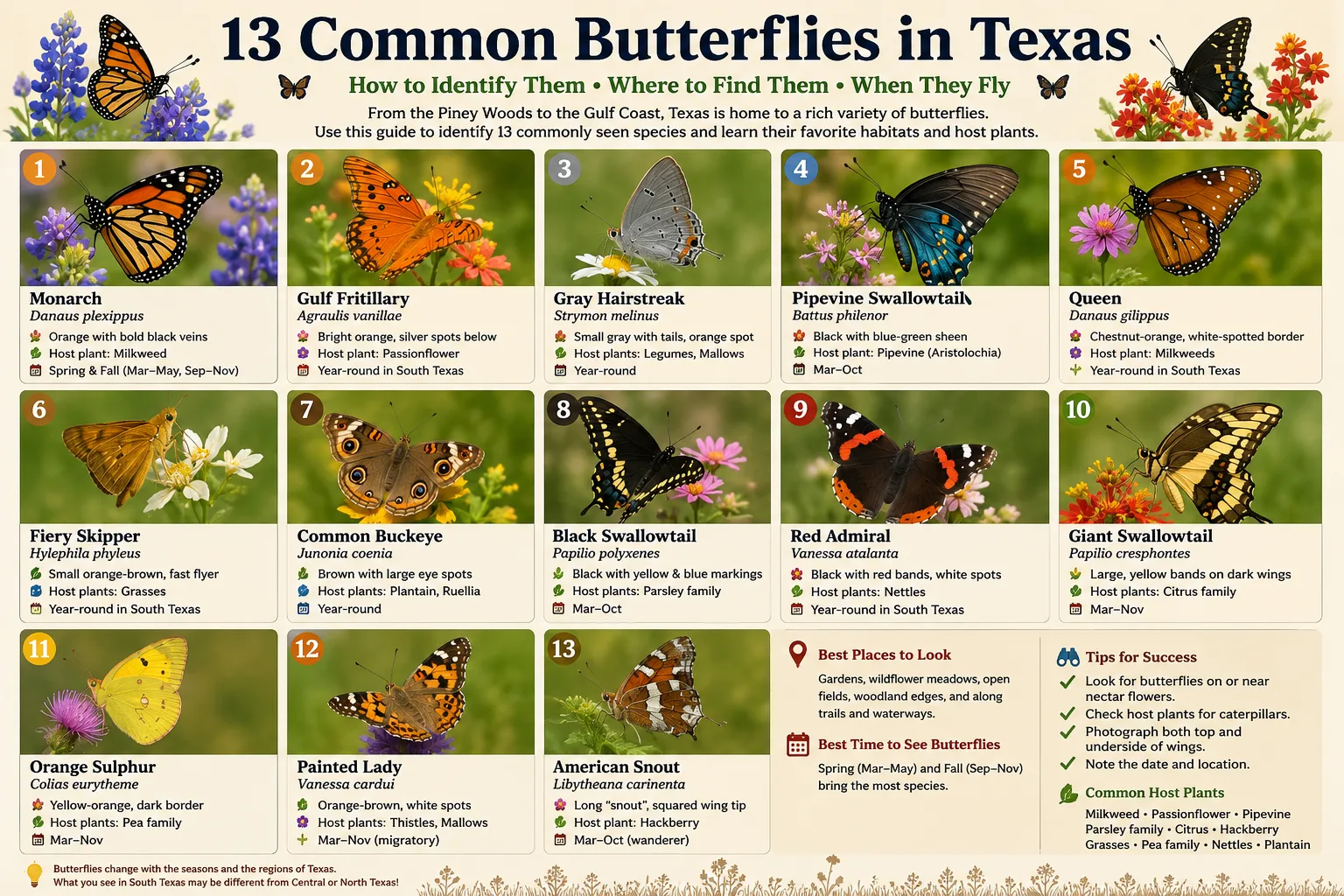
Common Butterflies in Texas at a Glance
| Butterfly | Scientific name | Quick identification clue | Good place to look |
|---|---|---|---|
| Monarch | Danaus plexippus | Orange wings, bold black veins, white-spotted borders | Flower-rich open areas, especially during migration |
| Gulf Fritillary | Agraulis vanillae | Bright orange above; brilliant silver spots below | Gardens and open areas with passionflower |
| Gray Hairstreak | Strymon melinus | Tiny gray butterfly with one tail and orange-red spot | Weedy fields, gardens, low flowers |
| Pipevine Swallowtail | Battus philenor | Dark wings with blue-green hindwing sheen | Woodland edges and flower gardens |
| Queen | Danaus gilippus | Chestnut-orange wings with white-spotted black borders | Sunny open country, especially warmer Texas |
| Fiery Skipper | Hylephila phyleus | Small orange-brown skipper with rapid flight | Lawns and grassy open areas |
| Common Buckeye | Junonia coenia | Several large, obvious eyespots | Bare ground and low vegetation |
| Black Swallowtail | Papilio polyxenes | Black wings with yellow, blue and orange markings | Gardens, fields and roadsides |
| Red Admiral | Vanessa atalanta | Black wings crossed by red-orange bands | Parks, yards and moist woodland edges |
| Giant Swallowtail | Papilio cresphontes | Very large dark swallowtail with yellow bands | Gardens, towns and areas with citrus-family plants |
| Orange Sulphur | Colias eurytheme | Yellow-orange wings, usually with dark margins | Clover fields, roadsides and meadows |
| Painted Lady | Vanessa cardui | Orange-brown with black forewing tips and white marks | Gardens and open disturbed ground |
| American Snout | Libytheana carinenta | Long projecting “snout” and squared forewing tip | Hackberry areas, brush and woodland edges |
These species all appear among BAMONA’s most commonly reported butterflies and moths for Texas. Individual markings and habitat associations are documented in BAMONA species profiles.
1. Monarch
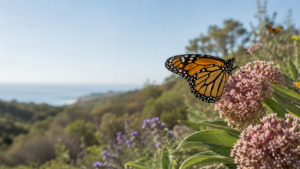
The Monarch is usually one of the easiest Texas butterflies to recognize. Look for orange wings divided by strong black veins, with a black outer border dotted in white. A Queen can look surprisingly similar from a distance, but the Monarch’s heavier black vein pattern is a useful clue.
Texas is especially important because Monarchs move through the state during both spring and fall migration. Texas Parks and Wildlife reports spring movement beginning as overwintering butterflies arrive from Mexico around March, while major fall movements pass through Texas from late September into November. Timing varies with route and weather.
If you are checking plants for caterpillars rather than adults, look at milkweeds. Monarch larvae depend on milkweed, while adults obtain nectar from many flowering plants.
Beginner clue: Strong black veins across orange wings point toward Monarch; a solid black line crossing the hindwing instead suggests a Viceroy.
2. Gulf Fritillary
Few Texas butterflies are easier to recognize once you see the underside. A Gulf Fritillary is brilliant orange above with black marks and several white spots near the leading edge of the forewing. When it closes its wings, elongated metallic-looking silver spots become obvious.
Passionflower is another strong clue. Gulf Fritillary caterpillars use Passiflora species as host plants, which is why adults and caterpillars frequently appear around passion vines in gardens. Texas Parks and Wildlife describes the species as common in gardens, parks and open country across Texas.
In South Texas it can fly throughout the year under suitable conditions, while occurrence farther north is more seasonal.
Beginner clue: Orange butterfly plus highly reflective silver underside spots is a very strong Gulf Fritillary combination.
3. Gray Hairstreak
A Gray Hairstreak can be easy to overlook because it is much smaller than a Monarch or swallowtail. Look closely at low flowers for a gray butterfly with a slender tail on each hindwing and an orange-red patch near the tail. The underside carries a relatively straight pale line bordered partly with orange.
This is a particularly useful butterfly to learn because Gray Hairstreaks are widespread and use many different host plants, especially plants in the pea and mallow families. Open, weedy and disturbed habitats are typical places to encounter them.
Beginner clue: Photograph hairstreaks from the side. The closed-wing pattern and tiny hindwing tails are usually more informative than the upperwing color.
4. Pipevine Swallowtail
The Pipevine Swallowtail is a large, dark butterfly that can look almost black while flying. When sunlight catches the hindwings, however, they may show an iridescent blue or blue-green sheen. The underside is even more useful: a row of seven rounded orange spots runs across a blue-toned hindwing.
As the name suggests, its caterpillars feed on pipevines in the genus Aristolochia. Adults occur in open habitats as well as woodland edges and regularly visit flowers.
Several dark swallowtails can occur in Texas, so avoid identifying this species from “large and black” alone.
Beginner clue: If possible, check the underside for the bold row of orange spots.
5. Queen
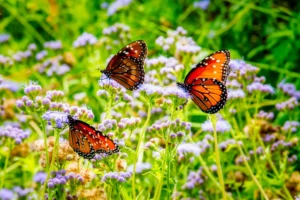
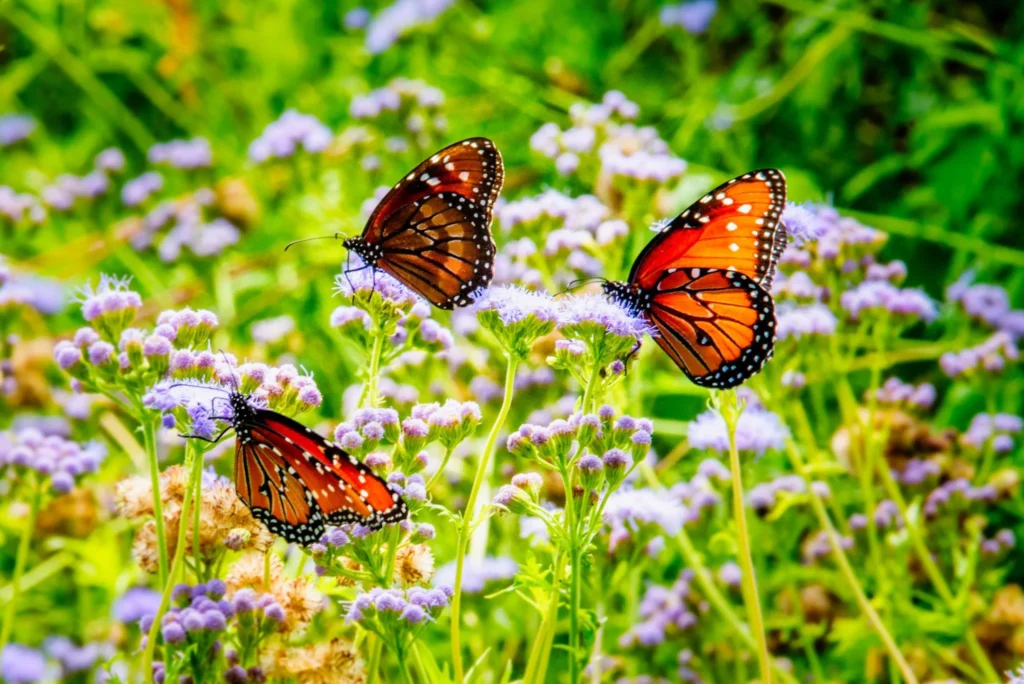
The Queen is one of the butterflies most likely to make a beginner think “Monarch.” It belongs to the same genus, Danaus, but its wings are generally chestnut brown to orange-brown and lack the Monarch’s strongly outlined black vein network on the upper surface. White spots appear around the dark wing borders.
Queens favor sunny open habitats and use milkweeds and milkweed vines as caterpillar hosts. They can occur throughout the year in South Texas, although their abundance farther north is more seasonal.
Beginner clue: For a Monarch-like butterfly, concentrate on the veins. Heavy black Monarch-style veining favors Monarch; a browner, less strongly veined upperwing favors Queen.
6. Fiery Skipper
Not every common Texas butterfly is large and showy. Fiery Skippers are small, compact butterflies often noticed darting through lawns or visiting low flowers.
Males are generally orange with a conspicuous dark stigma on the forewing, while females are darker brown with irregular orange markings. Small dark spots occur on the hindwing underside.
Their caterpillars feed on grasses, including Bermuda grass, crabgrass and St. Augustine grass, making ordinary lawns and grassy areas suitable habitat. BAMONA records Fiery Skippers throughout the year in South Texas.
Beginner clue: A tiny orange butterfly flying rapidly a few feet above a lawn may be a skipper rather than a small sulphur or fritillary.
7. Common Buckeye
The Common Buckeye is built for beginner identification: look for the eyespots.
Its brown upperwings contain prominent circular eyespots, orange bars and pale markings. Several large “eyes” are visible when the butterfly sits with its wings spread.
Buckeyes favor open sunny places with low vegetation and bare ground. Their caterpillars use several plant groups, including plantains and Ruellia. The underside can vary seasonally, becoming more reddish in some dry-season forms.
Beginner clue: If a medium brown butterfly repeatedly lands on bare ground and opens wings covered in conspicuous eyespots, Common Buckeye should be high on your list.
8. Black Swallowtail
The Black Swallowtail is frequently encountered in open areas and gardens, particularly where members of the parsley family grow.
Both sexes are predominantly black, but the pattern differs. Males usually have a conspicuous yellow band, while females tend to show more blue on the hindwings. Orange markings near the hindwing are another useful feature.
Its caterpillars use plants in the parsley family, including dill, carrot and related species. That host-plant relationship makes vegetable and herb gardens especially useful places to check for caterpillars.
Beginner clue: Do not identify every dark swallowtail as a Black Swallowtail. Compare the yellow spot pattern, blue hindwing markings and orange-red hindwing spot with Pipevine and other dark swallowtails.
9. Red Admiral
The Red Admiral has a pattern unlike most orange Texas butterflies. Its upperwings are predominantly dark brown to black, crossed by strong red-orange bands, with white spots near the forewing tips.
You may find it around yards, parks, moist fields and woodland edges. Caterpillars primarily use nettle-family plants. Adults are also notable because they may feed at tree sap and fermenting fruit in addition to visiting flowers.
Texas plays an important role in its seasonal distribution; BAMONA specifically notes winter occurrence in South Texas.
Beginner clue: A dark butterfly with a vivid red-orange diagonal band and white forewing spots is a strong Red Admiral candidate.
10. Giant Swallowtail
A butterfly that seems unusually large deserves a closer look. Giant Swallowtails can span roughly 4 to more than 6 inches, making them among the largest butterflies a Texas observer is likely to encounter.
The upperwings are dark with broad diagonal bands made from yellow spots. Its tails also contain yellow. Unlike the Black Swallowtail, the overall pattern reads more as broad yellow bands across a dark butterfly.
Caterpillars use plants in the citrus family, including citrus and native relatives such as prickly ash and hop tree. Young caterpillars have mottled brown and cream coloring that resembles bird droppings.
Beginner clue: Size plus a bold yellow band across very dark wings separates it from many other Texas swallowtails.
11. Orange Sulphur
Yellow butterflies often cause identification problems because several sulphurs occur in Texas. Orange Sulphurs vary considerably, but males typically show yellow wings overlaid with orange, dark borders and a dark forewing spot. Females may be yellow or whitish.
They are butterflies of open country—particularly fields, vacant lots, road edges, meadows and places where clover or alfalfa grows. Caterpillar hosts belong primarily to the pea family.
Beginner clue: Try to photograph a yellow butterfly both in flight and at rest. The orange wash, dark margin and underside markings can be more useful than simply recording “yellow butterfly.”
12. Painted Lady
The Painted Lady is orange-brown rather than bright Monarch orange. The tip of each forewing is dark with white markings, while the underside is mottled gray-brown and carries several small eyespots.
It uses an unusually broad range of caterpillar hosts, with thistles and mallows among the better-known examples. Adults occur in gardens, old fields and many other open or disturbed habitats.
Painted Ladies can also move over long distances, so abundance may change noticeably between years and seasons.
Beginner clue: Check the underside. Painted Ladies have several small hindwing eyespots rather than the huge dramatic eyespots of a Common Buckeye.
13. American Snout
The American Snout looks unusual even before you examine its wings. Long projecting mouthpart structures give the head a conspicuous “snout,” while the forewing has a somewhat squared-off tip.
The wings combine brown, orange and white. When resting with the wings closed, the muted underside and projecting snout can help the butterfly blend with twigs and dead vegetation. Caterpillars feed on hackberries (Celtis species).
American Snouts are also capable of spectacular population movements. Large numbers have occasionally appeared in Texas following conditions favorable to reproduction, so this is one species that can shift from inconspicuous to impossible to miss.
Beginner clue: Look at the head first. The exaggerated snout is more useful than trying to memorize every orange-brown wing marking.
Why Your Texas Location Matters
A butterfly guide for Texas cannot treat the state as one uniform habitat.
Texas Parks and Wildlife divides Texas into multiple natural regions ranging from humid Piney Woods and Gulf coastal habitats to the Edwards Plateau, High Plains, Trans-Pecos desert and subtropical South Texas. Annual rainfall and vegetation differ enormously among these regions.
South Texas is especially distinctive. The Lower Rio Grande Valley has subtropical influences, while the surrounding brush country combines thornscrub, grassland, desert and coastal elements. That helps explain why butterflies associated with warmer climates can remain active there for longer periods than they do farther north.
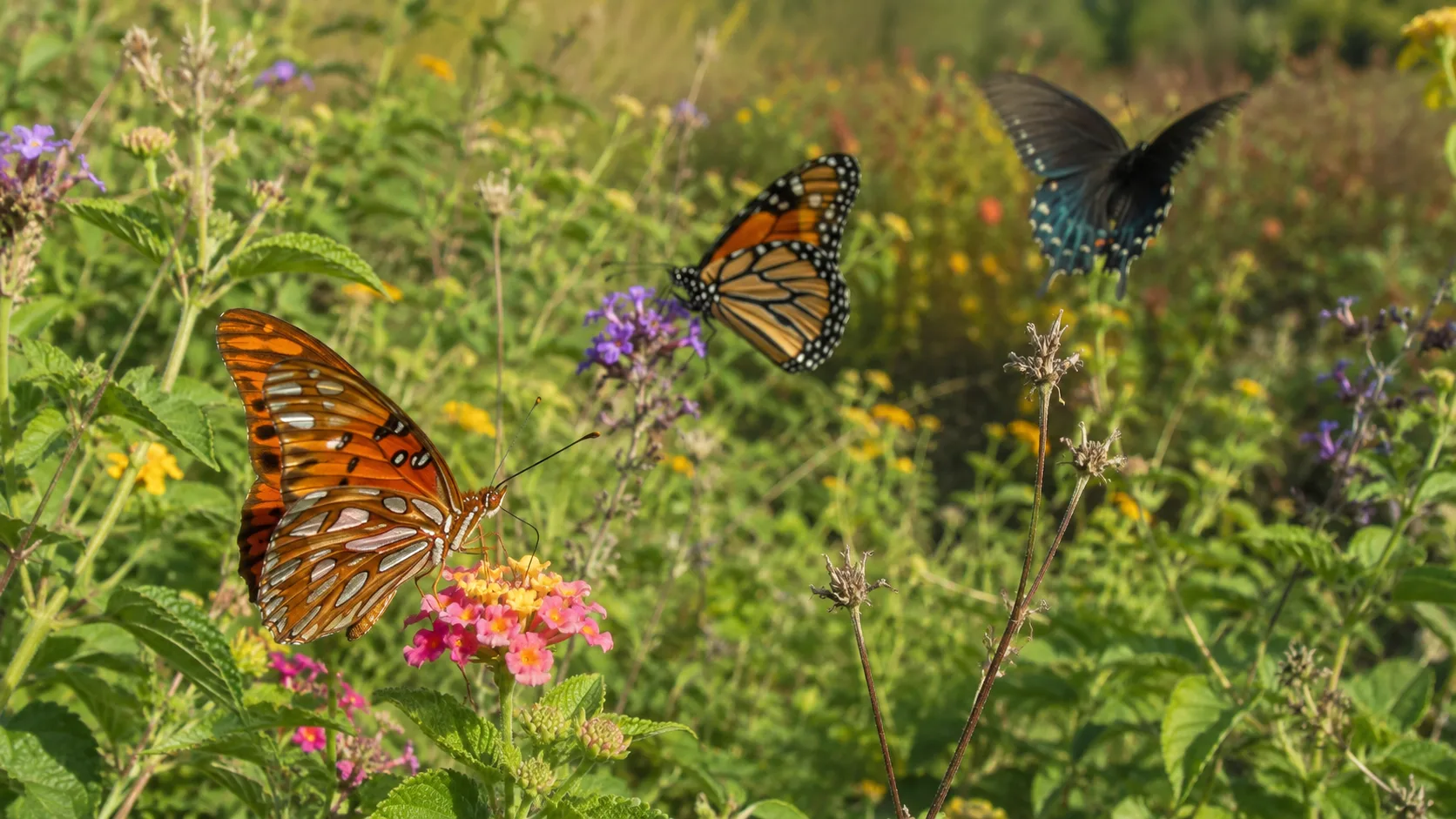
So if a field guide says a species occurs “in Texas,” treat that as a starting point—not proof that it should occur equally often in Dallas, El Paso, Houston, Amarillo and Brownsville.
The Fastest Way to Identify a Texas Butterfly
Color is useful, but pattern plus shape plus location is much better.
When you see an unfamiliar butterfly, try to record five things:
- Approximate size. Is it tiny like a hairstreak, medium-sized like a buckeye, or obviously large like a swallowtail?
- Upperwing pattern. Look for veins, bands, eyespots, borders and tails.
- Underside pattern. Gulf Fritillaries, hairstreaks and Painted Ladies become much easier to recognize from a side view.
- Nearby plants. Passionflower, milkweed, pipevine, hackberry, parsley-family plants and citrus-family plants can provide important clues because caterpillars often have specific host relationships.
- Location and date. A January butterfly in the Lower Rio Grande Valley should not automatically be judged by the same seasonal expectations as a January butterfly in the Texas Panhandle.
A clear photograph of both the upper and underside of the wings is often more valuable than trying to remember the exact shade of orange or yellow.
Host Plants Can Narrow the Identification
A flower that an adult visits for nectar is not necessarily its caterpillar host plant.
For example, Monarch caterpillars require milkweed, Gulf Fritillary caterpillars use passion vines, Pipevine Swallowtails use pipevines, American Snouts use hackberries, and Black Swallowtails commonly use parsley-family plants.
Adult butterflies are generally much less restrictive when choosing nectar flowers. A butterfly garden therefore works best when it provides both appropriate caterpillar host plants and flowering nectar sources. Texas A&M’s butterfly gardening guidance similarly distinguishes butterfly identification and host-plant selection as central parts of creating useful butterfly habitat.
When Is the Best Time to See Butterflies in Texas?
There is no single statewide butterfly season. Texas Parks and Wildlife notes that butterflies can be seen year-round in parts of the state, with spring and fall especially productive for viewing.
Migration can create particularly noticeable changes. Monarch numbers increase along Texas migration corridors in spring and fall, while species such as Painted Ladies and American Snouts can also show substantial movements when conditions favor them.
Warm South Texas supports a longer season for several species. Gulf Fritillaries, Queens and Fiery Skippers, for example, may be active there through periods when the same expectation would not apply farther north.
FAQ
What is the most common butterfly in Texas?
There is no scientifically useful single answer for every part of Texas because abundance changes by habitat, season and year. BAMONA’s Texas reporting data places Monarch, Gulf Fritillary, Gray Hairstreak, Pipevine Swallowtail and Queen among the state’s most commonly reported species.
What orange butterflies are common in Texas?
Common orange or orange-brown possibilities include Monarch, Queen, Gulf Fritillary, Painted Lady, Orange Sulphur and Fiery Skipper. Wing veins, borders, underside markings, size and shape are more reliable than orange color alone.
What black swallowtails can I see in Texas?
Pipevine Swallowtails and Black Swallowtails are both among BAMONA’s commonly reported Texas species, while Giant Swallowtails are also widespread in the state. They can be separated by combinations of yellow spotting, blue iridescence, orange underside spots, body size and overall wing pattern.
Are butterflies present in Texas during winter?
Yes, especially in the warmer south. BAMONA documents year-round flight for several species in South Texas, including Gulf Fritillary, Queen and Fiery Skipper, while Red Admirals also winter there. Winter activity should not be generalized to every part of the state.
What should I photograph to identify a butterfly?
Try to capture the upper wings, closed-wing underside, overall size and shape, and any distinctive tails, eyespots, bands or veins. Recording the date, Texas location and nearby plants can narrow the possibilities considerably because distribution, season and host plants differ among species.