If you have ever seen a black and yellow butterfly drifting through a garden, meadow, or woodland edge, you already know how eye-catching these insects can be. The tricky part is that several species look similar at first glance. That is why black and yellow butterfly identification usually comes down to a few small details: body pattern, wing shape, size, color bands, and sometimes even the plant the butterfly is visiting.
The good news is that you do not need to carry a field guide everywhere to get better at recognizing them. Once you know what to look for, many of the most common North American species become much easier to separate.
In this guide, we will look at the black and yellow butterflies people most often confuse, especially swallowtails, and break down the field marks that make identification simpler.
Why black and yellow butterfly identification can be confusing
A lot of the butterflies people notice first are swallowtails. They are large, graceful, and often marked with bold yellow, black, and sometimes blue or orange. Several species overlap in habitat, and some even visit the same flowers, which makes quick identification surprisingly difficult.
At a glance, you might only notice a flash of yellow and black. But if you pause for a second and look more closely, the clues start to stand out. Some species have vertical tiger-like stripes. Others have spotted bodies, striped bodies, or a stronger yellow band across the wings. Size can also help more than people expect.
Start with the easiest field marks
Before naming a species, look for these details:
1. Wing pattern
Are the markings stripes, spots, bands, or patches?
2. Body pattern
Some swallowtails have spotted bodies, while others look more striped.
3. Size
A butterfly that seems dramatically larger than the others may point you toward giant swallowtail rather than black swallowtail.
4. Color balance
Is it mostly yellow with black stripes, or mostly black with yellow spots?
5. Hindwing tails
Many swallowtails have tails, which helps place them in the group quickly.
6. Host plants and habitat
Sometimes the best clue is where you saw it. A butterfly around dill, parsley, fennel, or carrot-family plants may suggest black swallowtail. One near birch, aspen, or wild cherry could point elsewhere.
Eastern Tiger Swallowtail: the classic yellow-and-black look
For many people, this is the butterfly they picture first. The Eastern Tiger Swallowtail is large and bright yellow, marked with bold vertical black stripes. It has that classic “tiger” pattern that is hard to miss once you have seen it clearly.
Males are usually the more straightforward form to recognize: yellow wings, black striping, and a clean, striking look. Females are more variable. Some are yellow like the males, while others can be much darker and imitate the pipevine swallowtail. That darker female form causes a lot of confusion, especially in the South.
If the butterfly is mostly yellow with strong black tiger-striping, this is one of your top candidates.
Canadian Tiger Swallowtail: similar, but farther north
The Canadian Tiger Swallowtail looks very close to the Eastern Tiger Swallowtail, which is why the two are often mixed up. In general, the Canadian species is associated with cooler northern regions and tends to be somewhat smaller.
The overall impression is still yellow wings with black vertical striping. In practice, range and season often help. If you are farther north, especially in cooler parts of New England or Canada, the Canadian Tiger Swallowtail becomes more likely.
For casual backyard identification, many people will simply recognize these as “tiger swallowtails,” and that is understandable. But if you are trying to be more precise, geography matters.
Black Swallowtail: darker overall, with yellow spots and blue on females
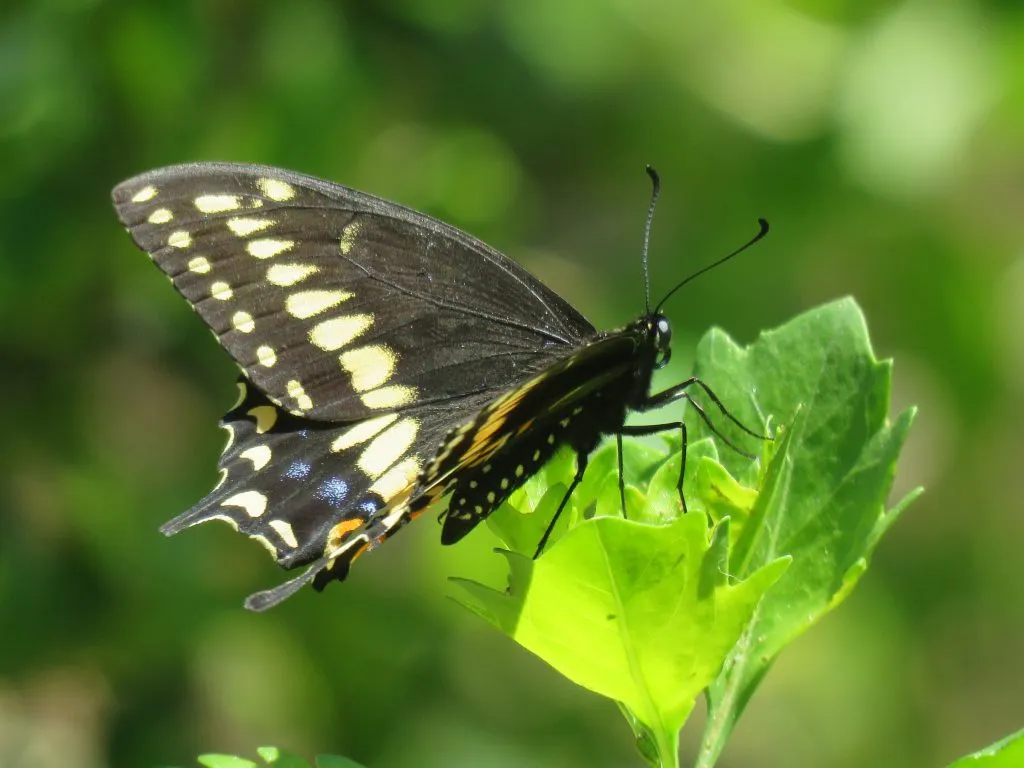
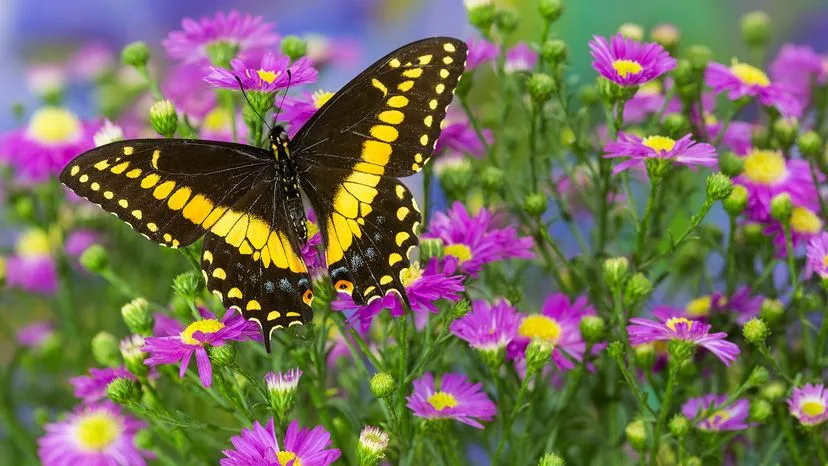
The Black Swallowtail is one of the most common butterflies people include in black and yellow butterfly identification searches, even though it is not as solidly yellow as a tiger swallowtail.
This species is basically black overall, but it carries yellow spots and bands that stand out beautifully in good light. Males usually show a stronger yellow band across the wings. Females tend to have more blue on the hindwings and fewer yellow markings, giving them a darker, richer appearance.
One of the easiest ways to separate black swallowtail from a similar species is the body. Black swallowtail has a spotted body, which is a very useful field clue. Its caterpillars also feed on plants in the carrot family, including parsley, dill, fennel, and carrots, so gardens can be excellent places to spot them.
If you see a mostly dark butterfly with yellow accents hovering around herb beds, black swallowtail should be high on your list.
Palamedes Swallowtail: larger, browner, and more striped in the body
Palamedes Swallowtail is a species that can confuse people who are trying to identify black swallowtails. At first glance, the two can seem similar, especially when both are nectaring on the same flowers.
But there are a few strong clues.
Palamedes is generally a little larger and browner. Its markings can look more fused, almost stripe-like rather than cleanly spotted. The body pattern matters here too: while black swallowtail has a spotted body, Palamedes has a more striped body.
That single comparison can save a lot of guesswork in the field.
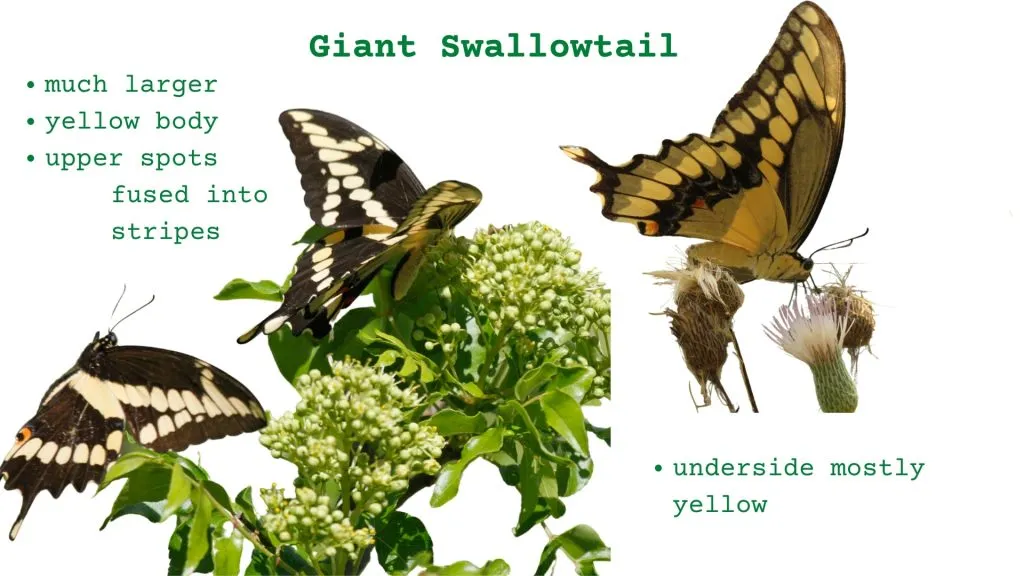
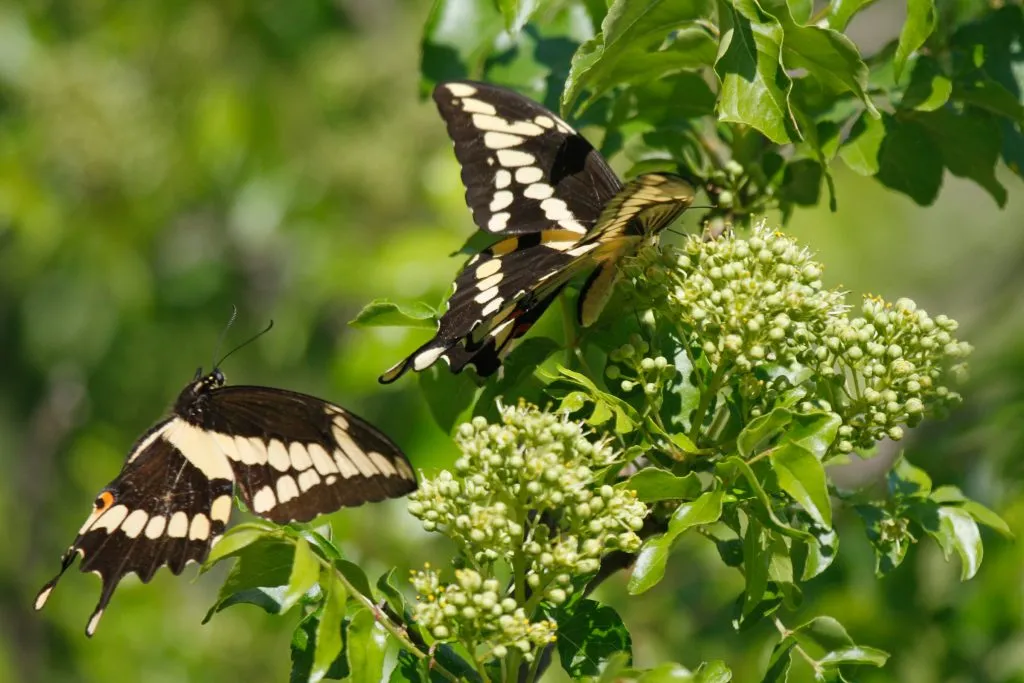
Giant Swallowtail: the oversized one
If the butterfly seems unusually large, do not ignore that impression. Giant Swallowtail really does stand apart in size. It is harder to confuse with black swallowtail once you get a decent look, because it tends to appear bulkier and more dramatic in flight.
It also has a distinctive pattern: a yellow body, bold striping on top, and a noticeably yellow underside. Compared with black swallowtail, it feels less delicate and more heavily marked.
So if you are torn between species and one butterfly looks almost oversized, giant swallowtail is worth considering immediately.
Spicebush Swallowtail: dark, elegant, and often mistaken for something else
Spicebush Swallowtail is another species that enters the confusion zone, especially when people are looking at dark butterflies with lighter markings. It is not the best example of a bright yellow-and-black butterfly, because its spots often read more bluish-green than yellow, but it still gets mistaken for related species.
It is especially easy to mix up with the dark female form of the Eastern Tiger Swallowtail. This is where behavior, habitat, and a closer look at color tone can help.
Its caterpillars are also memorable. Early on, they resemble bird droppings, which is one of the better disguises in the insect world. Later, they become green with large eye spots that make them look a little snake-like.
A simple comparison for black and yellow butterfly identification
Here is a quick way to narrow things down:
- Bright yellow with bold black tiger stripes: likely Eastern or Canadian Tiger Swallowtail
- Mostly black with yellow banding or spots: likely Black Swallowtail
- Larger and browner, with striped body: likely Palamedes Swallowtail
- Much larger overall, with strong yellow underside: likely Giant Swallowtail
- Dark with bluish-green spotting, often confused with dark tiger females: likely Spicebush Swallowtail
This kind of side-by-side thinking is often more useful than memorizing scientific names first.
Do caterpillars help with identification?
Absolutely. In fact, caterpillars can be some of the best clues.
Black swallowtail caterpillars are especially distinctive and often become familiar to gardeners. They feed on parsley-family plants and have a striking pattern as they mature. Many swallowtail caterpillars also use clever defenses. Some resemble bird droppings when young. Others develop large eye spots. And swallowtail larvae have a remarkable Y-shaped organ called an osmeterium, which they can push out when threatened to help deter predators.
So if you are trying to identify a butterfly species in your yard, it is worth paying attention not only to the adult butterfly, but also to the caterpillar and the plant it is feeding on.
Habitat and host plants can narrow things down fast
One of the easiest mistakes in butterfly identification is looking only at wing color. Habitat and host plants often tell you just as much.
For example:
- Black Swallowtail larvae feed on parsley-family plants like dill, fennel, parsley, and carrot
- Eastern Tiger Swallowtail often uses wild cherry, tulip poplar, ash, and related trees
- Canadian Tiger Swallowtail is more closely linked with birch and aspen in northern areas
- Spicebush Swallowtail is connected to spicebush and sassafras
- Giant Swallowtail uses plants in the citrus family
If you know the host plant, identification becomes much more confident.
Final thoughts
Black and yellow butterfly identification gets much easier once you stop asking, “What color is it?” and start asking better questions.
Is it striped or spotted?
Is the body striped or dotted?
Does it look mostly yellow, or mostly black?
Is it huge?
What plant is it using?
Those little details turn a quick glimpse into a real identification.
And honestly, that is part of the fun. The more time you spend watching swallowtails in gardens, roadsides, and woodland edges, the more these differences begin to feel obvious. What first looked like one beautiful butterfly becomes several distinct species, each with its own pattern, flight style, and favorite plants.
FAQ
What is the easiest way to start black and yellow butterfly identification?
Start with the overall wing pattern. If the butterfly is mostly yellow with bold black vertical stripes, it is often a tiger swallowtail. If it is mostly black with yellow spots or bands, black swallowtail becomes more likely.
How can I tell a black swallowtail from a Palamedes swallowtail?
A simple field clue is the body. Black swallowtail has a spotted body, while Palamedes has a striped body. Palamedes is also usually a bit larger and browner.
What black and yellow butterfly is most common in gardens?
Black swallowtails are very common around gardens, especially where parsley, dill, fennel, or carrots are growing. Their caterpillars frequently show up on those plants.
Are Eastern Tiger Swallowtails and Canadian Tiger Swallowtails the same?
They are closely related, but they are treated separately. They look similar, so range and climate often help with identification. Canadian Tiger Swallowtails are more associated with cooler northern areas.
Why do some swallowtails look so different from others in the same area?
Swallowtails are a diverse group. Males and females can look different, some females have dark forms, and several species overlap in habitat. That is why size, body pattern, host plant, and location matter so much.
Can caterpillars help identify the adult butterfly?
Yes. Caterpillars can be excellent clues. Black swallowtail caterpillars are especially helpful because they feed on carrot-family plants, while other swallowtails often use different trees or shrubs.