If you have found a green caterpillar with two enormous fake eyes, hiding inside a leaf folded over with silk on spicebush or sassafras, you have almost certainly found a spicebush swallowtail caterpillar. It is the larva of the spicebush swallowtail (Papilio troilus), a black swallowtail butterfly of eastern North America, and it is harmless to people and to your garden.
This guide covers how to recognize the caterpillar at every stage, what it eats, how to tell it from the two caterpillars most often confused with it, and what to expect when it turns yellow and disappears.
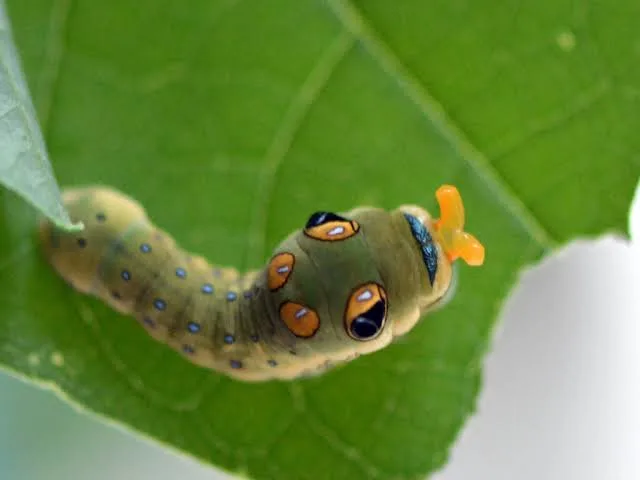
How to Identify a Spicebush Swallowtail Caterpillar
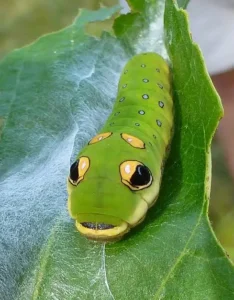
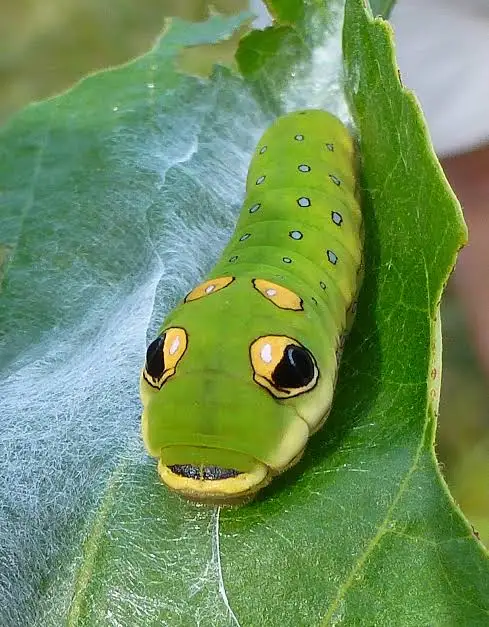
A fully grown spicebush swallowtail caterpillar is easy to recognize once you know what to look for:
- Body color: smooth and green on top. The underside starts pale green and turns pinkish-brown or burgundy as the caterpillar matures.
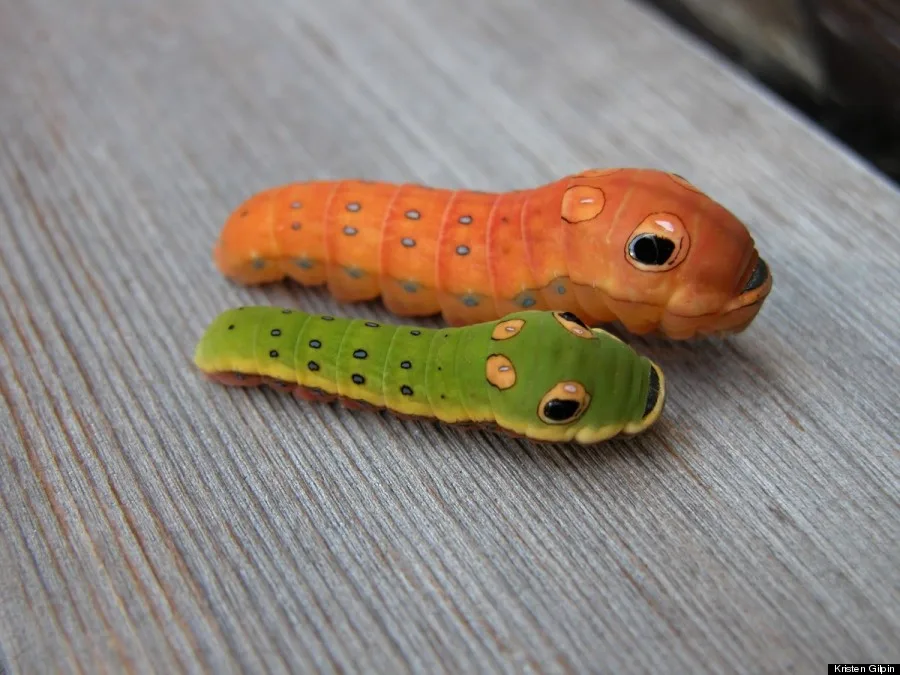
- False eyes: the front of the body is swollen into a hump that carries a pair of large tan or yellowish eyespots. Each has a black “pupil” with a small white highlight, which makes it look like a snake or a tree frog staring back at you. A second, smaller pair of tan spots sits just behind them.
- Blue dots: rows of small blue dots, each ringed in black, run across the abdominal segments.
- Side line: a pale yellow line runs along each side, edged below by a fine black line.
- Size: up to about 5.5 cm (2.2 inches) long when fully grown.
- Location: usually on spicebush, sassafras, redbay or swamp bay, often inside a folded or rolled leaf.
The real head is small and tucked down below the eyespots. The fake eyes are on the thorax, not the head.
Young caterpillars look like bird droppings
The first four stages (instars) look nothing like the mature caterpillar. They are brown to blackish with white markings, which makes them resemble a bird or lizard dropping lying on a leaf. Even at this stage, small tan false eyespots sit behind the head.
Only in the final, fifth instar does the caterpillar turn green and show the full eyespot display. So if you find a small brown-and-white caterpillar in a folded spicebush or sassafras leaf, it can be the same species at an earlier stage.
| Stage | What it looks like |
|---|---|
| Egg | Small, round, greenish-white; laid singly on the underside of a leaf |
| Instars 1–4 | Brown or blackish with white markings; looks like a bird dropping |
| Instar 5 | Green with large false eyespots, blue black-ringed dots and a pale yellow side line |
| Prepupa | Turns yellow, stops feeding and wanders off the host plant |
| Chrysalis | Green or brown with two short “horns” at the head end; overwintering chrysalides are brown |
The forked “horns” behind the head
Like all swallowtail caterpillars, this one has an osmeterium: a forked, normally hidden organ behind the head. When the caterpillar is poked or grabbed, it pushes out the bright yellow fork and releases a strong smell. It is a defense against ants and other small predators. It cannot sting or bite you.
Why Is the Caterpillar Hiding in a Folded Leaf?
Leaf shelters are one of the best field marks for this species. The caterpillar spins silk across a leaf. As the silk dries it contracts and pulls the leaf over. Very young caterpillars cut small slits from the leaf edge and curl just a flap. Older caterpillars fold or roll the whole leaf.
The caterpillar rests and molts inside the shelter during the day and comes out to feed mainly at night. If you see folded leaves fixed with silk on a spicebush or sassafras, gently open one and you may find a caterpillar inside. Fold it back afterwards.
What Do Spicebush Swallowtail Caterpillars Eat?
The caterpillars feed on plants in the laurel family (Lauraceae). University of Florida researchers note that the larvae are thought to use only this family.
| Host plant | Scientific name | Notes |
|---|---|---|
| Spicebush | Lindera benzoin | Main host across much of the range; uncommon in Florida |
| Sassafras | Sassafras albidum | Main host across much of the range |
| Redbay | Persea borbonia | Important in the Southeast and Florida |
| Swamp bay | Persea palustris | Southeast and Florida |
| Pondberry (southern spicebush) | Lindera melissifolia | A rare plant; rarely used |
| Camphor tree | Cinnamomum camphora | Introduced and invasive; used in Florida but not recommended for planting |
You will see tulip tree, sweetbay magnolia and prickly ash listed as hosts in some books and websites. Those records have not been confirmed. In laboratory tests, newly hatched spicebush swallowtail caterpillars starved rather than eat plants outside the laurel family, so a green eyespotted caterpillar on tulip tree or sweetbay magnolia is more likely an eastern tiger swallowtail (see below).
Adult spicebush swallowtails do not eat leaves. They drink nectar from flowers such as milkweeds, jewelweed, azaleas, lantana and Japanese honeysuckle, and males also sip moisture from damp ground. For more on the difference between caterpillar food plants and nectar flowers, see our guide to butterfly host plants.
Will they damage my spicebush or sassafras?
Usually not noticeably. The females lay eggs one at a time, the caterpillars feed alone, and NC State Extension notes that their leaf-folding and feeding are usually so minor that they go unnoticed. A healthy shrub or tree recovers easily. There is no reason to spray.
Where and When You Can Find Them
The spicebush swallowtail lives in the eastern United States and southern Ontario, south to Florida (but not the Miami area or the Keys) and west to Oklahoma and central Texas. It becomes less common west of the Mississippi River, and occasional strays turn up farther away.
Look along woodland edges, in moist woods, wooded swamps, yards and parks where spicebush or sassafras grows. Caterpillars are present from late spring to early fall. There are usually two generations a year in the North, and at least three in the Gulf Coast region and peninsular Florida, where adults fly from about March to December.
Spicebush Swallowtail vs. Look-Alike Caterpillars
Two other green swallowtail caterpillars with fake eyes cause most of the confusion.
| Feature | Spicebush swallowtail | Eastern tiger swallowtail | Palamedes swallowtail |
|---|---|---|---|
| Scientific name | Papilio troilus | Papilio glaucus | Papilio palamedes |
| Large false eyes | One large pair plus a smaller pair of tan spots behind | One pair: yellow ring with black and a blue center | One large pair plus a smaller pair of tan spots behind |
| Blue dots | Rows of blue dots with thick black rings | Faint blue dots | Rows of blue dots with thin black rings |
| Other marks | Pale yellow side line | Black-and-yellow band behind the hump (often hidden in a fold) | Pale yellow side line |
| Leaf shelter | Yes, folds leaves with silk | Rests on a silk pad on the leaf surface | No leaf-folding shelter |
| Typical host plants | Spicebush, sassafras, redbay, swamp bay | Tulip tree, black cherry, ash, sweetbay magnolia and others | Redbay and swamp bay |
| Color before pupating | Yellow | Brown | Yellow |
| Where | Eastern North America | Eastern North America | Mainly coastal plain of the Southeast, Virginia to Texas, and Florida |
Eastern tiger swallowtail caterpillar
This is the most common mix-up in the North. Both are green with a swollen front end, but the tiger swallowtail caterpillar has one pair of eyespots, each with a blue center, and lacks the second set of tan spots. The plant usually settles it: a tiger caterpillar on tulip tree or wild cherry, a spicebush caterpillar on spicebush or sassafras. Our swallowtail butterfly identification guide covers the adults of both species.
Palamedes swallowtail caterpillar
In the coastal Southeast, especially Florida and the Gulf Coast, the Palamedes swallowtail is the closest look-alike. Both feed on redbay and swamp bay, and the mature caterpillars are very similar. Two clues help:
- Leaf shelter: spicebush caterpillars fold leaves into shelters; Palamedes caterpillars do not.
- Blue dots: on a spicebush caterpillar, the black rings around the blue dots are much thicker.
Young caterpillars differ too: on a young Palamedes the rear end of the body is entirely white, while on a young spicebush swallowtail the very end is brown.
Why Did My Spicebush Swallowtail Caterpillar Turn Yellow?
A yellow caterpillar is not sick. When a fully grown caterpillar is ready to pupate, it stops feeding, empties its gut and turns yellow or orange-yellow. It then leaves the host plant and wanders in search of a sheltered spot, usually low down on a stem among leaves near the ground.
When it settles, it spins a silk pad, hangs from a silk girdle around its middle in a slightly curved, comma-like pose, and molts into a chrysalis. To learn what happens inside, see our guide to butterfly metamorphosis.
What Does a Spicebush Swallowtail Chrysalis Look Like?
The chrysalis is held upright against a stem by a silk girdle and has two short projections at the head end. It can be green or brown. Chrysalides formed during the growing season tend to match the color of the surface they are on, but chrysalides that will spend the winter are always brown, like a dead leaf or bit of bark.
How long does it stay in the chrysalis?
It depends on the season. Summer chrysalides produce butterflies within weeks. In late summer and fall, shortening days trigger diapause, and the chrysalis waits through the winter, with the adult emerging in spring. The spicebush swallowtail overwinters only as a chrysalis.
What to Do If You Find a Spicebush Swallowtail Caterpillar
- Leave it on its plant. The caterpillar can only eat laurel-family leaves. Moving it to another plant will usually starve it.
- Do not spray. Insecticides and broad “organic” sprays kill caterpillars along with pests.
- Expect it to vanish. A fully grown caterpillar that disappears has usually wandered off to pupate, not been eaten.
- Leave leaf litter in fall. Overwintering chrysalides can be on low stems and debris near the host plant.
- Plant native hosts. Spicebush and sassafras are the best choices across most of the range. Avoid camphor tree, which is invasive in the Southeast.
A note on laurel wilt
Laurel wilt is a fungal disease, spread by an introduced ambrosia beetle, that kills redbay, sassafras, spicebush and other laurel-family plants. It has spread through much of the southeastern United States since it was first found in 2003. Because every known host of the spicebush swallowtail is susceptible, University of Florida entomologists have described the disease as a threat to the butterfly. The species itself is still ranked as globally secure (G5), but loss of host plants matters locally, especially where redbay was the main host. Do not move firewood from laurel-wilt areas.
Frequently Asked Questions
Is the spicebush swallowtail caterpillar poisonous?
No. It has no stinging hairs or spines and is not known to be toxic to touch. The fake eyes and the smelly forked osmeterium are bluffs aimed at birds and small predators. Wash your hands if you handle one, because the osmeterium smell lingers.
Why does it have fake eyes?
The eyespots make the caterpillar look like a small snake or tree frog, especially when it rears up its swollen front end. This probably discourages birds that would otherwise eat a plump green caterpillar.
What butterfly does it turn into?
A spicebush swallowtail: a large black swallowtail with pale spots along the wing edges and a blue (female) or blue-green (male) wash on the hindwings. Its wingspan is about 7.5–10 cm (3–4 inches). The adult resembles the distasteful pipevine swallowtail, which may give it some protection from birds.
Can a spicebush swallowtail caterpillar eat other plants?
Not reliably. It feeds on laurel-family plants such as spicebush, sassafras, redbay and swamp bay. Records from tulip tree and sweetbay magnolia have not been confirmed, and caterpillars offered non-laurel plants in tests did not survive.
How long is the caterpillar stage?
The caterpillar passes through five instars over a few weeks in summer. Development is slower in cool weather. It then pupates, and the chrysalis either hatches that season or overwinters.
References
- Hall, D.W. and Butler, J.F. Spicebush Swallowtail, Papilio (Pterourus) troilus. UF/IFAS Extension, Featured Creatures EENY-636. https://edis.ifas.ufl.edu/publication/IN1107
- Hall, D.W. Palamedes Swallowtail, Papilio palamedes. UF/IFAS Extension, Featured Creatures EENY-060. https://ask.ifas.ufl.edu/publication/IN217
- Hall, D.W. and Butler, J.F. Eastern Tiger Swallowtail, Papilio glaucus. UF/IFAS Extension, Featured Creatures EENY-061. https://edis.ifas.ufl.edu/publication/IN218
- Baker, J. Spicebush Swallowtail. NC State Extension. https://content.ces.ncsu.edu/spicebush-swallowtail
- Spicebush Swallowtail, Papilio troilus. Butterflies and Moths of North America. https://www.butterfliesandmoths.org/species/Papilio-troilus
- Spicebush Swallowtail. Missouri Department of Conservation Field Guide. https://mdc.mo.gov/discover-nature/field-guide/spicebush-swallowtail
- Laurel Wilt Disease & Redbay Ambrosia Beetle (EF459). University of Kentucky Entomology. https://entomology.mgcafe.uky.edu/ef459