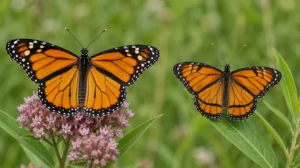
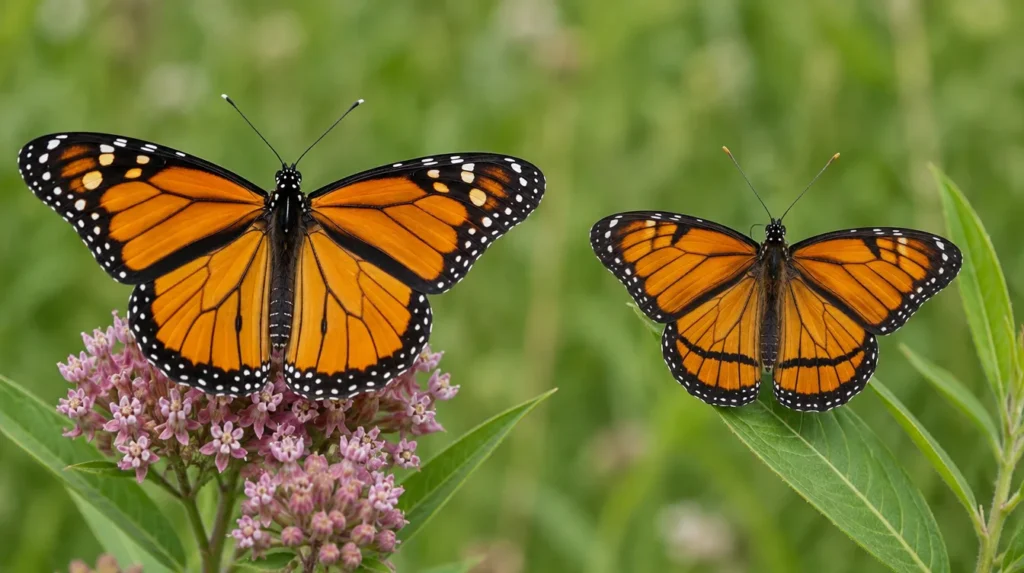
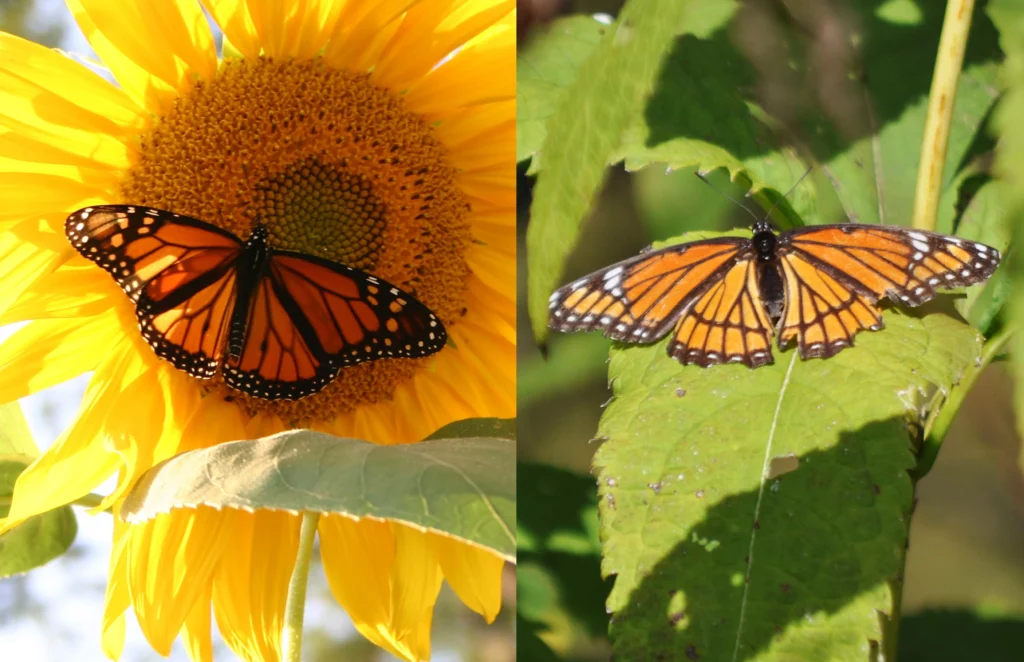
The quickest way to tell a monarch from a viceroy is to look at the hindwings. A viceroy has a black line curving across the middle of each hindwing. A monarch does not. Every other difference — size, flight, caterpillars, host plants — helps confirm the identification, but that one line settles most sightings.
The two butterflies look alike for a reason. The viceroy (Limenitis archippus) is a mimic of the monarch (Danaus plexippus), and in parts of the South it mimics the monarch’s close relative, the queen. Despite the resemblance, they belong to different subfamilies and are only distantly related.
Quick comparison
| Feature | Monarch | Viceroy |
|---|---|---|
| Scientific name | Danaus plexippus | Limenitis archippus |
| Family / subfamily | Nymphalidae: Danainae (milkweed butterflies) | Nymphalidae: Limenitidinae (admirals and relatives) |
| Hindwing | Black veins only — no line across the wing | Black veins plus a black line across the middle of the hindwing |
| Black wing border | White dots in the border and white spots near the forewing tip | One row of white dots in the black border |
| Wingspan | 3⅜–4⅞ in (8.6–12.4 cm) | 2½–3⅜ in (6.3–8.6 cm) |
| Flight | Flap-flap-glide; soars with wings held in a shallow V | Faster wingbeats; more erratic; glides with wings held flatter |
| Caterpillar | Yellow, black and white stripes; two pairs of black filaments | Olive-green to brown with white; looks like a bird dropping |
| Chrysalis | Jade green with gold spots | Mottled brown, bird-dropping-like |
| Caterpillar host plants | Milkweeds (Asclepias) and related vines | Willows (Salix), poplars, aspens and cottonwoods (Populus) |
| Winter | Adults migrate to overwintering sites (central Mexico, coastal California) | Does not migrate; young caterpillars overwinter in a rolled leaf |
| Typical habitat | Fields, meadows, roadsides, marshes and other open areas | Moist open areas near water: willow thickets, pond, lake and swamp edges, wet meadows |
The field mark that settles it: the hindwing line
Look at the hindwing — the lower, rounder wing. Both species have black veins running outward from the body. On a viceroy, an extra black line cuts across those veins, running roughly parallel to the outer edge of the wing. On a monarch, nothing crosses the veins.
This line is easiest to see when the butterfly is basking with its wings open. Take a moment to make sure you are looking at a true crossing line, not just a thick vein or a shadow. If you can photograph the butterfly, zoom in on the hindwing before deciding.
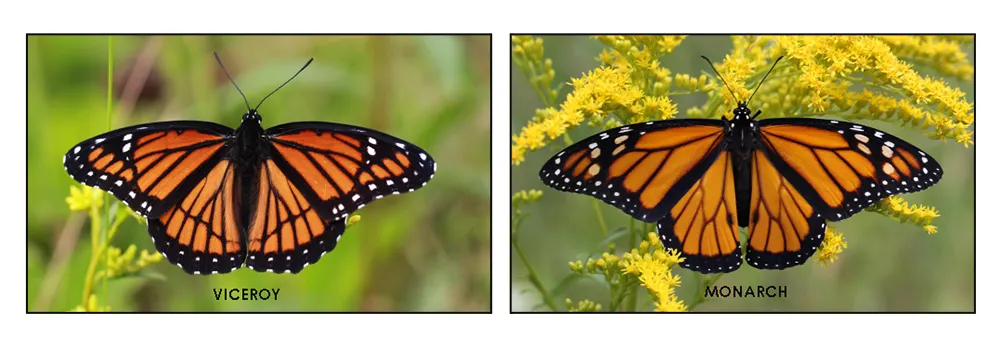
A secondary clue is in the black border along the wing edges. The viceroy has a single row of white dots in that border. The monarch’s border is also dotted with white, and it has white spots near the forewing tip. This is harder to judge in the field than the hindwing line, so treat it as supporting evidence.
Size: helpful, but not reliable on its own
Viceroys are smaller. Their wingspan runs about 2½ to 3⅜ inches (6.3–8.6 cm), while monarchs measure roughly 3⅜ to 4⅞ inches (8.6–12.4 cm).
The trouble is that the ranges meet, and size is hard to judge on a butterfly flying past or sitting alone on a flower. A small monarch and a large viceroy can look about the same. Use size to make a first guess, then check the hindwing.
Flight and behavior
With practice, you can often separate them before they land.
- Monarch: a steady flap-flap-glide rhythm. When it soars, it holds its wings up in a shallow V.
- Viceroy: quicker wingbeats and a more erratic, darting flight. When it glides, the wings are held flatter, closer to horizontal.
Viceroy males often perch and defend a territory from late morning into early afternoon while they watch for females.
Telling male and female monarchs apart
You don’t need this to separate a monarch from a viceroy, but it explains some variation you may notice. Male monarchs have bright orange wings with relatively thin black veins and a small black spot of scent scales on a vein of each hindwing. Females are a duller orange-brown with thicker, slightly blurred black veins and no hindwing spot.
That small black spot on a male monarch is not the viceroy’s line. It sits on one vein; it doesn’t cross the wing.
A regional twist: brown viceroys and the queen
In Florida, Georgia and parts of the Southwest, monarchs are less common, and the local viceroys are a darker, rusty or chestnut brown rather than bright orange. There they resemble the queen (Danaus gilippus), a milkweed butterfly closely related to the monarch. Some southwestern viceroys also show a fainter hindwing line, which makes identification harder.
How to sort the three:
- Queen: chestnut-brown wings, white spots scattered on the forewing itself (not just in the border), and no line across the hindwing.
- Monarch: bright orange, bold black veins, no hindwing line.
- Viceroy: orange or brown depending on region, with the line across the hindwing.
In southern Texas, Florida and the Southwest, a fourth look-alike, the soldier (Danaus eresimus), is also possible. If you are in those regions and the butterfly is brown, a regional field guide is worth checking.
Caterpillars and chrysalises look nothing alike
The adults are mimics; the young stages are not.
Monarch caterpillars are boldly striped in yellow, black and white, with two pairs of soft black filaments — one pair near the head and one near the tail. They feed only on milkweeds. Their warning colors advertise that they are distasteful.
Viceroy caterpillars are camouflaged. They are mottled olive-green, brown and white, and older caterpillars look remarkably like a bird dropping or a bit of twig. They carry spiky projections near the front of the body.
The pupae follow the same pattern. The monarch chrysalis is jade green with gold spots. The viceroy chrysalis is brown and mottled, continuing the bird-dropping disguise.
If you find a striped caterpillar on milkweed, it is very likely a monarch. A lumpy brown-and-white caterpillar on willow or poplar is a good candidate for a viceroy.
Host plants vs nectar plants
It helps to keep two things separate: what the caterpillars eat, and what the adult butterflies feed on.
Caterpillar host plants
- Monarch: milkweeds (Asclepias), including common, swamp and showy milkweed, plus milkweed vines in warmer regions. The caterpillars store toxic cardiac glycosides from these plants.
- Viceroy: trees and shrubs in the willow family (Salicaceae) — willows (Salix) and poplars, aspens and cottonwoods (Populus). The caterpillars take up salicylic compounds from these plants.
Adult food
- Monarch: flower nectar. Milkweed flowers are used heavily, and in fall, late-blooming composites such as goldenrods, blazing stars and ironweed are important.
- Viceroy: flowers, especially composites, but also less glamorous foods. Like many of its relatives, it feeds on aphid honeydew, rotting fruit, carrion and dung, particularly early in the season.
Host plants are one of the most useful practical clues. A monarch egg or caterpillar will be on milkweed. A viceroy egg is laid on the tip of a willow or poplar leaf.
For more on the monarch’s diet, see what monarch butterflies eat. For the general difference between food plants and nectar plants, see our guide to butterfly host plants.
Migration and winter: the biggest life-history difference
The monarch is famous for migrating. In late summer and fall, monarchs in eastern North America fly south to overwintering colonies in the mountains of central Mexico, while many western monarchs overwinter along the California coast. Some also winter along the Gulf and southern Atlantic coasts. In spring, the butterflies move north again over several generations.
The viceroy does not migrate. In fall, the young caterpillar — usually in its third stage — rolls a leaf into a tube, ties the leaf stem to the twig with silk so it won’t fall, and spends the winter inside. In spring it comes out and resumes feeding on fresh willow or poplar leaves.
This means a large orange-and-black butterfly moving steadily south in autumn, or a cluster of them roosting in trees, is almost certainly a group of monarchs.
Range and habitat
Monarch: breeds from southern Canada through the United States, and the species also occurs through Central and much of South America. It has become established in other parts of the world, including Hawaii and Australia. It favors open habitat: fields, meadows, roadsides and other places where milkweed grows.
Viceroy: found only in North America, from the Northwest Territories in Canada south to central Mexico. It occurs across the eastern United States and through much of the interior West, but is largely absent from the Pacific coast west of the Cascade and Sierra Nevada ranges. It stays close to its host trees, so look for it in moist, open places — willow thickets, wet meadows, and the edges of ponds, lakes, rivers and swamps.
Across much of the eastern and central United States and southern Canada, you can find both species in the same area during summer.
Why the viceroy looks like a monarch
For decades, the viceroy was the textbook example of Batesian mimicry, in which a harmless, tasty species copies the warning colors of a toxic one. The idea was that birds learned to avoid monarchs, which are distasteful and can make predators vomit, and so also avoided viceroys.
Research published in 1991 by David Ritland and Lincoln Brower found that viceroys are themselves unpalatable to birds. That makes the relationship Müllerian mimicry: two distasteful species sharing a similar warning pattern, so a predator that learns to avoid one also avoids the other. Both species benefit.
The full story may be more complicated. Some evolutionary studies suggest that the viceroy’s orange pattern evolved before its own chemical defense, which means it may have started out as a Batesian mimic and later became distasteful. Either way, the current understanding is that the viceroy is not simply a harmless copy.
Conservation notes
Monarch: the migratory monarch is listed as Vulnerable on the IUCN Red List (reassessed in 2023). In the United States, the Fish and Wildlife Service proposed listing the monarch as threatened under the Endangered Species Act in December 2024, but did not finalize that rule. Under a court settlement announced on September 30, 2026, the agency must issue a final listing decision by June 6, 2030. Until then, the monarch remains proposed for listing, not listed.
Viceroy: the species as a whole is widespread. One southwestern subspecies, sometimes called the obsolete viceroy (L. a. obsoleta), has lost much of its streamside habitat to development, water management and invasive saltcedar.
Frequently asked questions
Is the viceroy a type of monarch? No. Both belong to the brush-footed butterfly family (Nymphalidae), but the monarch is a milkweed butterfly (Danainae) and the viceroy belongs to the admiral group (Limenitidinae). Its closest relatives include the red-spotted purple and the white admiral, which look nothing like a monarch.
Is the viceroy poisonous? Viceroys are distasteful to birds, according to feeding studies. The chemicals come from the willow-family leaves the caterpillars eat. This is a defense against predators.
Do viceroys migrate like monarchs? No. Viceroys spend the winter as small caterpillars in a rolled leaf on their host tree.
What if I can only see the underside of the wings? Check the hindwing for a line crossing the veins, as you would from above. If the angle is poor or the photo is blurry, look for other clues: size, the plants nearby, and how the butterfly flew before it landed.
Can a viceroy lay eggs on milkweed? No. Viceroy caterpillars feed on willows, poplars, aspens and cottonwoods. A caterpillar on milkweed is not a viceroy.