If you have spotted a green caterpillar with black stripes and yellow spots on your dill, parsley, or fennel, you may have found a black swallowtail caterpillar (Papilio polyxenes).
Also known as a parsleyworm, this caterpillar is the larval stage of the black swallowtail butterfly, a familiar visitor to gardens across much of North America.
Although it can eat a surprising amount of your herbs, it is usually not a serious garden pest. And if you leave it undisturbed, you might get to watch one of nature’s most remarkable transformations: a caterpillar becoming a butterfly.
Here’s how to identify it, what to do when you find one, and what happens when it forms a chrysalis.
How to Identify a Black Swallowtail Caterpillar
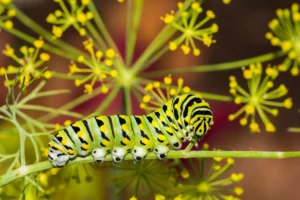
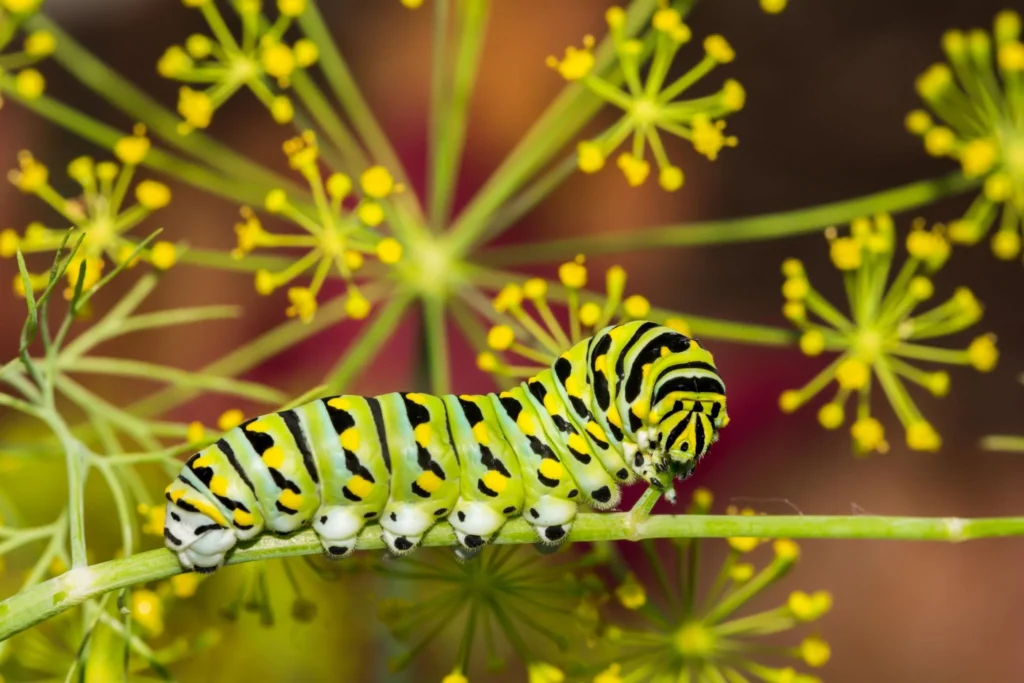
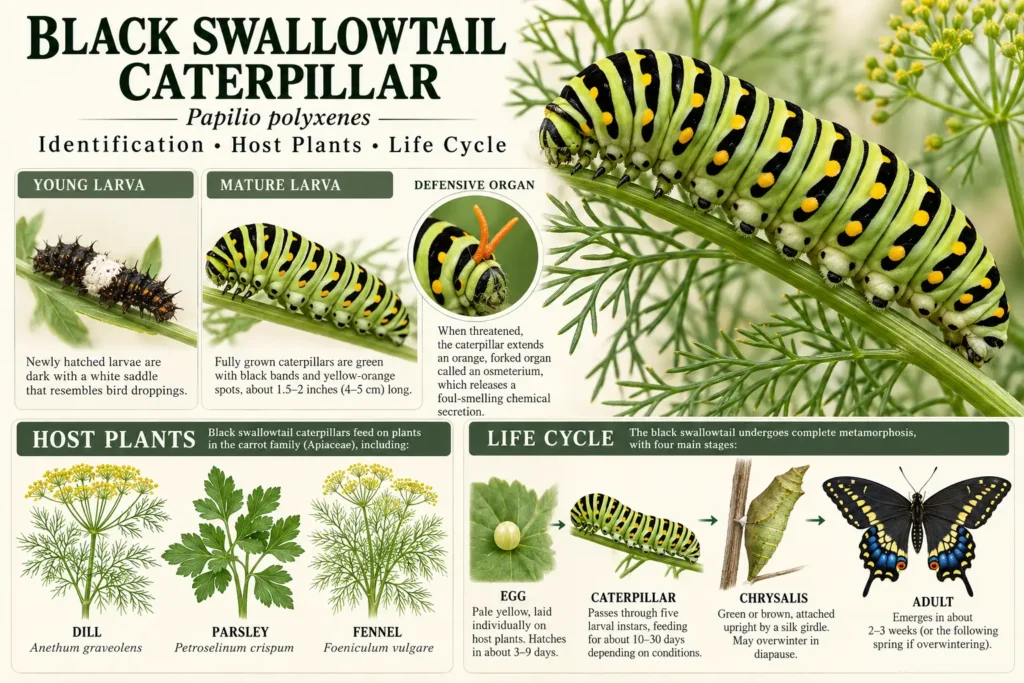
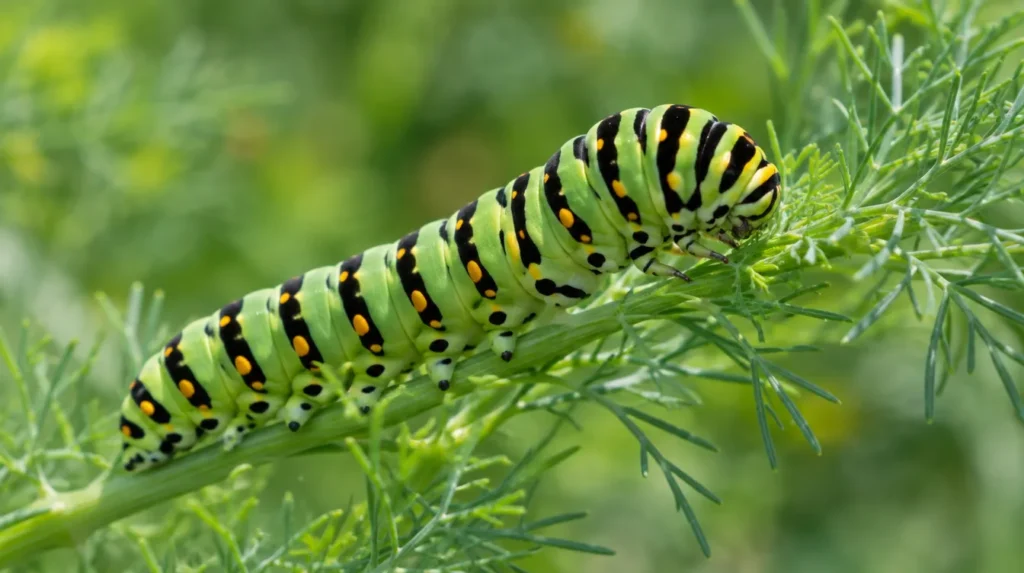
A mature black swallowtail caterpillar is typically green with black bands running across its body. Each black band contains small yellow or orange spots.
Fully grown caterpillars commonly reach about 1.5–2 inches (4–5 cm) long.
Key identification features include:
- A smooth, mostly green body in the final larval stages
- Black bands crossing each body segment
- Yellow-orange spots within the black bands
- A plump, cylindrical body with a relatively small head
- Frequent feeding on parsley, dill, fennel, or other carrot-family plants
The host plant is an especially useful clue. If you find a green-and-black striped caterpillar eating dill in an eastern North American garden, black swallowtail is a strong possibility.
However, appearance and host plant should be considered together, particularly in regions where other swallowtail species occur.
Why Young Black Swallowtail Caterpillars Look Different
One of the most confusing things about black swallowtail caterpillars is how dramatically they change as they grow.
Newly hatched larvae look nothing like the familiar green-and-black striped caterpillars.
Instead, they are dark, somewhat spiny, and have a pale white patch across the middle of the body. This pattern resembles bird droppings and helps disguise the young caterpillar from predators.
As the larva molts through successive growth stages, called instars, its appearance changes.
| Growth stage | Typical appearance |
|---|---|
| Early instars | Dark brown or black, with a white saddle-like marking and small spines |
| Middle instars | Dark coloration with developing orange or yellow markings |
| Late instars | Mostly green with black bands and yellow-orange spots |
| Fully grown larva | Smooth, prominently striped, approximately 1.5–2 inches long |
This means that two very different-looking caterpillars on the same parsley plant can actually belong to the same species.
Black Swallowtail Caterpillar on Dill
Dill (Anethum graveolens) is one of the best-known host plants for black swallowtail caterpillars.
The fine, feathery foliage provides food for growing larvae. Caterpillars may feed on the leaves, flowers, and developing seed heads.
If you notice stems becoming bare or clusters of dill flowers disappearing, look closely for caterpillars.
Female black swallowtail butterflies lay individual eggs on suitable host plants. The young larvae begin feeding after hatching and consume progressively more foliage as they grow.
A single mature caterpillar can eat considerably more than a newly hatched one.
Should You Remove Caterpillars From Dill?
Usually, there is no need.
A small number of black swallowtail caterpillars can often be tolerated, especially if you are growing dill partly to attract butterflies.
If you want to protect your culinary herbs, consider growing additional pesticide-free host plants in another part of the garden.
Where relocation is necessary, move the caterpillar carefully to a correctly identified, suitable host plant. Avoid moving it to an unrelated plant simply because its leaves look similar.
Caterpillar on Parsley: Is It a Parsleyworm?
If you discover a striped caterpillar eating parsley, it may be the insect commonly called a parsleyworm.
Parsleyworm is a common name for the caterpillar of the black swallowtail butterfly, rather than a separate butterfly species.
Parsley (Petroselinum crispum) belongs to the carrot family, Apiaceae, which contains many of the plants used by black swallowtail larvae.
The caterpillars can feed on both flat-leaf and curly parsley.
Young larvae may be difficult to notice because they are small and resemble bird droppings. Older larvae become much easier to spot as their distinctive striped patterns develop.
If your parsley suddenly has missing leaves or chewed stems, examine the plant before assuming the damage was caused by slugs or another garden pest.
Are Parsleyworms Harmful?
Black swallowtail caterpillars are not medically dangerous to people. They do not sting, although they have a defensive organ that produces an unpleasant odor when they feel threatened.
They may damage herbs by feeding on the foliage, but their presence is not automatically a reason to use insecticides.
In fact, many butterfly gardeners deliberately grow extra parsley to support them.
Caterpillar on Fennel: Another Common Host Plant
Fennel (Foeniculum vulgare) is another well-documented host for black swallowtail caterpillars.
Like dill, fennel has fine foliage and flowering structures that provide food for developing larvae.
You may find caterpillars feeding along the stems, among the leaves, or near the flower clusters.
In areas where other swallowtails also use fennel, the plant alone is not enough for reliable species identification. Check the caterpillar’s markings and the species known from your region.
For butterfly gardening, choose host plants appropriate to your location. Fennel can spread aggressively and is invasive in some regions, so locally suitable native host plants may be a better choice.
What Do Black Swallowtail Caterpillars Eat?
Black swallowtail caterpillars primarily feed on plants in the carrot family (Apiaceae).
Common documented hosts include:
| Host plant | Scientific name |
|---|---|
| Parsley | Petroselinum crispum |
| Dill | Anethum graveolens |
| Fennel | Foeniculum vulgare |
| Carrot | Daucus carota |
| Celery | Apium graveolens |
| Caraway | Carum carvi |
| Queen Anne’s lace | Daucus carota |
Black swallowtails also use certain other plants, including common rue (Ruta graveolens), which belongs to the citrus family (Rutaceae).
Some wild host plants, such as poison hemlock and water hemlock, are extremely toxic to humans and animals. They should not be collected or planted as a casual butterfly-rearing project.
An important distinction is that caterpillars eat host plants, while adult butterflies drink nectar from flowers.
Learn more about this distinction in our guide to butterfly host plants.
Why Does a Black Swallowtail Caterpillar Show Orange Horns?
Sometimes, when a black swallowtail caterpillar is touched or disturbed, a bright orange, fork-shaped structure suddenly appears behind its head.
This is called an osmeterium.
It is a specialized defensive organ found in swallowtail caterpillars.
When threatened, the caterpillar can extend the osmeterium and release an unpleasant-smelling chemical secretion that helps discourage predators.
The structure may look alarming, but it is not a stinger.
If you see it, the caterpillar is reacting defensively. Give it space rather than repeatedly touching it to make the organ appear.
Black Swallowtail Caterpillar Life Cycle
Black swallowtails undergo complete metamorphosis, passing through four main stages:
- Egg
- Caterpillar (larva)
- Chrysalis (pupa)
- Adult butterfly
The length of each stage depends on temperature, season, and other environmental conditions.
Stage 1: Egg
Female black swallowtails lay small, rounded, pale yellow eggs individually on suitable host plants.
The eggs generally hatch in about 3–9 days, depending on conditions.
Stage 2: Caterpillar
After hatching, the young caterpillar begins feeding and growing.
It passes through five larval instars, shedding its outer skin between stages.
The larval period commonly lasts about 10–30 days, with development varying according to temperature and the host plant.
Stage 3: Chrysalis
When the caterpillar reaches maturity, it usually stops feeding and begins wandering away from its host plant.
It searches for a suitable place to pupate, such as a plant stem, branch, tree trunk, or other firm surface.
The caterpillar attaches its rear end to a silk pad and spins a thin silk girdle around the upper part of its body.
It then molts into a chrysalis.
Stage 4: Adult Butterfly
Inside the chrysalis, the insect undergoes metamorphosis.
During the growing season, adults may emerge after roughly two to three weeks, although development time varies.
In some regions and seasons, the chrysalis enters diapause, a state of arrested development, and remains in that stage through winter.
When the adult emerges, its wings are initially soft. They expand and harden before the butterfly can fly.
For a broader explanation, see our guide to the transformation from caterpillar to butterfly.
What Does a Black Swallowtail Chrysalis Look Like?
A black swallowtail chrysalis is typically angular, with short horn-like projections near the head end.
It may be greenish or mottled brown.
Unlike many moths, black swallowtails do not spin a protective silk cocoon around the pupa. Instead, the chrysalis remains exposed and is supported by its silk attachments.
The chrysalis is usually positioned upright or at an angle, attached to a firm surface by the rear end and a silk girdle.
Its coloration helps make it inconspicuous in its surroundings.
How Long Does a Black Swallowtail Stay in Its Chrysalis?
That depends largely on the season.
A chrysalis formed during the active breeding season may produce an adult butterfly after approximately two to three weeks.
A late-season chrysalis may remain dormant throughout winter and not produce an adult until the following spring.
Therefore, a chrysalis that remains unchanged for several weeks is not necessarily dead.
If you find one outdoors, avoid detaching or disturbing it unnecessarily.
What Should You Do If You Find a Black Swallowtail Caterpillar?
Finding one on your herbs presents a simple choice: protect the plant or make room for the butterfly.
You can often do both.
Leave It on Its Host Plant
The easiest option is to leave the caterpillar where you found it.
It already has a suitable food source, and moving it introduces unnecessary disturbance.
Provide Enough Food
If several caterpillars are feeding on a small plant, they may consume its foliage rapidly.
Additional pesticide-free plants of a suitable host species can provide more food.
Avoid Insecticides
Insecticides that target leaf-feeding caterpillars can also kill black swallowtail larvae.
If your goal is butterfly conservation, avoid spraying the plants they are using.
Let the Caterpillar Choose Its Pupation Site
A full-grown caterpillar may wander away from dill or parsley before pupating.
This is normal.
If you have confirmed its identity and it appears healthy, do not assume that leaving the plant means it needs rescuing.
Keep the surrounding area as undisturbed as practical so it can find a suitable place to form its chrysalis.
Black Swallowtail vs. Monarch Caterpillar
Black swallowtail caterpillars are sometimes confused with monarch caterpillars because both can have black, yellow, and pale markings.
There are important differences.
| Feature | Black swallowtail | Monarch |
|---|---|---|
| Scientific name | Papilio polyxenes | Danaus plexippus |
| Typical host plants | Parsley, dill, fennel, carrot family | Milkweeds |
| Mature body markings | Green with black bands and yellow-orange spots | Black, white, and yellow stripes |
| Distinctive feature | Eversible orange osmeterium | Two pairs of dark fleshy filaments |
| Chrysalis | Green or brown, supported by a silk girdle | Typically green with gold-colored markings, hanging without a girdle |
The plant the caterpillar is actually eating is often one of the most helpful clues.
For additional comparisons between adult swallowtails, see our swallowtail butterfly identification guide.
Frequently Asked Questions
Is a black swallowtail caterpillar poisonous?
Black swallowtail caterpillars are not considered medically harmful to people. They may release a foul-smelling defensive secretion when disturbed, so unnecessary handling is best avoided.
Will black swallowtail caterpillars kill my parsley?
Several large caterpillars can strip substantial foliage from a small parsley plant. However, feeding damage does not always kill an established plant, and the severity depends on plant size and the number of caterpillars.
Can black swallowtail caterpillars eat spinach or lettuce?
Spinach and lettuce are not recognized normal host plants for this species. Provide a correctly identified host plant rather than assuming that any leafy vegetable will work.
Why did my caterpillar stop eating?
A caterpillar may temporarily stop feeding before molting. A mature larva may stop eating and begin wandering when preparing to pupate. However, reduced feeding alone is not enough to diagnose its condition.
Why is my black swallowtail caterpillar turning dark?
Young larvae are naturally dark, while older larvae develop green and black markings. Some individuals also show darker coloration. Sudden discoloration accompanied by weakness or unusual behavior may have a different cause, so color alone does not establish whether a caterpillar is healthy.
Do black swallowtail caterpillars turn into monarchs?
No. Black swallowtail caterpillars become black swallowtail butterflies. Monarch butterflies are a different species, and their caterpillars normally feed on milkweed.
Can a black swallowtail chrysalis survive winter?
Yes. In suitable climates, black swallowtails naturally overwinter as pupae. Their development can pause during diapause and resume when seasonal conditions become favorable.
How can I attract more black swallowtails?
Grow suitable, locally appropriate caterpillar host plants and provide nectar-rich flowers for adults. Avoid insecticides and leave some undisturbed habitat where caterpillars can complete their development.
Final Thoughts
Finding a black swallowtail caterpillar on your dill, parsley, or fennel can be an unexpected discovery, especially if your first concern is protecting your herbs.
But the striped caterpillar is also an opportunity to observe a butterfly’s life cycle at close range.
Its changing body pattern, defensive orange osmeterium, and eventual transformation into a chrysalis are all part of the same remarkable process.
A little extra space for the caterpillar, along with enough suitable host plants, may be all it takes to turn an ordinary herb garden into a place where the next generation of black swallowtail butterflies can develop.
References
- University of Wisconsin–Madison Extension. Black Swallowtail, Papilio polyxenes. https://hort.extension.wisc.edu/articles/black-swallowtail-papilio-polyxenes/
- Virginia Tech Extension. Parsleyworm. https://www.pubs.ext.vt.edu/3104/3104-1557/3104-1557.html
- University of Florida IFAS Extension. Eastern Black Swallowtail: Papilio polyxenes asterius. https://ask.ifas.ufl.edu/publication/in906
- University of Arkansas Arthropod Museum. Black Swallowtail Caterpillar (Parsleyworm). https://arthropod.uark.edu/black-swallowtail-caterpillar-parsleyworm/
Editorial note: This guide was prepared using published university extension and entomological identification resources. Development times and host-plant use can vary with geography and environmental conditions.