Florida’s warm climate supports more butterfly species than any other state east of the Mississippi River. The Florida Fish and Wildlife Conservation Commission puts the state total at 187. Most of those species are local, seasonal, or rare. A much smaller group turns up again and again in gardens, roadsides, parks, and coastal areas across the state, and those are the butterflies covered here.
This guide covers 16 butterflies that Florida observers see often. Each entry lists the field marks that separate the species from its look-alikes, where and when to look for it, and which plants its caterpillars eat. Color gives you a starting point, but it rarely settles an identification by itself. Wing shape, the pattern on the underside, size, habitat, and location within Florida usually decide it.
Common Butterflies in Florida at a Glance
| Butterfly | Scientific name | Size | Quick identification clue | Good place to look |
|---|---|---|---|---|
| Zebra Longwing | Heliconius charithonia | Large | Long, narrow black wings with thin yellow stripes | Shady garden edges, hammocks |
| Gulf Fritillary | Agraulis incarnata (formerly A. vanillae) | Medium–large | Orange above; silver spots on the underside | Gardens with passionflower vines |
| Monarch | Danaus plexippus | Large | Orange with bold black-lined veins | Fields, gardens with milkweed |
| Queen | Danaus gilippus | Large | Mahogany-brown; no bold black vein lines above | Open fields, marsh edges, milkweed |
| Eastern Giant Swallowtail | Papilio cresphontes | Very large | Dark wings with a diagonal yellow band; tails with yellow centers | Citrus trees, wild lime, woodland edges |
| Palamedes Swallowtail | Papilio palamedes | Large | Dark with yellow bands; a yellow stripe along the base of the hindwing underside | Wooded swamps, moist woods |
| Black Swallowtail | Papilio polyxenes | Large | Black with rows of yellow spots, blue on the hindwing, orange eyespot | Vegetable and herb gardens, open fields |
| Eastern Tiger Swallowtail | Papilio glaucus | Very large | Yellow with black tiger stripes (some females are black) | Woodland edges, swamps with sweetbay |
| Cloudless Sulphur | Phoebis sennae | Medium | Large, plain lemon-yellow butterfly with a fast flight | Roadsides, gardens with senna |
| Barred Yellow | Eurema daira | Small | Small yellow; males have a black bar on the forewing | Grassy fields, pinelands, dunes |
| Great Southern White | Ascia monuste | Medium | White with a black forewing tip; turquoise antenna tips | Beaches, salt marshes, coastal roadsides |
| Common Buckeye | Junonia coenia | Medium | Brown with large eyespots and orange bars | Open sunny ground, paths, lawns |
| White Peacock | Anartia jatrophae | Medium | Pale white-and-tan with small black spots; flies low | Wet ditches, pond and canal edges |
| Ceraunus Blue | Hemiargus ceraunus | Tiny | Gray underside with an orange-rimmed eyespot | Weedy lawns, roadsides, old fields |
| Long-tailed Skipper | Urbanus proteus | Medium | Brown with long tails and blue-green iridescence | Gardens, field edges, bean patches |
| Fiery Skipper | Hylephila phyleus | Small | Small orange skipper with a jagged dark border | Lawns, especially St. Augustinegrass |
Size is approximate: tiny = about 1 inch or less; small = up to about 1.5 inches; medium = about 1.5–2.75 inches; large = about 2.75 inches or more, measured wingtip to wingtip.
1. Zebra Longwing
The Zebra Longwing is Florida’s official state butterfly, designated by the legislature in 1996. Few Florida butterflies are easier to recognize. Its forewings are long and narrow, and the black wings are crossed by thin, pale-yellow stripes. It also flies slowly and floats rather than darting.
It occurs throughout Florida and is most common in the south of the state. It favors hardwood hammocks, thickets, shady garden edges, and parks. The caterpillars feed only on passionflower vines (Passiflora), including maypop (P. incarnata), yellow passionflower (P. lutea), and corkystem passionflower (P. suberosa).
Adults also do something most butterflies cannot: they collect and feed on pollen as well as drinking nectar. They live longer than most butterflies, and at night they gather in small groups on the same roost.
Beginner clue: Long, narrow black wings with yellow stripes and a slow, gliding flight. No other common Florida butterfly looks like this.
2. Gulf Fritillary
The Gulf Fritillary is one of the most common garden butterflies in Florida and is seen statewide all year. From above it is bright orange with black markings, and there are three small white spots ringed in black near the leading edge of each forewing. The underside gives the surest identification: it is brown with large, elongated silver spots that flash when the butterfly moves.
Many recent references split the gulf fritillary group into several species and call the North American butterfly Agraulis incarnata. Older guides and some databases still use Agraulis vanillae, so you may see either name.
Its caterpillars, like those of the Zebra Longwing, feed on passionflower vines. When a garden has passionflower, it often has both species. The caterpillars are orange with rows of black branching spines.
Beginner clue: An orange butterfly that shows silver spots when its wings are closed.
3. Monarch
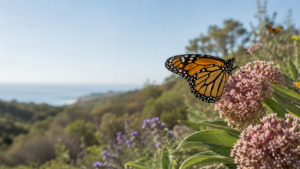
The Monarch is orange with bold black veins, wide black borders, and small white spots in those borders. Males have a small black scent patch on a vein of each hindwing, and females have thicker black veins.
Florida has two kinds of Monarch activity. Migrating Monarchs from farther north pass through the state, especially in fall. Resident Monarchs also breed year-round in Central and South Florida. Caterpillars eat only milkweeds (Asclepias). Native Florida hosts include white swamp milkweed (A. perennis), butterflyweed (A. tuberosa), and pineland milkweed (A. humistrata).
If you plant for Monarchs in Florida, choose native milkweeds. UF/IFAS Extension advises against tropical milkweed (A. curassavica). It keeps growing through the winter, which can keep Monarchs breeding in one place and is linked to a harmful protozoan parasite called OE (Ophryocystis elektroscirrha).
For more on this species, see the Monarch butterfly profile.
Beginner clue: Bright orange crossed by bold black vein lines.
4. Queen
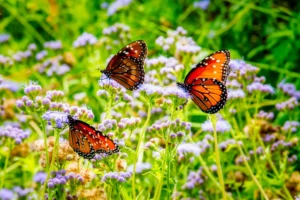
People often mistake the Queen for a Monarch, but the two are easy to separate once you know what to check. The Queen is a richer mahogany-brown, and its upperside has no bold black vein lines. Small white spots are scattered across the forewing, not only along the border.
In Central and South Florida the Queen flies all year. It spreads into North Florida each year in numbers that vary from year to year. Look for it in open fields, marsh edges, pinelands, coastal areas, and gardens. Like the Monarch, its caterpillars feed on milkweeds, and chemicals from the plant make both caterpillars and adults distasteful to predators.
Beginner clue: Monarch-shaped but darker brown, with white spots and no bold black veins on top.
5. Eastern Giant Swallowtail
The Eastern Giant Swallowtail is one of the largest butterflies in Florida. Above, the wings are dark brown to black, and a band of yellow spots runs diagonally across the forewing toward the tip. Each hindwing tail has a yellow spot in the middle. The underside is mostly pale yellow, which is the side you usually see when it feeds.
It is found throughout Florida and flies all year in the south of the state. Its caterpillars feed on plants in the citrus family. The wild hosts are wild lime (Zanthoxylum fagara), Hercules’ club (Z. clava-herculis), and hop tree (Ptelea trifoliata), and the caterpillars also feed on cultivated citrus. Citrus growers call them “orange dogs.” They are brown and white and look much like a bird dropping.
Beginner clue: A huge dark swallowtail with a yellow band that slants diagonally across the forewing, often seen near citrus trees.
6. Palamedes Swallowtail
The Palamedes Swallowtail is a large dark swallowtail with a band of yellow spots across both wings. The best field mark is on the underside: a thin yellow stripe runs along the base of the hindwing, parallel to the body. The body is black with yellow stripes, and the adults keep fluttering their wings while they feed.
It lives throughout Florida and is especially common in and near wooded swamps and moist woods. Adults fly from about February to November. Its caterpillars feed on trees of the laurel family, especially red bay, swamp bay, and silk bay (Persea species). Laurel wilt, a fungal disease carried by the invasive redbay ambrosia beetle, has killed many of these trees across the Southeast. Researchers are studying how the loss of these host trees affects this butterfly.
Beginner clue: A dark swallowtail near swampy woods with a thin yellow line along the base of the hindwing underside.
7. Black Swallowtail
The Black Swallowtail (also called the Eastern Black Swallowtail) has black wings crossed by rows of yellow spots. Each hindwing has blue scaling and an orange eyespot with a black center, near the inner edge of the hindwing. Males have wider yellow bands. Females have smaller yellow spots and more blue on the hindwing. Both sexes have yellow spots along the abdomen.
It is found statewide and can be seen all year, but it is less common in the Florida Keys, where its native host plants are scarce. The caterpillars feed on plants in the carrot family (Apiaceae). In gardens they eat parsley, dill, and fennel. Native Florida hosts include mock bishopsweed, water cowbane, and rattlesnake master. Gardeners often find the green, black-banded, yellow-spotted caterpillars on herb plants.
Beginner clue: A black swallowtail with yellow spot rows, a blue hindwing patch, and an orange eyespot with a black pupil.
8. Eastern Tiger Swallowtail
Typical Eastern Tiger Swallowtails are unmistakable: yellow wings with black tiger stripes, black borders, and one tail on each hindwing. Males are always yellow. Females come in two forms. One is yellow like the male. The other is dark, almost black with faint stripes, and has blue on the hindwing. The dark form mimics the distasteful Pipevine Swallowtail. Because of that form, a dark swallowtail in a Florida yard is not always a Black or Palamedes Swallowtail.
Look along woodland edges, broadleaf swamps, waterways, and gardens from about February to November. Sweetbay magnolia (Magnolia virginiana) is the main host in peninsular Florida and appears to be the only one in the southern half of the peninsula. In North Florida the caterpillars also use black cherry and ash.
Beginner clue: A very large yellow swallowtail with black stripes. If the swallowtail is dark, check the underside for faint tiger stripes.
9. Cloudless Sulphur
The Cloudless Sulphur is the large, bright yellow butterfly that flies fast and high over roadsides and gardens. Males are clear lemon yellow with almost no markings. Females range from yellow to whitish. They have dark spots along the wing edges and a hollow round spot in the middle of the forewing.
It flies all year throughout Florida and migrates. Adults stop breeding in winter. The caterpillars feed on sennas and partridge peas, including partridge pea (Chamaecrista fasciculata), sicklepod (Senna obtusifolia), coffee senna (S. occidentalis), and candlestick plant (S. alata).
In southern Florida, compare it with the Orange-barred Sulphur. That species is larger, and males have orange patches on the upperside.
Beginner clue: A plain lemon-yellow butterfly, larger than the little yellows, that rarely seems to stop.
10. Barred Yellow
The Barred Yellow is a small yellow butterfly of open, grassy places, including pastures, open pine woods, and dunes. Males have a black bar along the inner edge of the forewing upperside, which gives the species its name, plus a black forewing tip. Females are more variable. The species also has seasonal forms. Butterflies of the rainy season are smaller and more boldly marked. Dry-season butterflies have a plainer hindwing underside that ranges from satiny white to brick red or tan.
It is active year-round in the Deep South, and adults of the dry season overwinter without breeding. Caterpillars feed on legumes such as pencil flower (Stylosanthes biflora) and joint vetches (Aeschynomene).
Beginner clue: A small yellow butterfly in the grass. Look for a black bar along the lower edge of the forewing.
11. Great Southern White
The Great Southern White is mostly a coastal butterfly in Florida. It is common around salt marshes, beaches, and coastal roadsides and flies all year. Males are white with a black, zigzag-edged border at the forewing tip. Females are darker, from dirty white to gray, and have a black spot in the forewing. At close range, both sexes have turquoise antenna tips, a mark that separates this species from the Checkered White and other whites.
The caterpillars feed on plants in the mustard and caper families and on saltwort. Hosts include saltwort (Batis maritima), Virginia pepperweed (Lepidium virginicum), sea rocket, and limber caper.
Beginner clue: A white butterfly near the coast with turquoise-tipped antennae.
12. Common Buckeye
The Common Buckeye has been recorded in all 67 Florida counties. It is brown with large, target-like eyespots, orange bars in the forewing cell, and a pale band near the forewing tip. It likes open, sunny, bare ground such as paths, lawns, and disturbed sites, where it often rests with its wings spread flat.
Its caterpillars feed on plantains, especially Virginia plantain, and also on false foxglove (Agalinis), blue toadflax, frogfruit, twinflower, and American bluehearts. Buckeyes fly all year in Florida. Northern populations stop breeding and move south in late summer and fall.
Two related buckeyes also occur in Florida. The Mangrove Buckeye and the Tropical Buckeye are largely confined to coastal areas and the southern tip of the state. Buckeyes seen away from the coast and outside the far south are usually Common Buckeyes.
Beginner clue: A brown butterfly with big eyespots, resting with open wings on bare ground.
13. White Peacock
The White Peacock is pale white to cream with tan-brown markings and orange along the wing edges. The forewing has one small round black spot, the hindwing has two, and each hindwing has a short tail. It flies low and close to the ground, usually near water.
It occurs across Florida and is most common in the southern half, and in some years it spreads into the northern peninsula. Look along wet ditches, canal banks, pond edges, and damp roadsides. The caterpillars feed on water hyssop (Bacopa monnieri) and frogfruit (Phyla nodiflora).
Beginner clue: A pale butterfly with small black dots, flying low along a wet ditch or pond edge.
14. Ceraunus Blue
The Ceraunus Blue is tiny, often under an inch across, and flies very low over weedy ground. Males are blue above and females are mostly brown. The underside of the hindwing gives the identification: two black spots sit along the leading edge, and one black eyespot ringed in orange sits on the outer edge.
It flies all year in Florida and has three or more generations a year. It regularly spreads into the northern part of the state. Caterpillars feed on legumes such as hairy indigo, creeping indigo, and partridge pea. The Cassius Blue is similar, but its underside is patterned with white stripes and bands.
Beginner clue: A tiny grayish butterfly low over a lawn or roadside, with an orange-ringed spot on the hindwing underside.
15. Long-tailed Skipper
Skippers are small, fast butterflies with thick bodies. The Long-tailed Skipper is one of the easiest to recognize. It is brown, has long tails on the hindwings, and shows glassy spots on the forewings. Its body and wing bases have a blue-green shine.
It lives year-round in peninsular Florida, and some adults move north each season into the Southeast before returning. Its caterpillars feed on plants in the pea family, including butterfly peas, American wisteria, tick-trefoils (Desmodium), and non-native kudzu. They also feed on cultivated beans, which is why the caterpillar is known as the “bean leafroller.”
Beginner clue: A small brown butterfly with long tails and a blue-green shimmer on its back.
16. Fiery Skipper
The Fiery Skipper is a small orange skipper often seen in Florida lawns. Males are bright orange with a jagged dark border and a black mark in the middle of the forewing. Females are darker brown with orange spots. On both sexes the hindwing underside is yellow-orange with small dark spots.
It is recorded throughout Florida and flies all year. Its caterpillars feed on grasses, including Bermudagrass and St. Augustinegrass, and hide in shelters near the base of the grass. Adults fly low and fast, then settle on flowers with the forewings partly raised above the hindwings, the posture many grass skippers use.
Beginner clue: A tiny orange “moth-like” butterfly skipping over a lawn. The quick darting flight and thick body mark it as a skipper. (See how butterflies differ from moths.)
Easily Confused Florida Butterflies
Several of Florida’s most common butterflies have close look-alikes. These comparisons cover the ones beginners confuse most often.
Orange butterflies: Gulf Fritillary, Julia, Monarch, Queen, and Viceroy
| Butterfly | Key difference |
|---|---|
| Gulf Fritillary | Silver spots on the underside; three white spots near the forewing edge |
| Julia (Julia Heliconian) | Long, narrow orange wings; no silver spots underneath; mainly South Florida |
| Monarch | Bold black veins; white-spotted black border |
| Queen | Mahogany-brown; no bold black veins above; white spots on forewing |
| Viceroy | Like a Monarch, but with a black line curving across the hindwing |
The Viceroy is worth knowing in Florida. In the north of the state it is mostly orange and resembles the Monarch. In the south of the state it tends to be a darker mahogany and resembles the Queen. The black line across the hindwing identifies it in either area. Its caterpillars feed on willows, including Carolina willow.
For more orange species, see orange and black butterfly identification.
Dark swallowtails: Giant, Palamedes, Black, Spicebush, and dark Tiger females
Florida has several large dark swallowtails, and one quick look is often not enough to separate them. Photograph the underside if you can.
- Eastern Giant Swallowtail: yellow band slanting diagonally across the forewing; underside mostly yellow.
- Palamedes Swallowtail: yellow stripe along the base of the hindwing underside.
- Black Swallowtail: rows of yellow spots, and an orange eyespot with a black center.
- Dark female Eastern Tiger Swallowtail: faint tiger stripes on the underside of the forewing.
The swallowtail identification guide has more field marks. For yellow-and-black species in general, see black and yellow butterfly identification.
Yellow butterflies: Cloudless Sulphur vs. smaller yellows
Size and markings decide this one. The Cloudless Sulphur is much larger than the Barred Yellow, Little Yellow, and Sleepy Orange, and males are nearly unmarked. Small yellow butterflies with black edges or bars usually belong to the smaller groups. There is more on this in the guide to yellow butterfly identification.
Why Your Location in Florida Matters
Florida spans a wide range of climates, from temperate in the Panhandle to subtropical in the south. Where you are in the state changes which butterflies you are likely to see.
South Florida and the Keys have tropical species that are rare or absent farther north:
- Julia Heliconian (Dryas iulia) is resident in peninsular Florida and flies all year in the south. It feeds on passionflower like the Zebra Longwing and Gulf Fritillary.
- Atala (Eumaeus atala) is a small black hairstreak with blue spots, a red abdomen, and a red patch on the hindwing. It was once thought to be gone from Florida after coontie, its only host plant, was heavily harvested. It now lives in scattered local colonies, mainly in southeastern Florida. People who planted coontie helped it recover, and it has recently been found as far north as Gainesville.
- Malachite (Siproeta stelenes) is a large brown-and-green butterfly that has been established in South Florida since the 1960s. See the Malachite butterfly profile.
- The Mangrove Buckeye and the Orange-barred Sulphur are also mainly southern and coastal.
Central Florida gets many of the same year-round species as the south, including the Queen, the White Peacock, and the resident Monarchs. It also has more species from farther north than South Florida does.
North Florida and the Panhandle have a more pronounced seasonal cycle. Some southern species, such as the Queen, White Peacock, and Ceraunus Blue, arrive there in varying numbers during the warmer months instead of flying all year. The Eastern Tiger Swallowtail has more host trees to use in the north, where its caterpillars feed on black cherry and ash as well as sweetbay.
The Fastest Way to Identify a Florida Butterfly
- Get a photo of the underside if you can. The silver spots of the Gulf Fritillary, the hindwing stripe of the Palamedes, and the spots on the Ceraunus Blue are all underneath.
- Note the wing shape. Tails suggest a swallowtail, a long-tailed skipper, or a White Peacock. Long, narrow forewings suggest a longwing (Zebra Longwing or Julia).
- Estimate size. Compare it with something nearby. A Cloudless Sulphur and a Barred Yellow are both yellow, but they are very different sizes.
- Record the habitat. A beach, a ditch, a swamp edge, a lawn, and a citrus tree each point to different species.
- Record where in Florida you are. A Julia in Miami is expected. One in Tallahassee is worth a second look.
- Check what plant it is on. A female laying eggs, or a caterpillar feeding, often identifies the species.
For a step-by-step method that works anywhere, see how to identify a butterfly. For other groups and species, go to the butterfly identification hub.
Host Plants Can Narrow the Identification
Many Florida butterflies are tied to a small group of caterpillar host plants. These are the plants females lay eggs on and caterpillars eat. They are a different group from the nectar flowers adults visit.
| If you find caterpillars or egg-laying females on… | Likely butterflies |
|---|---|
| Passionflower vines (Passiflora) | Gulf Fritillary, Zebra Longwing, Julia |
| Milkweeds (Asclepias) | Monarch, Queen |
| Citrus, wild lime, Hercules’ club | Eastern Giant Swallowtail |
| Red bay, swamp bay, silk bay | Palamedes Swallowtail |
| Parsley, dill, fennel, mock bishopsweed | Black Swallowtail |
| Sweetbay magnolia | Eastern Tiger Swallowtail |
| Sennas, partridge pea | Cloudless Sulphur, Sleepy Orange |
| Saltwort, pepperweed, sea rocket | Great Southern White |
| Plantain, false foxglove, frogfruit | Common Buckeye |
| Water hyssop, frogfruit | White Peacock |
| Coontie | Atala |
| Lawn grasses | Fiery Skipper and other grass skippers |
To support these species in a Florida garden, grow both host plants and nectar flowers, and use native species where you can. Learn more about butterfly host plants and what flowers attract butterflies.
When Is the Best Time to See Butterflies in Florida?
Florida is one of the few places in the continental United States where butterflies can be seen in every month. In South and Central Florida, species such as the Zebra Longwing, Gulf Fritillary, Queen, White Peacock, Fiery Skipper, and Long-tailed Skipper fly all year.
Numbers and variety generally peak from late spring through fall, as successive generations build up. Fall also brings migrants. Monarchs pass through, Common Buckeyes from farther north move south, and Cloudless Sulphurs move through. In North Florida, winter is noticeably quieter, and some tropical species are absent until warmer months.
On any day, butterflies are most active in warm sunshine from mid-morning to mid-afternoon. On cool mornings, look for them basking with their wings open.
FAQ
What is Florida’s state butterfly?
The Zebra Longwing (Heliconius charithonia), designated in 1996. It has long, narrow black wings with thin yellow stripes and lives throughout Florida, and it is most common in the southern part of the state.
How many butterfly species live in Florida?
The Florida Fish and Wildlife Conservation Commission lists 187 butterfly species for the state. Totals vary between sources depending on whether rare strays and occasional visitors are included.
What is the most common butterfly in Florida?
No official ranking exists, and abundance varies by region and season. The Gulf Fritillary, Zebra Longwing, Cloudless Sulphur, Common Buckeye, and Fiery Skipper are among the butterflies Florida observers see most often, especially in gardens.
What orange butterflies are common in Florida?
The Gulf Fritillary, Monarch, Queen, Viceroy, and, in South Florida, the Julia. The small orange butterflies on lawns are usually skippers, such as the Fiery Skipper.
What large black butterflies are common in Florida?
Most are swallowtails: the Eastern Giant, Palamedes, Black, Spicebush, and Pipevine Swallowtails, and the dark form of the female Eastern Tiger Swallowtail. The Zebra Longwing is black too, but its narrow wings and yellow stripes set it apart.
Are there butterflies in Florida in winter?
Yes, especially in Central and South Florida, where many species fly all year. North Florida has fewer butterflies in winter, but warm, sunny days can still bring out several species.
Should I plant tropical milkweed for Monarchs in Florida?
UF/IFAS Extension recommends native milkweeds instead. Tropical milkweed stays green through the winter in Florida, which is linked to higher levels of the OE parasite in Monarchs. Native options include white swamp milkweed, butterflyweed, and pineland milkweed.
What should I photograph to identify a butterfly in Florida?
Photograph the upperside and the underside if possible. Note the size, the habitat, and where in Florida you are. If the butterfly is on a plant, a photo of the plant helps as well.
Sources
- Florida Fish and Wildlife Conservation Commission — Butterfly Viewing: https://myfwc.com/viewing/how/butterfly-viewing/
- Florida Department of State — State Butterfly: https://dos.fl.gov/florida-facts/florida-state-symbols/state-butterfly/
- Florida Museum of Natural History — Florida’s Wildflowers & Butterflies (species accounts): https://www.floridamuseum.ufl.edu/wildflowers/butterfly-search/
- UF/IFAS EDIS — Featured Creatures: Eastern Tiger Swallowtail (IN218) and Palamedes Swallowtail: https://ask.ifas.ufl.edu/publication/IN218
- UF/IFAS Extension Polk County — Monarchs and Milkweed: An Important Update (2025): https://blogs.ifas.ufl.edu/polkco/2025/09/25/monarchs-and-milkweed/